


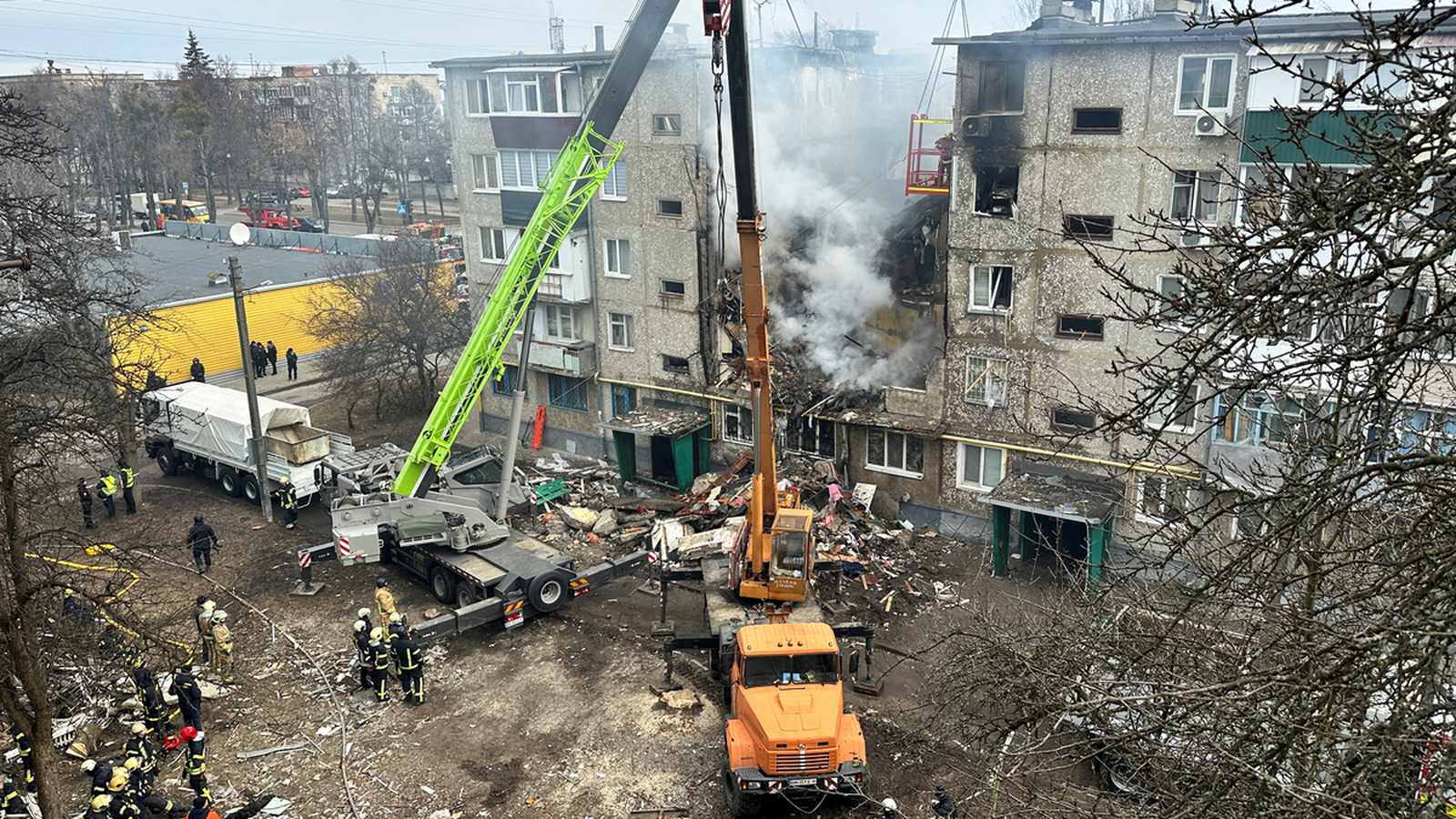
Drone Strike Hits Emergency Teams at Komyshuvakha Blast Site
A Russian drone struck emergency workers on rescue missions in southern Ukraine on Sunday, hitting a former school and nearby shelter that had earlier been blasted by multiple Russian guided bombs as residents waited for humanitarian aid, ABC-7 reported, in an article published by the outlet. The initial attack in the village of Komyshuvakha, near the front line in the Zaporizhzhia region, killed at least 55 people. While Sunday’s follow-up strike resulted in no personnel injuries, specialized rescue equipment at the site was severely damaged, according to Ukraine’s State Emergency Service.
The sequence follows a pattern of iterative bombardment that complicates ongoing recovery operations. Around 50 people were still listed as missing, Ukraine’s military intelligence agency, HUR, reported. Many of the recovered bodies remain unidentified, and DNA analysis is ongoing at regional facilities. Village resident Mykola Krasnov, 72, told The Associated Press that he was still searching for his wife, noting she had gone to collect humanitarian aid when the initial 3-ton bomb struck the facility.
Military intelligence representatives stated that authorities have identified several Russian service members allegedly involved in executing the tactical double-tap operation. Such iterative strikes, according to Ukrainian officials, intentionally target first responders who rush to sites of mass civilian casualties. The destruction of heavy clearing tools and detection systems forces rescue teams to proceed with heightened vulnerability while combing through unstable rubble.
Funerals and Regional Security Stakes
On Saturday, police officers and grieving relatives gathered in Zaporizhzhia for a solemn farewell ceremony honoring six police officers killed in the Komyshuvakha strikes, including four who died near the former school. Rain fell as families stood beside coffins draped in state colors, while officers held portraits of their fallen colleagues. Andrii Khomenko, a police lieutenant colonel who worked alongside the victims, said the officers had used every available skill to protect themselves, but that deliberate targeting of civilians gathered in one place left few options.
Senior police lieutenant Yuliia Nykonenko also reflected on the risks taken by the fallen personnel, recalling how they had previously evaded an FPV drone together while working to evacuate vulnerable children and neighbors. The community mourned local residents killed in the bombardment as well, including Natalia Karapetian. Her husband, Yurii Karapetian, urged the international community to take decisive action, warning that unchecked aggression would not stop at national borders.
President Volodymyr Zelenskyy denounced the attack on emergency crews as absolute cynicism and brutality. In a public statement on X, Zelenskyy noted that separate overnight Russian strikes on energy infrastructure in the Dnipropetrovsk region had left more than 600,000 people without power, compounding civilian hardships. Pointing to extensive weekly aerial bombardments utilizing thousands of guided bombs, missiles, and drones, Zelenskyy called for rigorous international sanctions targeting the supply chains and manufacturing plants producing modern Russian weaponry.
Nuclear Plant External Power Severed
Amid the ongoing regional strikes, the Russian-controlled Zaporizhzhia Nuclear Power Plant lost its external power supply after a damaged power line was disconnected for safety, plant management reported. The facility transitioned to backup diesel generators after an automatic protection system shut down the damaged Ferosplavna line. While the plant has remained offline since early in the war, it requires a stable external power supply to operate essential cooling systems, periodically raising safety concerns among international monitors.
International atomic energy monitors have repeatedly warned that recurrent disconnections of external power lines introduce severe vulnerabilities to plant safety management. Although backup diesel generators possess sufficient fuel reserves for temporary operational windows, reliance on emergency generation during sustained regional combat operations underscores the persistent hazard that frontline military engagements pose to nuclear safety architecture across southern Ukraine.