


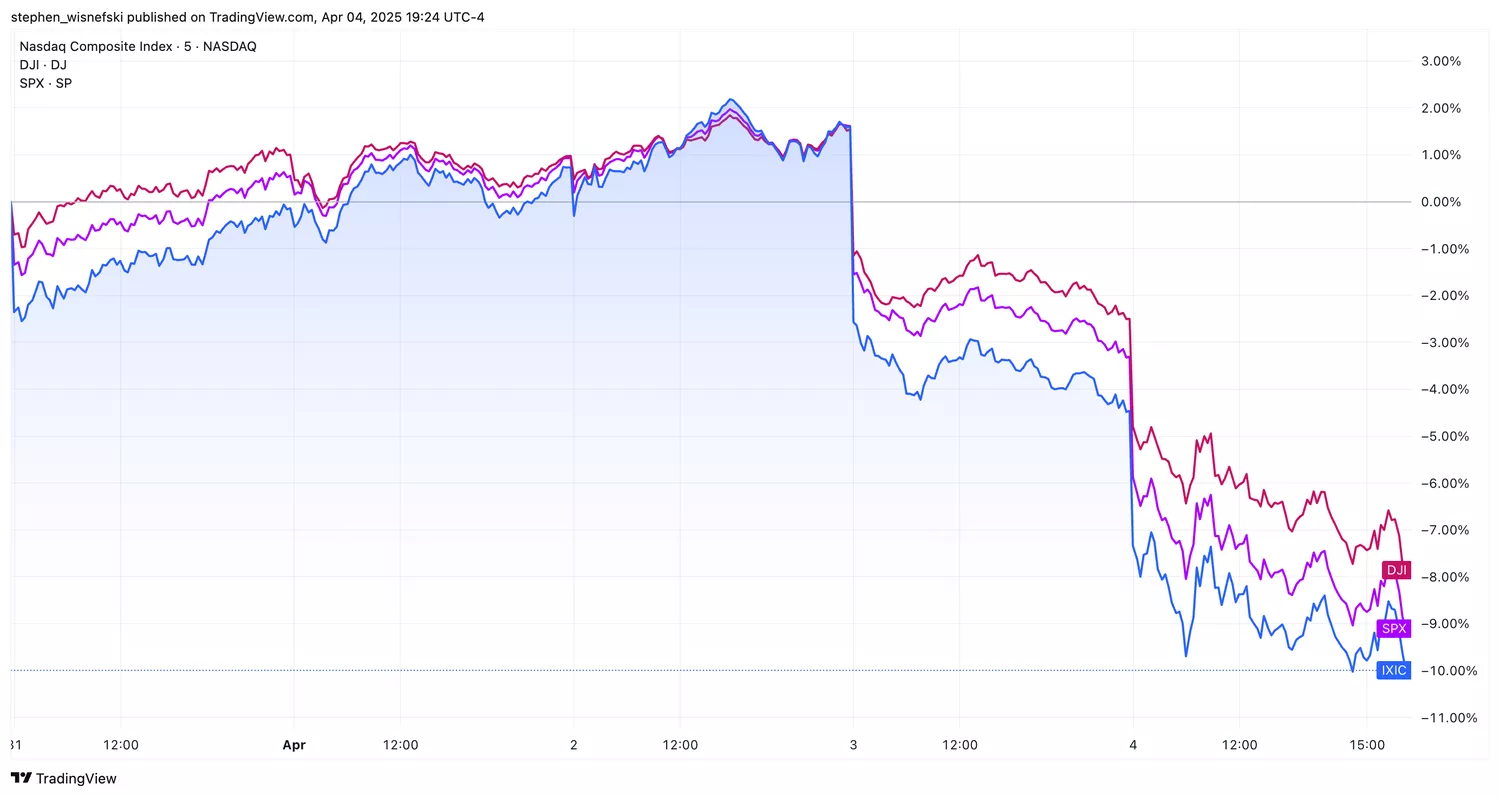
- Dow Jones Industrial Average fell by 2,200 points on Friday.
- S&P 500 and Nasdaq posted steep weekly losses of 9.1% and 10%, respectively.
- China retaliated against U.S. tariffs, impacting multiple sectors.
- GE HealthCare shares dropped 16%, leading S&P 500 decliners.
- Bonds rallied as Treasury yields fell below 4%, benefiting homebuilders.
Dow Drops 2,200 Points Amid Tariff Retaliation
U.S. stock markets experienced a historic selloff on April 4, 2025, following China’s retaliation against President Donald Trump’s sweeping tariffs. The Dow Jones Industrial Average plunged by 2,200 points, marking one of its worst single-day declines in history. The S&P 500 and Nasdaq Composite also suffered significant losses, with weekly declines of 9.1% and 10%, respectively. This marked the second consecutive week of sharp downturns for all major indexes.
Market Reaction to Tariff Announcement
Earlier this week, President Trump announced a far-reaching plan to impose tariffs on Chinese imports, raising the effective U.S. tariff rate to levels not seen in over a century. China’s Ministry of Commerce responded with reciprocal tariffs, targeting key sectors of the U.S. economy. Economists warn that these measures could severely impact global economic growth and reignite inflation.
Sector-Specific Impacts
Healthcare and Technology
Shares of GE HealthCare (GEHC) led the decliners in the S&P 500, dropping 16% on Friday. Analysts attributed this to China’s tariff measures and the launch of an anti-dumping probe into medical CT tubes from the U.S. and India. GE HealthCare derives approximately 12% of its sales from China, with 70% of its locally manufactured products sold within the country.
Semiconductor companies also faced significant pressure. Micron Technology (MU) shares fell 12.9%, as analysts warned of potential margin volatility and recession risks stemming from the tariffs.
Energy and Commodities
Oil prices dropped sharply amid concerns over trade tensions and increased production from OPEC+. Shares of APA Corp. (APA) and Baker Hughes (BKR) declined 14.4% and 13.3%, respectively. Copper and gold prices also fell, further affecting commodity-linked stocks like Freeport-McMoRan (FCX), which lost 13%.
Homebuilders and Bonds
While most sectors suffered, homebuilders saw gains as Treasury yields fell below 4%, reducing borrowing costs. D.R. Horton (DHI) and NVR (NVR) shares rose 4.5% and 4.2%, respectively. Lower mortgage rates could stimulate demand in the housing market, despite broader economic uncertainty.
Historical Context and Broader Implications
This week’s selloff ranks among the worst in recent memory. The Dow’s 7.9% weekly loss was its sixth-worst of the 21st century, while the S&P 500’s 9.1% decline was its seventh-worst in 25 years. The Nasdaq Composite dropped 11.4% since Trump’s tariff announcement, marking its worst two-day stretch since March 2020.
Major companies like Apple (AAPL) were not spared. Apple’s shares fell 15.9% over two days, wiping out over half a trillion dollars in market capitalization.
Outlook and Analyst Perspectives
Wall Street analysts have grown increasingly cautious about earnings projections for 2025. FactSet reported a 4.2% drop in bottom-up earnings per share estimates for the S&P 500 during the first quarter. The financials sector was the only area to see a rise in full-year EPS estimates.
Defense stocks like Lockheed Martin (LMT) and Northrop Grumman (NOC) may be relatively insulated from tariff impacts due to their U.S.-based supply chains and government contracts. However, companies with commercial exposure, such as General Dynamics (GD), could face more pressure.
The April 4, 2025, selloff underscores the far-reaching consequences of escalating trade tensions between the U.S. and China. As markets grapple with uncertainty, investors and policymakers will closely monitor developments in the coming weeks.
Sources: Primary Source, S&P 500 and Nasdaq Fall for 6th Time in 7 Weeks; Secondary Sources