


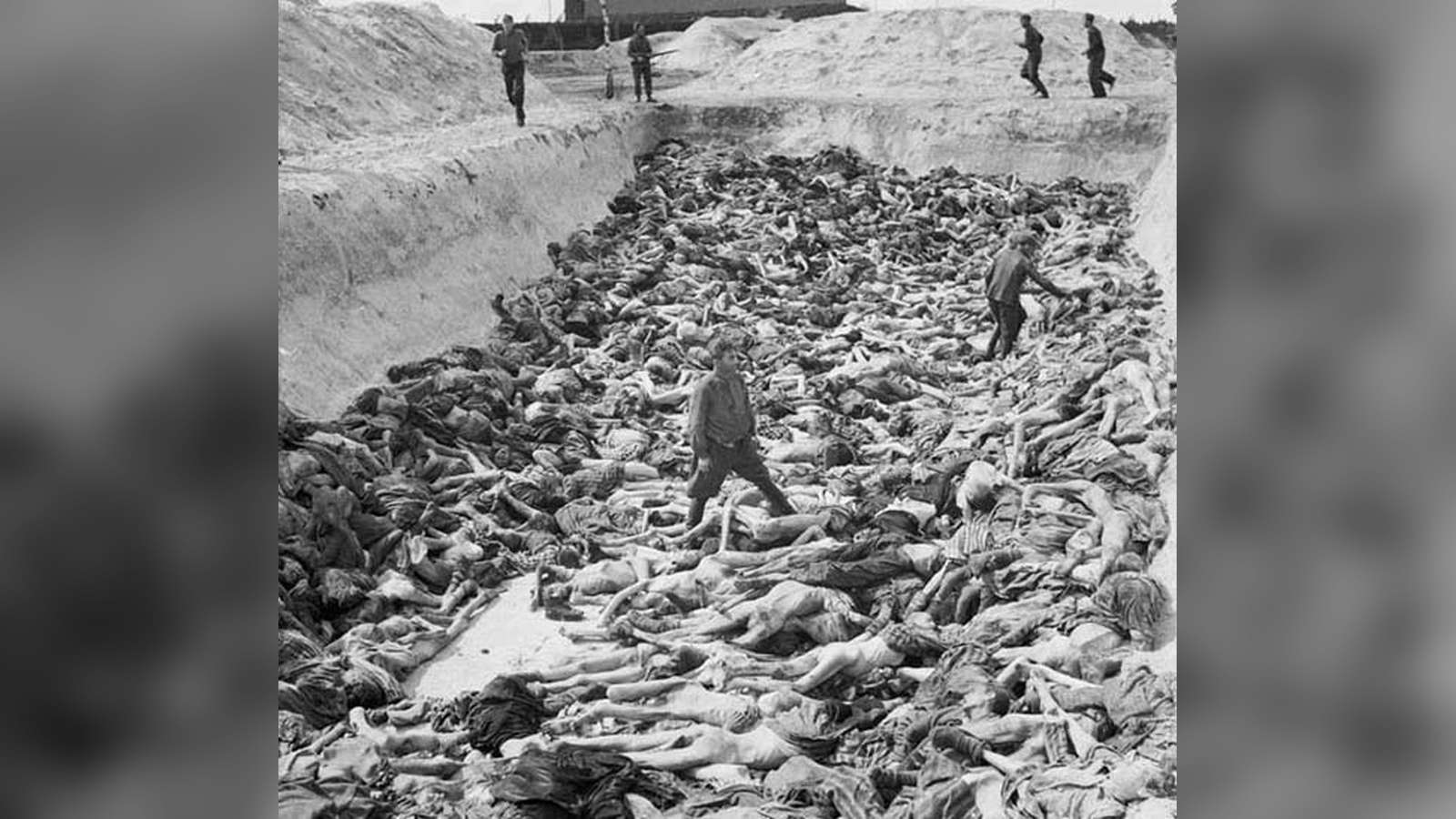
What the photograph shows
This stark, black-and-white photograph captures one of the most chilling visual documents of the Holocaust, anchoring history in a moment of profound moral revulsion. In the foreground, standing almost casually upright within the grim confines of a massive earthen pit known as Mass Grave 3, is Dr. Fritz Klein. He is dressed in a dark coat, his expression remarkably neutral, looking directly toward the camera lens without flinching. Surrounding his boots and piling up high along the steep earthen walls of the trench are dozens of emaciated, lifeless bodies of prisoners who perished in the catastrophic final weeks of the Nazi regime. In the background, under a flat, overcast sky, the desolate outlines of the Bergen-Belsen camp structures and the Small Arms Range are faintly visible, grounding the horrific scene in a specific, bleak geography of state-sponsored murder.
A close visual reading of the frame reveals the stark dichotomy between the living perpetrator and the dead victims. Klein’s posture is composed, almost administrative, standing amidst a chaotic jumble of human remains that have lost all individual dignity through systematic starvation and disease. The lighting is harsh and natural, casting sharp shadows that emphasize the depth of the grave and the sheer volume of human destruction. The composition places Klein slightly off-center, drawing the viewer’s eye immediately to his living figure before forcing the gaze outward across the horrific expanse of corpses that stretch beyond the edges of the pit. Every detail in the frame—from the texture of the soil to the vacant expressions of the dead—serves as an unalterable record of the crimes uncovered by Allied forces.
The moment behind the image
The photograph was taken on April 24, 1945—nine days after British forces liberated the Bergen-Belsen concentration camp on April 15. When British troops under the command of Brigadier Glyn Hughes entered the camp, they discovered an unmitigated humanitarian disaster: roughly 60,000 surviving prisoners were starving, gravely ill, and living among more than 10,000 unburied corpses because the camp’s crematoria and administrative systems had completely collapsed under the weight of utter brutality, overcrowding, and neglect. Typhus, dysentery, and starvation were killing hundreds of inmates daily even after liberation.
In the immediate aftermath of the handover, surviving SS personnel, guards, and medical staff—including Klein—were rounded up by the British military authorities and ordered to perform the grueling, horrific labor of burying the dead into massive communal graves. This was not merely an administrative necessity to prevent disease, but a deliberate psychological and moral confrontation. The British military command intended to force the perpetrators to handle the physical reality of their systematic atrocities before facing formal judicial reckoning. Standing inside Mass Grave 3, Klein was not a passive observer; he was actively engaged in the grim aftermath of a catastrophe he had helped orchestrate through active medical selection and administrative complicity.
Photographer and provenance
The image was captured by Sergeant Harry Oakes, a photographer attached to the British No. 5 Army Film & Photographic Unit. Oakes and his colleagues operated under official military orders to document the liberated camps comprehensively, ensuring that undeniable visual evidence was gathered for future war crimes trials, historical archives, and public awareness across the globe. The British military units understood that mere written reports would be insufficient to convey the sheer scale of Nazi criminality to the international community.
Preserved under catalog number IWM BU 4260 by the Imperial War Museum in London, the negative became part of a vast archive of visual testimony that shocked the global public upon publication in newspapers and newsreels. Because these photographs were created by British military personnel on active service, they initially fell under Crown Copyright provisions before eventually entering the public domain, allowing the visual evidence of Nazi crimes to circulate widely as an enduring historical warning. The provenance of the photograph is exceptionally well-documented, tracing directly from the combat cameraman’s negative to the official military archives in London.
Historical context
Fritz Klein, born in Austro-Hungary in 1888, was an ethnic German physician and an early member of the Nazi Party who officially joined the SS in 1943. He worked for nearly a year at Auschwitz-Birkenau starting in December 1943, where he actively participated in brutal ramp selections, determining which arriving deportees would be immediately sent to the gas chambers and which were temporarily deemed fit for forced labor. Survivors later testified to his chilling calmness during these selections, where a flick of his wrist decided life or death.
After a brief period at Neuengamme, Klein was transferred to Bergen-Belsen in January 1945 as the Eastern Front collapsed. There, he continued his medical complicity in an environment fast deteriorating into an unmitigated hellscape. When interrogated and later put on trial by a British military court at Lüneburg—the famous Belsen Trial held between September and November 1945—Klein notoriously defended his actions by claiming his medical ethics compelled him to separate the sick from the healthy, demonstrating a total inversion of medical morality. He was convicted of war crimes and hanged at Hameln prison in December 1945.
Why it still matters
Mass Grave 3 stands as a monumental visual indictment of institutionalized inhumanity and individual moral collapse. The juxtaposition of a living doctor—someone sworn by the Hippocratic Oath to preserve life—standing composed atop a pile of his victims encapsulates the chilling banality and absolute horror of the Nazi apparatus. It strips away any abstract notions of evil, presenting it instead as bureaucratic, calm, and disturbingly ordinary.
Preserved across decades in international archives, textbooks, and Holocaust memorials, Sergeant Oakes’s photograph remains a powerful, unshakeable reminder of the cost of unchecked hatred, racism, and medical corruption. It challenges viewers to confront the reality of human cruelty and reinforces the vital necessity of historical accountability, ensuring that the victims of Bergen-Belsen are never forgotten and their murderers are forever anchored in the light of truth.