


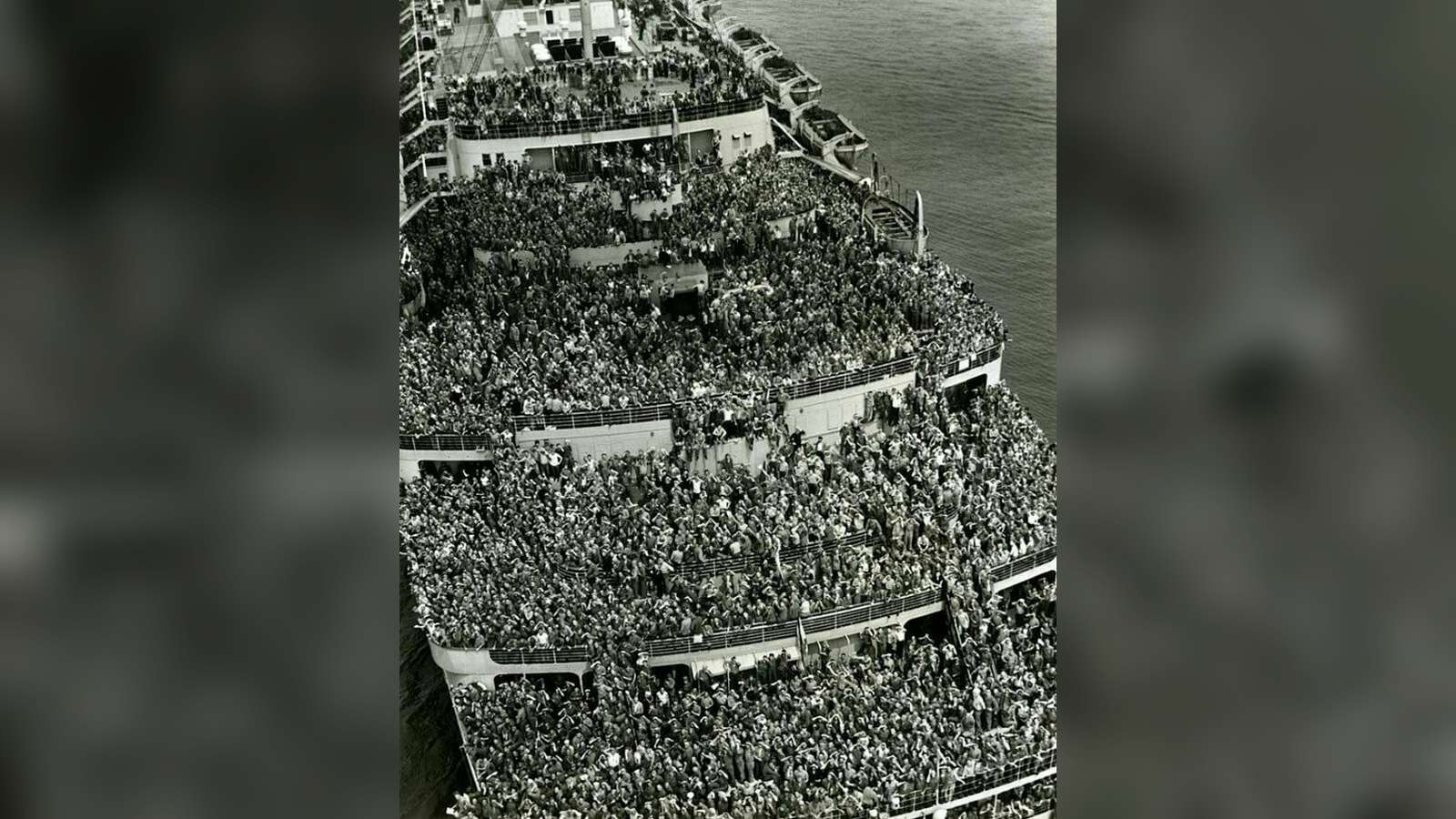
Towering above the waters of the Hudson River, the massive hull of the RMS Queen Elizabeth fills the frame, her towering decks packed shoulder-to-shoulder with thousands of American servicemen eagerly gazing toward the New York City skyline. This striking photograph, preserved in archives such as the New-York Historical Society and widely circulated through contemporary publications like The New York Times in June 1945, captures an extraordinary human moment at the close of World War II. Every available inch of the superstructure is dense with figures, forming a living wall of weary yet jubilant veterans who have survived the European theater. The image serves as an enduring visual monument to the massive repatriation effort that followed Victory in Europe Day, instantly communicating the scale of the homecoming through the sheer human density crowding the vessel’s upper decks.
What the photograph shows
A closer inspection of the frame reveals a sea of uniformed figures covering the towering levels of the world’s largest ocean liner as she maneuvers toward Pier 90. Unlike standard passenger photography where individuals are spaced out across leisure decks, this image presents a study in absolute maximum capacity. Soldiers are pressed tightly against railings, peering over higher levels, and turning their faces toward the shore where cheering crowds and family members await. The immense height of the ship’s black-painted hull dwarfs the surrounding waters, emphasizing the engineering marvel that made such mass transportation possible. The atmosphere captured in the shutter click is one of palpable relief and collective anticipation, marking the literal boundary between years of brutal wartime service abroad and the long-awaited return to American soil.
The moment behind the image
The photograph was secured in mid-to-late June 1945, just weeks after Nazi Germany’s unconditional surrender. The RMS Queen Elizabeth had departed Gourock, Scotland, on June 15, carrying precisely 13,311 GIs back across the Atlantic. The decision to cram vessels to their absolute breaking point was driven by intense pressure from the troops themselves. According to General Dwight D. Eisenhower’s memoirs, American servicemen abroad grew vocal and impatient with the initial, slower rates of demobilization and transport. When given a choice at large troop gatherings between waiting for comfortable, standard-capacity voyages or being crammed onto fast liners to get home as quickly as possible, the servicemen overwhelmingly chose speed and overcrowding. This specific voyage epitomized that pragmatic, urgent rush to demobilize.
Photographer and provenance
While frequently attributed to institutional archives like the New-York Historical Society and famously splashed across the front page of The New York Times on June 30, 1945, with the headline "The World’s Largest Ship Brings Veterans Home,& exact individual press photographer attribution for this specific negative often blurs into the broader pool of wire service and newspaper pool photographers covering New York Harbor arrivals. Working under deadline constraints for major dailies, these photographers positioned themselves on tugboats, piers, or accompanying craft to capture the dramatic scale of incoming troopships. Their images were immediately pressed into service by editors seeking to convey the triumphant conclusion of the Atlantic war to an anxious American public.
Historical context
During World War II, both the RMS Queen Elizabeth and her sister ship RMS Queen Mary were requisitioned for Allied military service. Stripped of their luxurious peacetime amenities and painted in stark wartime gray, the mammoth liners utilized their exceptional high speeds—often exceeding 28 knots—to outrun German U-boats, allowing them to sail independently without the need for protective naval convoys. Over the course of the conflict, the Queen Elizabeth alone transported more than 750,000 troops across some 500,000 nautical miles. When the guns finally fell silent in Europe, these grey ghosts of the Atlantic were swiftly repurposed for Operation Magic Carpet, shifting from an eastbound offensive pipeline to a frantic westbound homecoming engine.
Why it still matters
Decades after the last soldier disembarked at Pier 90, this photograph remains a masterclass in visual storytelling, encapsulating the sheer scale of the greatest logistical migration in modern history. It moves beyond cold statistics of troop counts to show the living, breathing human element of demobilization. For the veterans on board, the journey did not end at the gangway; many would face long train rides home or queue at Western Union offices to wire their families of their arrival. Yet, frozen in this single frame by an anonymous press photographer, the moment captures the eternal, universal elation of returning safely from the brink of history.