


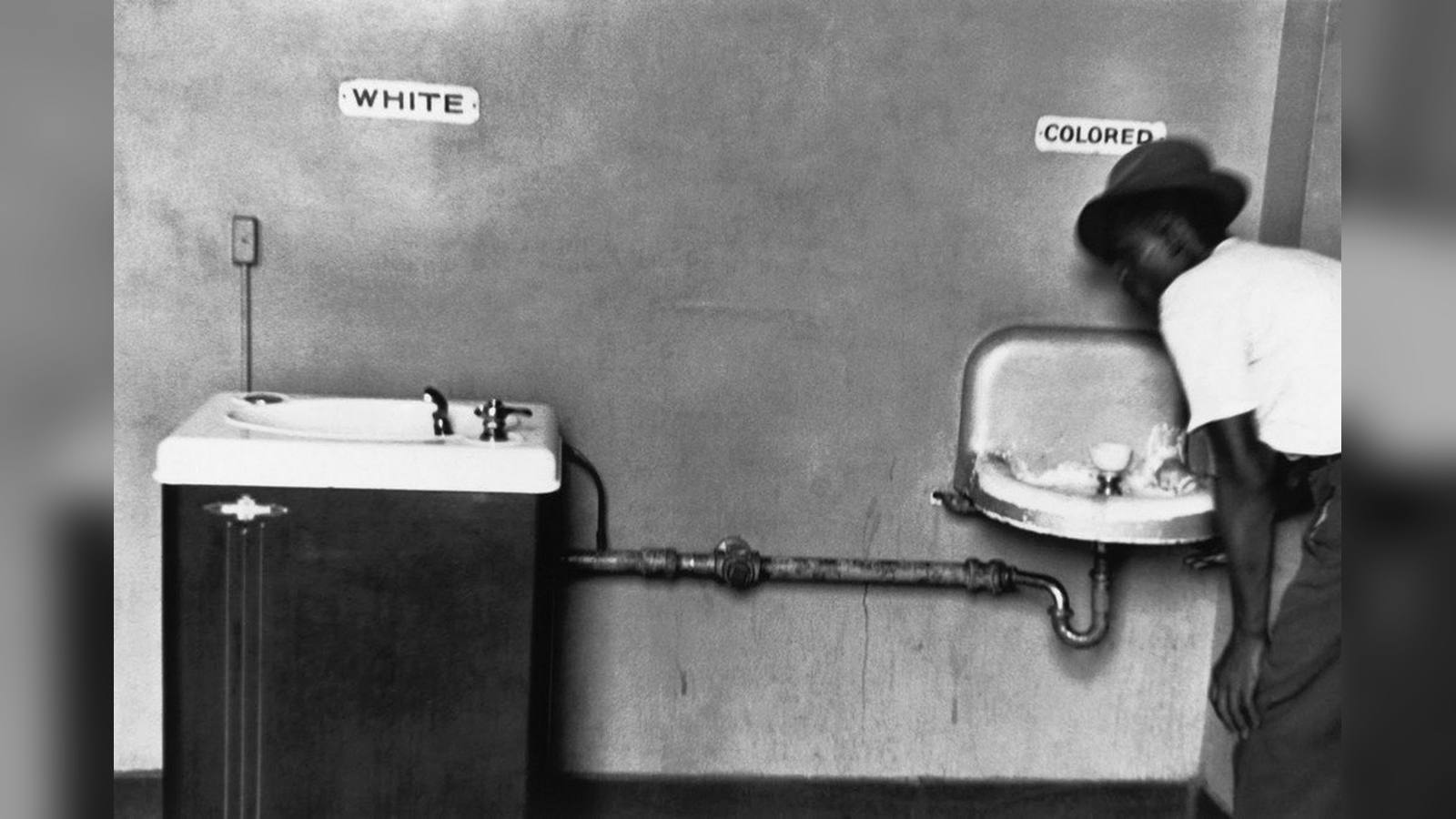
A man leans down to quench his thirst, his hand braced against a tarnished wall, unaware or unconcerned that an enduring indictment of American society is crystallizing around his shoulders. In this black-and-white frame taken in North Carolina in 1950, photographer Elliott Erwitt captured two public drinking facilities mounted side by side. On the left stands a bulky, modern, porcelain-enameled electric water cooler beneath a crisp sign reading “WHITE.” On the right, fed by exposed plumbing and anchored into the stained wall, is a humble, utilitarian spigot and shallow sink marked by a smaller sign: “COLORED.” The instant is quiet, devoid of violence or grand oratory, yet it captures the precise mechanism of racial subjugation in the American South. How did a twenty-two-year-old itinerant photographer capture one of the most succinct visual teardowns of segregation ever recorded?
What the photograph shows
The composition is deceptively straightforward, built around an almost surgical contrast. On the left half of the horizontal frame, an electric drinking fountain rises like a piece of modern domestic luxury. It is clean, boxy, refrigerated, and designed for convenience, topped by a neatly stenciled placard reading “WHITE.” Just inches to its right, separated only by a stripe of vertical space, hangs an antiquated, shallow metal or ceramic basin. Attached to bare piping and showing visible wear, it sits beneath a handwritten or utilitarian placard reading “COLORED.”
An African American man, seen from behind and in three-quarter profile, leans over the rudimentary sink to take a drink. He wears work clothes—dark trousers and a button-down shirt with suspenders or harness straps visible across his shoulders. His body language is entirely unperformative; he is simply thirsty on a working day. The camera angle is positioned at eye level, ensuring both signs and both appliances are presented on the exact same plane. By refusing to dramatize the scene with tilted angles or sensational lighting, Erwitt let the stark physical disparity between the two objects deliver the entire moral verdict.
The moment behind the image
In 1950, Elliott Erwitt was a young photographer traveling through the American South. Born in Paris to Russian-Jewish emigré parents and raised across Italy and California, he was an outsider attuned to the absurdities, tensions, and cruelties of his adopted country. While moving through North Carolina, he encountered a public building—likely a bus terminal, train station, or courthouse corridor—where the segregationist regime was built directly into the plumbing.
Erwitt noticed the scene not as a set piece of dramatic confrontation, but as a textbook study in systemic degradation. There were no police dogs, fire hoses, or shouting mobs in the frame; those images of the Civil Rights movement would come a decade later. Instead, there was the mundane, everyday friction of Jim Crow laws, quietly accepted and systematically enforced. Erwitt waited until a person interacted with the space, raised his camera, and released the shutter, capturing the man at the precise second water met his lips.
Photographer and provenance
When he took this photograph, Erwitt was barely twenty-two years old and had not yet joined Magnum Photos, the cooperative he would later lead as president. He had studied photography in Los Angeles and film in New York, catching the eye of legendary figures like Robert Capa, Edward Steichen, and Roy Stryker. Stryker, who had directed the Farm Security Administration’s historic documentary project in the 1930s, hired Erwitt for photographic assignments in the early 1950s, sharpening the young artist’s eye for social documentary.
The North Carolina negative became part of Erwitt’s personal archive and soon entered the roster of Magnum Photos after Erwitt became a member in 1953 at Capa’s invitation. While Erwitt became globally famous for his whimsical, comedic street scenes and affectionate dog portraits, this quiet documentary photograph took on an entirely different trajectory. Distributed through Magnum, published in historic retrospectives, and reproduced in educational textbooks worldwide, the picture evolved from a roadside observation into an indispensable historical artifact.
Historical context
In 1950, the doctrine governing racial relations across the American South was still the 1896 Supreme Court ruling in Plessy v. Ferguson, which established the principle of “separate but equal.” Under this constitutional shield, southern states and municipalities constructed an exhaustive system of apartheid known as Jim Crow, mandating racial separation in schools, transportation, hospitals, restrooms, and drinking fountains.
The defense of this system had always rested on the legal fiction that separated facilities were fundamentally equal in standard and access. Erwitt’s photograph demolished that argument without needing a single word of legal rebuttal. The viewer could clearly see the lavish modern appliance reserved for white citizens and the neglected, second-rate basin relegated to Black citizens. Four years after this photograph was taken, the Supreme Court would unanimously strike down school segregation in Brown v. Board of Education, beginning the legal unraveling of the system Erwitt had documented in miniature.
Why it still matters
Elliott Erwitt often credited luck and simple observation for his greatest pictures, insisting that photography was merely about noticing what others walk past. Yet the North Carolina fountain picture endures because it demonstrates the documentary power of stillness. It captures state-sanctioned bigotry not as an explosion of rage, but as an institutionalized plumbing code, woven into the infrastructure of daily life.
By recording the two fountains side by side, Erwitt captured the psychological machinery of discrimination: the deliberate maintenance of an inferior class, marked on every wall and corner of public life. More than seven decades later, the photograph remains an unassailable visual truth, reminding viewers that inequality was never an abstract concept, but a physical reality measured in cold water and porcelain.