


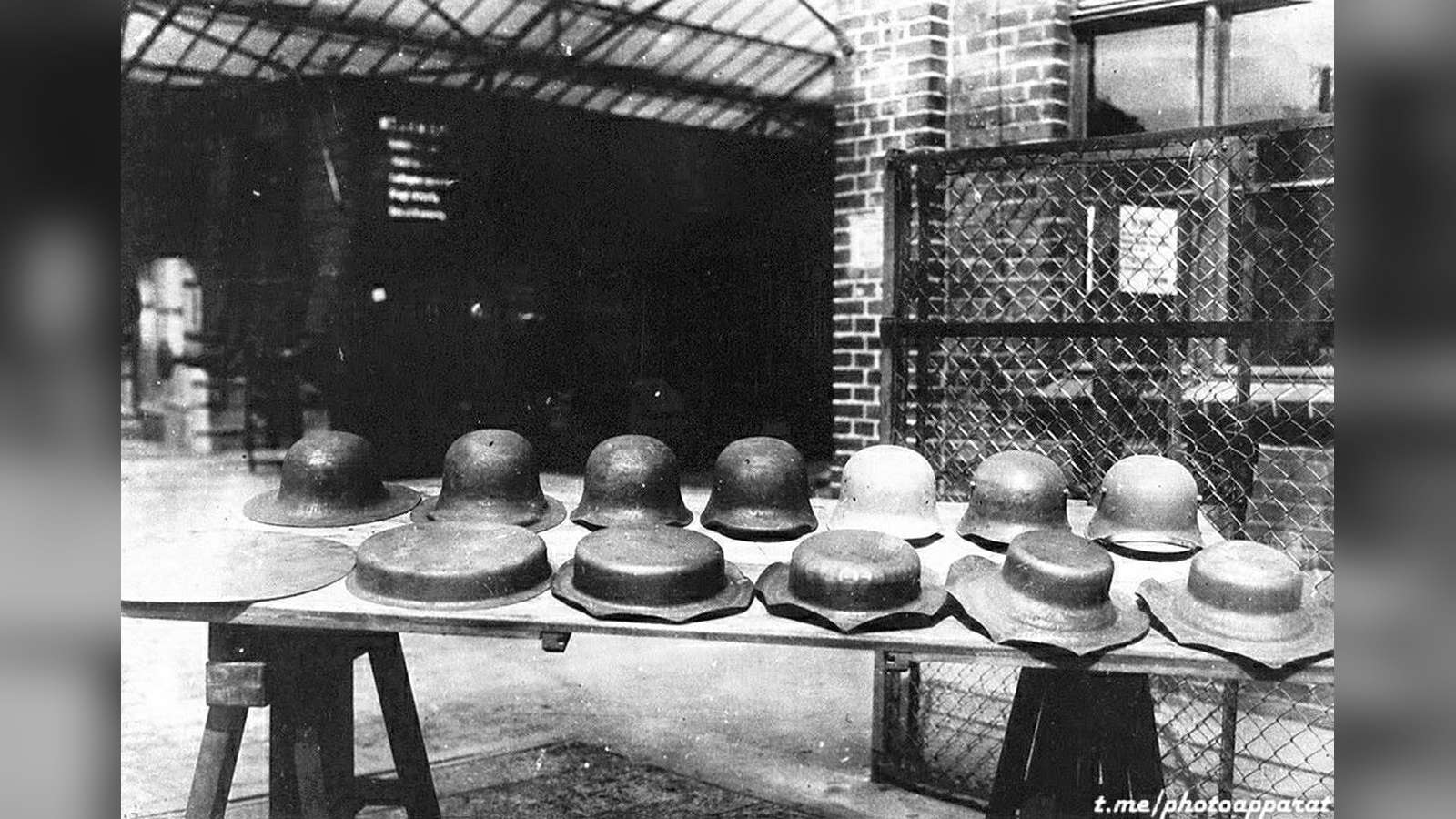
This stark, industrial photograph captures a series of steel shells arranged in a meticulous line upon a wooden table, each representing a distinct stage in the manufacturing process of the M-16 Stahlhelm. Taken in 1916 at a metalworks factory in Lübeck, Germany, the image serves as a clinical documentation of how a flat steel disk was transformed into the most recognizable piece of military headgear of the 20th century. By looking closely at the progression, one can trace the evolution from raw metal blank to the finished, iconic silhouette that would soon define the German soldier on the front lines of the Great War.
What the photograph shows
In the frame, we see a horizontal progression of nine distinct shells. On the far left, the initial, barely shaped disks represent the raw material—a specialized alloy of manganese, nickel, silicon, and carbon steel. As the eye travels right, the metal deepens, the brim begins to flare, and the characteristic “skirt” of the Stahlhelm emerges. The final shells on the right are complete, save for the liner and chinstrap, showing the signature side lugs that would later serve as both ventilation ports and mounting points for additional armor. The composition is utilitarian and sterile, characteristic of industrial photography of the era, intended to emphasize the precision of German manufacturing.
The moment behind the image
At the time this photograph was taken, the Imperial German Army was undergoing a radical transition. As trench warfare turned into a bloody, grinding stalemate, the primary cause of casualties shifted from rifle fire to artillery shrapnel. Soldiers who had previously worn only cloth or leather caps—the famous Pickelhaube—were suddenly vulnerable to devastating head wounds. This image captures the German state’s industrial response to this crisis. The display was likely organized as an official demonstration of domestic production capabilities, showcasing the meticulous stamping process—which required at least nine separate stages—that gave the Stahlhelm its characteristic shape, including the dome, visor, and flared neck guard.
Photographer and provenance
The photograph is widely attributed to official German military archives, likely commissioned to document the efficiency and scale of the war effort. While the specific photographer remains anonymous, the image was captured during the early months of 1916, when production began in earnest at factories across Germany, including the facilities in Lübeck. These types of images were often circulated in German newspapers or industrial reports to bolster morale, proving that the home front was providing the necessary technology to protect the soldiers in the trenches. The survival of this image suggests it was part of a larger propaganda effort to showcase German technological superiority. The lack of a specific named photographer is typical for institutional military photography of this era, where the image was treated as state property rather than an individual artistic work.
Historical context
The Stahlhelm was the brainchild of Dr. Friedrich Schwerd of the Technical Institute of Hannover. After conducting a study on head injuries, he designed the helmet not just for aesthetics, but for maximum coverage. The resulting M-16, weighing over one kilogram, was constructed from a high-quality steel alloy. The famous side lugs, clearly visible on the finished models in the photograph, served a dual purpose: they provided ventilation and acted as mounting points for the Stirnpanzer, an additional armored plate meant for sentries and machine gunners. Though the armor was often discarded by soldiers for being too cumbersome, the helmet itself became a permanent fixture of modern warfare. It was a massive undertaking, involving ten factories that together produced from 3,500 to 4,000 helmets per day. The production process was complex, involving hot-pressing on electrically heated dies and dipping in an anti-rust finish, making it a more expensive piece of equipment than the British Brodie helmet, which could be formed from a single piece of steel.
Why it still matters
This image remains a poignant reminder of the intersection between industrial mass production and the brutal realities of the battlefield. It captures the moment when the German military machine attempted to turn the tide of attrition by engineering better protection. From the humble steel disks on the table to the millions of helmets that eventually reached the front, the photograph documents a shift in military history where the individual soldier became a component in a larger, industrialized system of survival and destruction. The Stahlhelm is more than just a piece of equipment; it is a symbol of the total war era, where the factory floor became as critical to the outcome of the conflict as the front line itself. The photograph serves as a testament to the industrialization of death, where the precision of the stamping die directly influenced the survival rate of millions of men in the mud of the Western Front.