


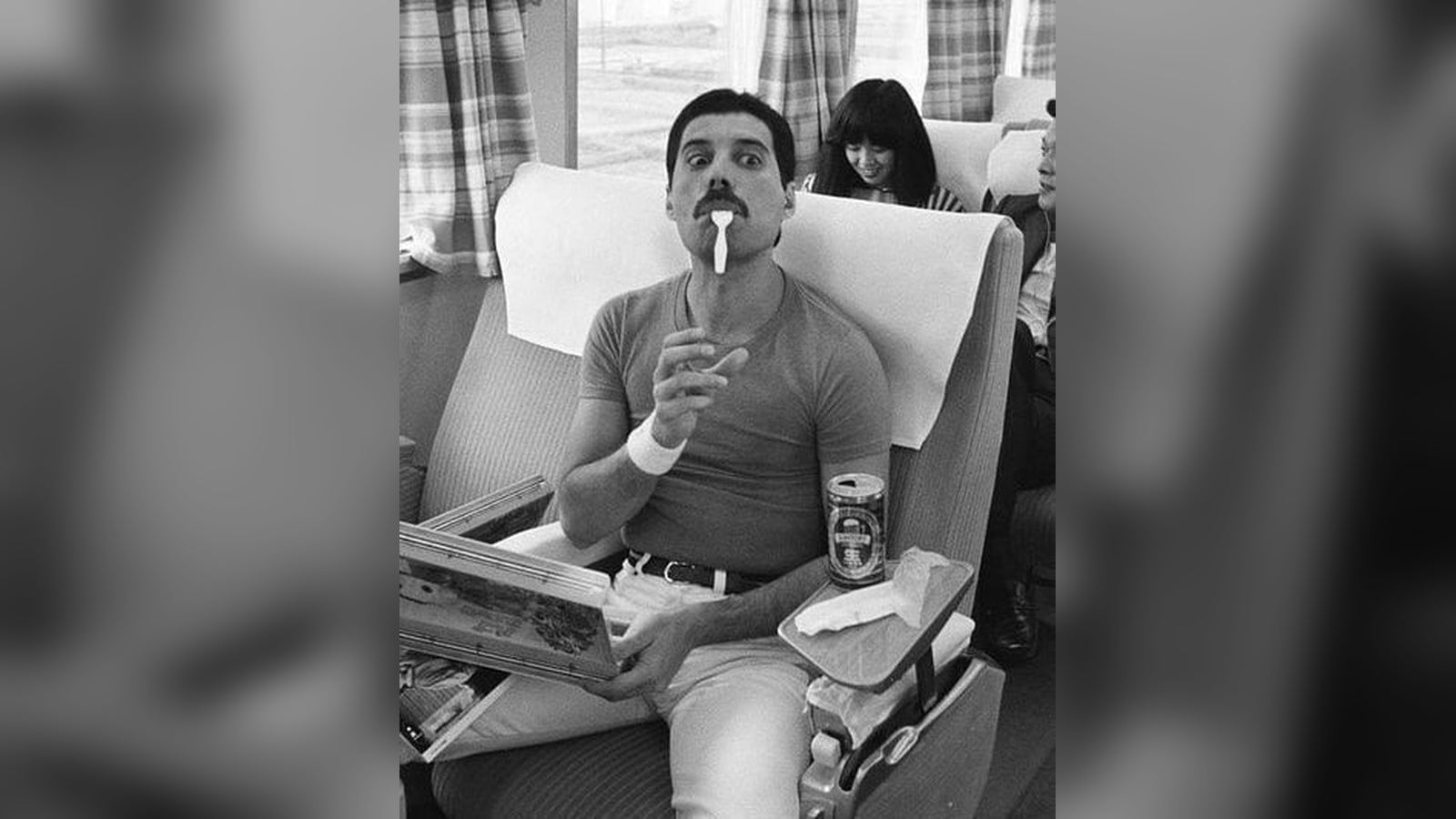
In this intimate and arresting photograph, Freddie Mercury is captured in a rare state of stillness that feels worlds away from the pyrotechnics, lighting rigs, and roaring stadium crowds of a Queen concert. Seated near a train window during the band’s demanding 1982 tour of Japan, the legendary lead singer appears deeply lost in thought, his gaze turned away from the camera lens. Dated October 25, 1982, this candid frame documents a quiet transition along the Osaka-Nagoya line, offering viewers a poignant glimpse into the private reality of a man who famously described himself as the ‘Great Pretender.’ Rather than performing for an adoring public, Mercury is caught in the quiet interstices of a grueling international tour, embodying the complex intersection between hyper-visible public iconography and private human exhaustion.
What the photograph shows
A careful visual reading of the frame reveals a striking study in contrasts. Mercury is seated inside the utilitarian, functional interior of a Japanese passenger train, surrounded by the unassuming architecture of mid-journey public transport. He is dressed simply in casual, unpretentious clothing, completely devoid of the flamboyant, theatrical costumes—the silk jumpsuits, leather jackets, and military-inspired regalia—that defined his explosive stage presence. Natural light pours in through the large train window, washing over his face and highlighting the subtle signs of physical weariness around his eyes. His posture is relaxed yet heavy with the accumulation of relentless travel. There is no performance here, no calculated angle for the tabloid press; instead, the camera captures the unvarnished posture of a global superstar navigating the mundane logistics of modern touring.
The moment behind the image
October 1982 placed the members of Queen squarely in the middle of their extensive ‘Hot Space’ tour of Japan, a country where the band enjoyed a fervent, near-hysterical fan following since their breakthrough in the mid-1970s. The ‘Hot Space’ era was a commercially and artistically challenging period for the group, marked by a sharp pivot toward synth-pop, funk, and dance rhythms that polarized some traditional rock critics while showcasing Mercury’s restless sonic experimentation. The train journey from Osaka to Nagoya was a standard logistical transit amid an exhausting itinerary of concerts, press conferences, and promotional appearances. Immediately preceding this shutter click were hours of bustling station platforms, autograph-seeking crowds, and tight security cordons. Immediately following this brief window of respite lay another wave of frantic venue arrivals, soundchecks, and the immense pressure of delivering an arena-level spectacle night after night.
Photographer and provenance
While the precise identity of the individual behind the camera remains uncredited in many widely circulated archival repositories, photographs of this nature typically originated from official tour photographers, embedded journalists, or management-sanctioned media crews granted close access to the band’s inner circle. Japanese media and specialized music publications frequently documented these transit moments with respectful discretion, capturing the human side of visiting western artists. Over the decades, this specific image transcended its ephemeral origins in Japanese tour reports to become a staple of archival retrospectives, circulating widely among fans and historians as an authentic visual anchor representing Mercury’s life on the road in the early 1980s.
Historical context
To fully grasp the resonance of this photograph, one must understand the unique cultural bond between Queen and Japan during the post-disco era. Japanese audiences embraced the theatricality, melodic complexity, and visual extravagance of the band with unmatched enthusiasm. Yet, this adoration came with intense public scrutiny and confinement. Foreign rock stars touring Japan were often shielded by elaborate security apparatuses, moving swiftly between luxury hotels, bullet trains, and massive concert halls. Within this tightly controlled environment, moments of unscripted personal space were exceedingly rare commodities. Mercury’s ability to carve out a mental sanctuary while seated in plain view among fellow passengers speaks to the psychological adaptation required to survive international celebrity.
Why it still matters
Decades after its capture, this photograph endures because it challenges the two-dimensional mythos of rock stardom. Mercury himself frequently emphasized that his larger-than-life stage persona was an act of deliberate showmanship—a mask worn to channel energy and captivate tens of thousands of people. By stripping away the lights, the makeup, and the roaring adulation, this image invites viewers to look directly at the artist behind the illusion. It reminds us that behind the legendary vocal power and immortal anthems stood a mortal human being who experienced fatigue, sought quietude, and found brief moments of peace on a moving train.