


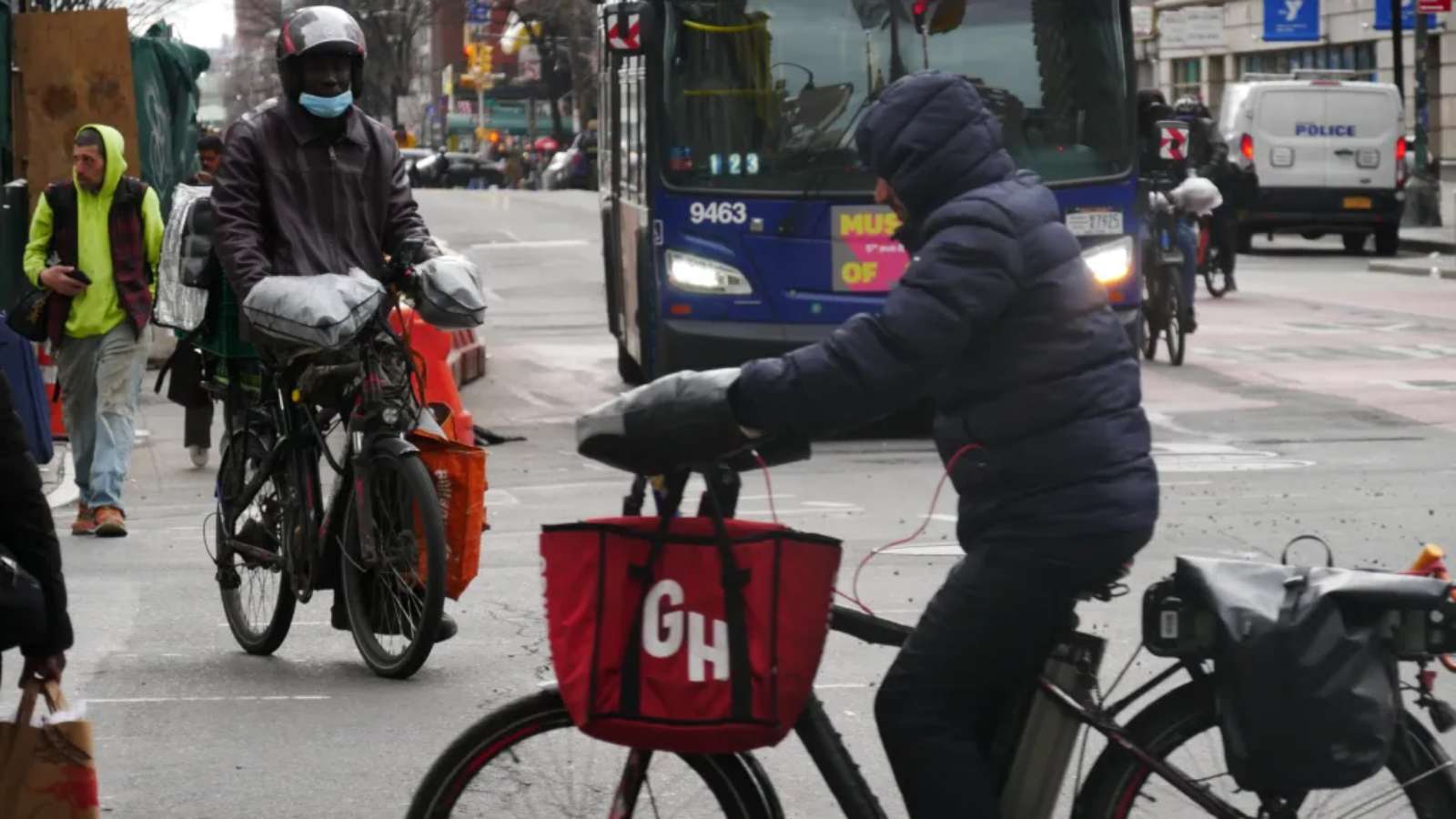
NEW YORK (Azat TV) – Internal company documents and testimony from former employees reveal that food delivery giant Grubhub systematically subcontracted orders to a third-party platform, Relay, to circumvent New York City’s landmark minimum wage law. The practice, which occurred throughout 2024, allowed the company to bypass mandated hourly pay standards that were specifically designed to guarantee fair compensation for gig workers.
Circumventing the Minimum Wage Mandate
Since December 2023, NYC regulations have required delivery apps to provide a guaranteed hourly rate to contractors. However, court filings indicate that Grubhub utilized a loophole by routing an average of nearly 20 percent of its New York City orders to Relay. Because Relay initially operated under a legal injunction that exempted it from the city’s pay standard, its couriers were paid as little as $13.35 per hour, significantly less than the $17.96 to $21.44 per hour rate required for standard app-based delivery workers during that period.
Internal communications from May 2024 confirm that Grubhub leadership explicitly sought the partnership to “stem elevated driver pay costs” following the implementation of the new law. The company estimated that this strategy saved approximately $5 million annually, despite the fact that customers using the Grubhub app were largely unaware that their deliveries were being fulfilled by lower-paid subcontractors.
Consolidation and the End of the Loophole
The subcontracting arrangement eventually drew the attention of the Department of Consumer and Worker Protection (DCWP). In June 2025, the startup Wonder—which had acquired both Relay and later Grubhub—reached a settlement with the city, agreeing to drop the legal challenge against the wage law and comply with the standard. While this effectively closed the loophole, the transition has left many former Relay workers without employment, as the company announced it would shut down its New York City operations in April 2026.
Economist James Parrott, who assisted in drafting the city’s pay standard, noted that the move was a deliberate effort to treat worker time as a “free good” rather than a professional responsibility. Grubhub has defended its actions as part of a broader effort to diversify its courier network and maintain operational sustainability amid rising regulatory costs.
The systematic use of subcontracting to bypass labor protections highlights a recurring pattern in the gig economy, where rapid corporate consolidation—seen here through Wonder’s acquisition of Grubhub—is increasingly used to pressure regulatory frameworks and diminish the impact of hard-won wage standards for vulnerable workforces.