


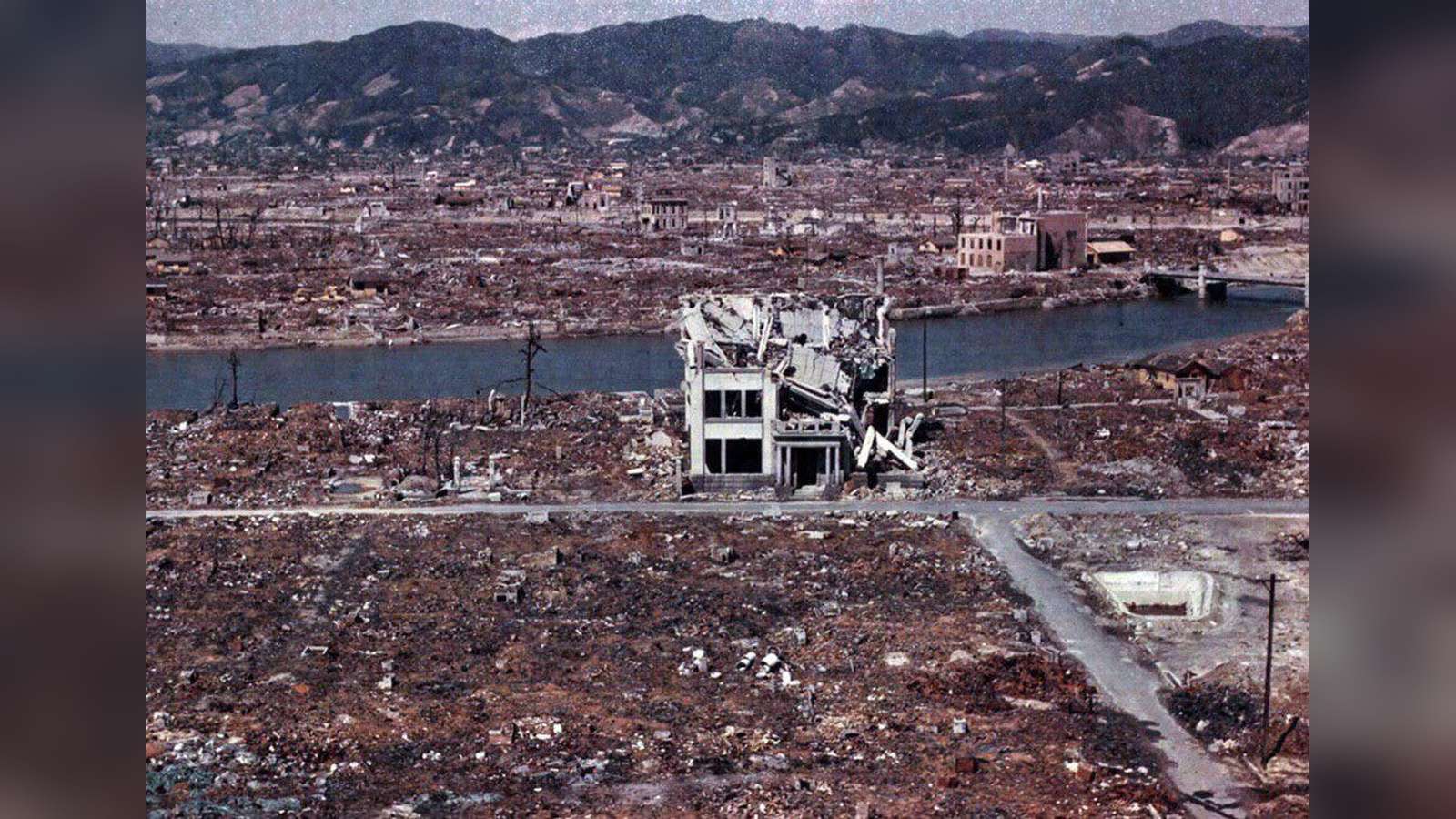
This rare color photograph captures the skeletal remains of Hiroshima in March 1946, presenting a landscape transformed into a vast, desolate mosaic of grey rubble, rust, and scorched earth. Standing as an unsparing visual witness to the immediate aftermath of the atomic age, the image forces the viewer to confront the physical reality of the city six months after the world’s first wartime nuclear strike. The photograph raises an enduring historical question: how did an official military documentation project preserve such an intimate, devastating portrait of ruin, and what does the choice of rare color film reveal about the systematic efforts to record the dawn of the atomic era?
What the photograph shows
The camera frames a wide, sweeping perspective over the flattened expanse of central Hiroshima. Where densely populated neighborhoods, wooden merchant homes, and commercial offices once stood, the ground is now an undulating wasteland of pulverized grey debris and scattered brick foundations. Unlike the stark, high-contrast monochrome images that dominated postwar newsreels, this color transparency exposes the muted, unnatural palette of an incinerated city. The eye is drawn to the reddish-brown tones of baked earth, the sickly yellow-brown rust creeping across collapsed steel girders, and the distant, resilient concrete skeletons of modern buildings that somehow defied total collapse. Every visible detail in the frame—from the absence of vegetation to the faint outlines of cleared paths through the rubble—describes a landscape reduced to its bare, tortured geological elements.
The moment behind the image
By March 1946, the initial acute shock of surrender and military occupation had settled into the grim, grinding reality of survival. Before the shutter clicked for this exposure, survey teams and local residents had begun the agonizing work of sorting through the toxic debris. People moved across these very ruins daily, salvaging bricks, searching for personal belongings, or attempting to establish rudimentary shelters amid the emptiness. The atmosphere of the moment was not one of active destruction, but of profound, heavy stillness—a haunting interim period where the war had officially ended, yet daily life existed entirely within the shadow of total annihilation. The photographer captured this quiet devastation during a systematic survey mission, freezing a transient seconds-long pause in a city undergoing slow, painful purgation.
Photographer and provenance
This image is preserved in the United States National Archives under catalog number 342-C-K6011, having originated from the visual documentation branch of the Department of Defense and the Department of the Air Force. Specifically, it belongs to the comprehensive visual archives compiled by the U.S. Strategic Bombing Survey, an organization established to evaluate the psychological and physical impacts of Allied air campaigns on enemy territories. The production and filming efforts in Japan during this period were spearheaded by military officers such as Lt. Col. Daniel A. McGovern, alongside skilled cinematographers and photographers including Japanese-American and local cinematic personnel like Harry Mimura, who worked under strict military orders to secure exhaustive scientific and propaganda records. Operating under logistical constraints and the heavy moral weight of their assignment, these camera operators utilized rare color stocks to ensure that future military and civilian leaders could analyze the true extent of atomic devastation in full, unvarnished hues.
Historical context
The wider historical backdrop of this photograph is defined by the immediate postwar transition and the dawn of the Cold War. In the spring of 1946, Hiroshima was the epicenter of intense scientific, medical, and geopolitical scrutiny. American survey commissions, Japanese municipal authorities, and international journalists converged on the ruined city to measure radiation effects, structural resilience, and human trauma. While medical teams documented horrific flash burns and keloid scars in makeshift hospitals, engineering teams mapped structural failures block by block. This photograph acts as a critical bridge between the cataclysmic flash of August 1945 and the decades-long reconstruction movement that eventually built modern Hiroshima. It captures the exact moment when history stood suspended between utter ruin and the stubborn human resolve to rebuild.
Why it still matters
Decades after it was taken, this color photograph retains an unsettling power because it strips away the comfortable historical distance provided by black-and-white photography. Color bridges the chronological gap, making the ruins feel contemporary, tangible, and terrifyingly close to our own modern reality. It serves not only as an invaluable artifact of World War II military history, but as an eternal, sobering reminder of the physical cost of nuclear warfare, urging modern viewers never to forget the fragility of civilization when confronted with weapons of mass destruction.