


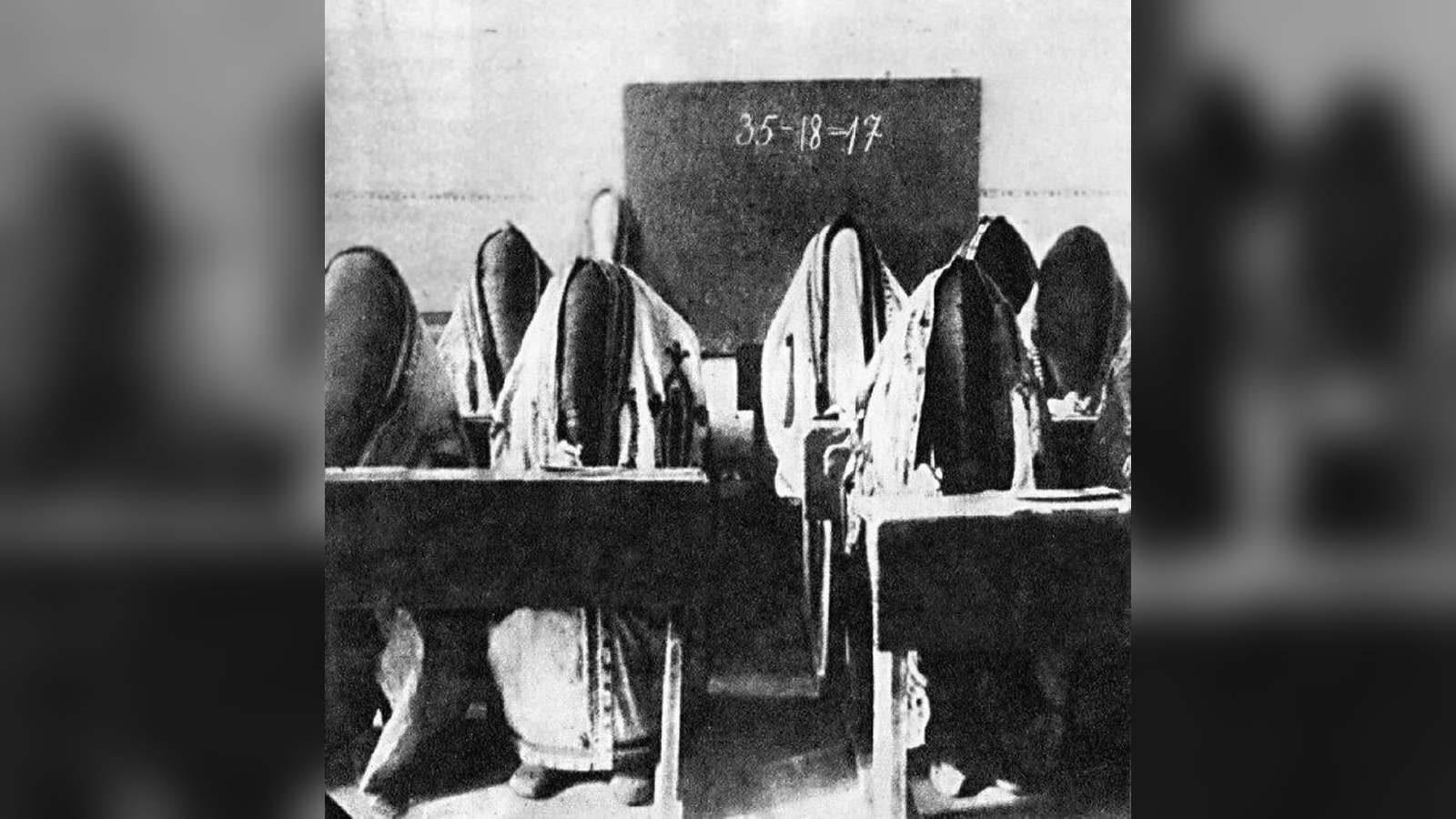
This striking historical photograph captures a group of young Uzbek schoolgirls seated attentively at wooden desks inside a Tashkent classroom in 1921. The composition centers on their focused, serious expressions as they look toward a blackboard or an instructor just out of frame, holding rudimentary writing tools. Their traditional garments, combined with the sparse yet orderly setting of the newly established Soviet-era school, highlight a poignant collision of eras. The image freezes a delicate, fleeting instant of personal concentration against the backdrop of massive institutional upheaval, offering a rare visual testament to children experiencing the very vanguard of modern education.
What the photograph shows
A careful visual reading of the frame reveals several distinct elements that ground the photograph in its specific era. The children, mostly young girls ranging from pre-teens to early adolescence, wear traditional regional head coverings and patterned tunics that signal their cultural heritage. They are arranged in rows at long, shared wooden desks, a standard configuration for early 1920s classrooms intended to maximize capacity under severe resource shortages. Their posture is notably upright, reflecting either the strict discipline of the new school environment or the intense concentration required to follow an unfamiliar lesson. The background is deliberately austere: plain whitewashed walls, an absence of decorative distractions, and perhaps the faint reflection of natural light entering through high windows. There is no visible sign of religious icons or royal portraits; instead, the spatial economy points toward the utilitarian pedagogical methods introduced by the new administration. The direct gazes of a few children toward the camera suggest either a momentary distraction from the shutter click or the curious awareness that their presence in this room was being recorded as something historically unusual.
The moment behind the image
The shutter moment in this 1921 Tashkent classroom took place amid intense revolutionary reorganization across the Turkestan region. Immediately before the exposure, the classroom would have buzzed with the unfamiliar rustle of paper, the scratching of chalk, and the cautious voices of children navigating a completely new curriculum. Before this era, formal schooling for young girls in traditional Uzbek society was exceedingly rare, heavily constrained by patriarchal norms, domestic labor expectations, and religious customs that kept women within the private sphere. The introduction of mathematics—arithmetic, geometry, and early algebra—as a mandatory subject for female students was designed by reformers to instill structured, rational thinking. The atmosphere in the room was charged with the quiet tension of transition, as these students stepped across a generational threshold into an unprecedented public sphere. What happened immediately afterward is lost to direct record, but the students would have returned to their recitation drills, closing their slates and stepping out into streets undergoing their own turbulent transformations under the new regime.
Photographer and provenance
While the individual photographer remains uncredited in surviving archival records, images of this type were typically captured by roving official documentarians, state-sponsored photojournalists, or educational inspectors working for Soviet Turkestan agencies such as the People’s Commissariat of Education. Commissioned to document the success of cultural and social reforms, these photographers operated under explicit ideological directives to showcase the emancipation of women, the eradication of illiteracy, and the expansion of the socialist state into Central Asia. The prints were preserved in regional archives, administrative report portfolios, and later circulated through historical retrospectives, academic studies, and digital heritage platforms like Dzen. The anonymity of the lensman emphasizes that the subjects themselves—the pioneering schoolgirls—remain the true focal point of the historical record, even as their images were co-opted to serve political narratives of progress.
Historical context
The year 1921 marked a critical juncture in the history of Tashkent and the broader region following the turbulence of World War I, the 1917 revolutions, and the subsequent consolidation of Bolshevik power. The new government launched aggressive campaigns aimed at transforming traditional society, dismantling old legal structures, and enforcing gender equality through decrees and state-backed institutions. Education became the chief instrument of this social engineering. Opening classrooms to Uzbek girls was not merely an administrative shift; it was a profound ideological challenge to centuries-old traditions that confined women to domestic roles. Mathematics, prized for fostering secular, rational mindsets, stood at the core of the new curriculum, intended to prepare a new generation of female citizens for active participation in the workforce, administration, and public life. This educational push was part of a larger, often contested campaign that would later intensify during the brutal anti-veil campaigns of the late 1920s, known as the Hujum.
Why it still matters
More than a century after the exposure was made, this photograph retains its power because it compresses a monumental historical pivot into a single, intimate classroom scene. It reminds viewers of the high stakes embedded in access to basic education and the immense courage required to step into a completely reimagined future. By capturing the exact moment when young Uzbek minds first grappled with mathematical equations in a formalized public school, the image transcends its original propagandistic intent to honor the enduring human desire for knowledge, self-reliance, and personal transformation.