


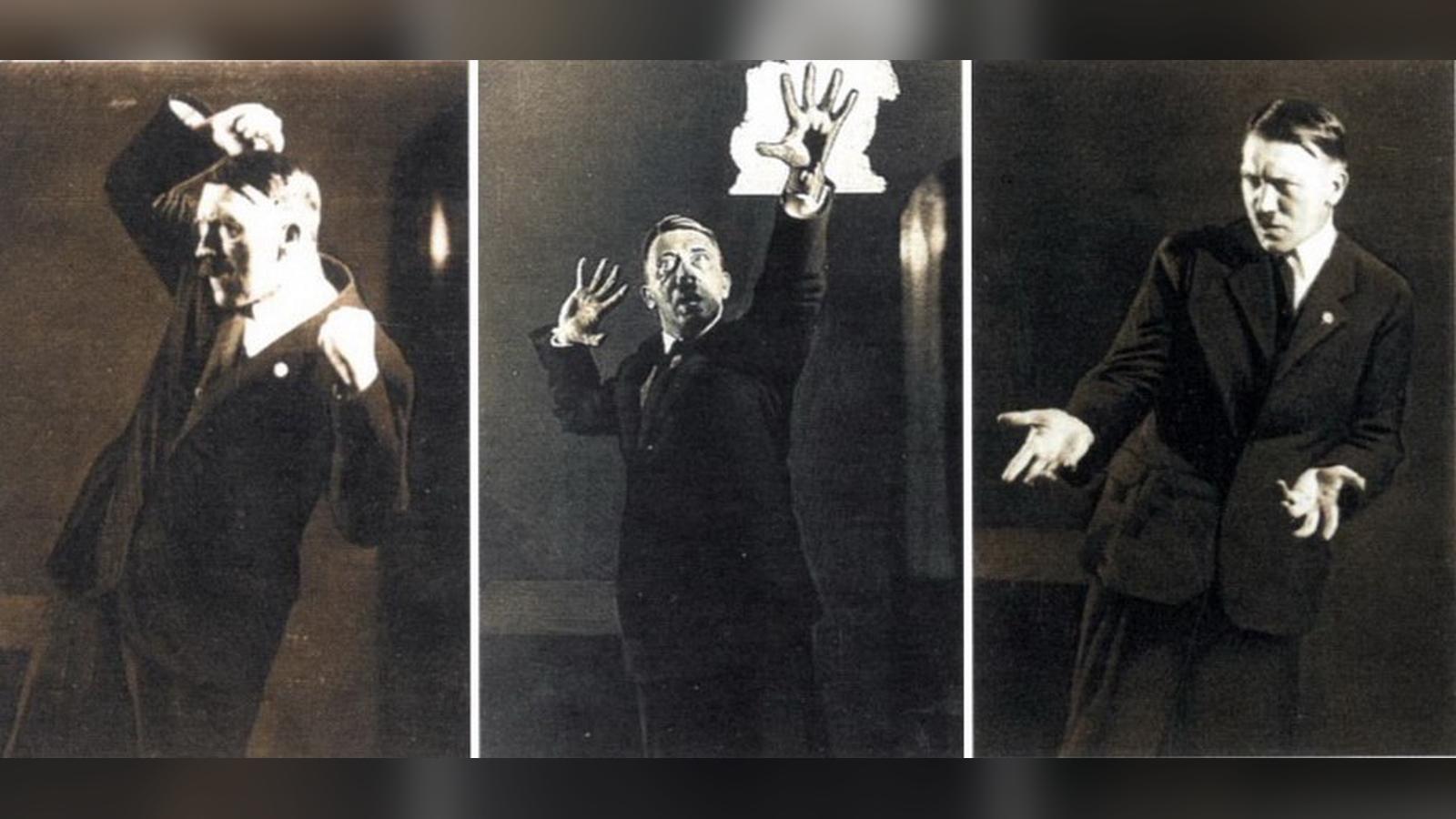
In a stark studio frame captured in 1925, Adolf Hitler stands in a dark, tailored suit and tie, leaning aggressively toward an empty room with an outstretched index finger and a twisted facial expression. This image—part of a private series of posed rehearsal portraits taken by Munich photographer Heinrich Hoffmann—captures a moment not of spontaneous political frenzy, but of methodical, calculated preparation. Historically meaningful because it strips away the totalitarian myth of effortless magnetic charisma, the photograph raises a fundamental question: how was the visual theatricality of fascist rhetoric engineered behind closed doors, and how did these forbidden images manage to survive?
What the photograph shows
In the photograph, Hitler is depicted against a neutral, shadow-draped background, entirely isolated from the mass rallies, marching SA stormtroopers, and tens of thousands of cheering onlookers that would later define his public iconography. Stripped of the arena setting, his movements appear strikingly theatrical and awkward. He thrusts his arm forward with an extended finger, his eyes narrowed, his brow tightly furrowed, and his lips pulled into an exaggerated snarl aimed at an imaginary audience.
Other frames from the same 1925 photographic session reveal a wide sequence of calibrated postures: clenched fists raised near the head, broad open-palm gestures imploring an absent crowd, and rigid, upright stances with folded arms across his chest. He wore a dark wool suit with a crisp white shirt and tie—a modern bourgeois attire chosen before the Nazi party had standardized its full paramilitary regalia. Because the camera was positioned at chest height in a small room, the stark contrast between the intense, arena-scale physical exertion and the quiet, artificial studio environment creates a disconcerting, almost surreal portrait of political performance art.
The moment behind the image
The secret photographic session took place in Munich during 1925, shortly after Hitler was released from Landsberg Prison. He had served nine months following the failed 1923 Beer Hall Putsch, a violent attempt to overthrow the Bavarian government. Upon his release, Hitler recognized that taking power in Weimar Germany would require rebuilding the banned Nazi Party and mastering the emerging media landscape of mass persuasion. Rhetoric was his primary weapon, but he recognized that in large halls without amplification systems, body language carried as much emotional weight as spoken words.
To refine his technique, Hitler set up a phonograph or early playback machine in Hoffmann’s studio to listen to audio recordings of his own voice delivering speeches. As his recorded voice boomed through the studio, he paced, gestured, and struck aggressive stances in sync with his cadence. Hoffmann stood behind the camera, firing off frames to capture each split-second motion. Afterward, the photographic prints were brought to Hitler so he could conduct a rigorous self-audit—evaluating which arm angles projected authority, which facial grimaces looked convincing, and which postures appeared absurd or weak.
Photographer and provenance
Heinrich Hoffmann was not merely a passive photographer; he was a pivotal architect of the Nazi Party’s visual brand. Having met Hitler in Munich in 1920, Hoffmann joined the party early and secured an exclusive monopoly as Hitler’s official personal photographer. Over the next two decades, Hoffmann took more than two million photographs of the Nazi leader, earning vast royalties and publishing propaganda photobooks that shaped the public perception of the regime.
However, this specific 1925 rehearsal series was never intended for public consumption. Upon inspecting the test prints, Hitler reportedly deemed the exaggerated postures embarrassing, declaring them “beneath one’s dignity” and commanding Hoffmann to destroy the glass-plate negatives immediately. Hoffmann nodded, but secretly defied the direct order. Recognizing the historical and financial value of the unique plates, he tucked them away in a secure, hidden cabinet within his Munich photo archive. The negatives survived the Allied bombing raids of World War II intact. Following the war, U.S. military forces seized Hoffmann’s vast photographic archive. The forbidden rehearsal images finally surfaced in 1955 when Hoffmann published his postwar memoir, Hitler Was My Friend (Hitler war mein Freund), revealing to the world the hidden labor behind the dictator’s public persona.
Historical context
In mid-1920s Weimar Germany, political culture was being transformed by modern technologies, including popular photojournalism, newsreels, and public address audio systems. Political leaders could no longer rely solely on traditional parliamentary debate; they had to perform for mass audiences and media lenses. Hitler’s obsession with his photographic image reflected a broader fascist understanding of modern mass psychology, where visual spectacle and emotional manipulation replaced rational political argument.
By treating his physical delivery as an actor would treat a theatrical script, Hitler methodically built the persona of the impassioned, prophetic orator. The 1925 photos demonstrate that the explosive outbursts on stage—the sudden transitions from low, somber murmurs to screeches accompanied by violently thrusting arms—were not spontaneous emotional breakdowns, but carefully rehearsed mechanics developed years before the NSDAP gained parliamentary power.
Why it still matters
Today, Heinrich Hoffmann’s 1925 photographs serve as a powerful historical antidote to authoritarian myth-making. Fascist propaganda relied on presenting the dictator as an extraordinary, almost supernatural force of nature whose power flowed effortlessly from inherent destiny. Hoffmann’s surviving glass plates shatter this illusion, showing that behind the terrifying spectacle of totalitarian rallies lay hours of mundane, self-conscious rehearsal in front of a studio mirror and camera.
By revealing the artificial mechanics behind political manipulation, the photograph remains an enduring visual lesson in media literacy. It reminds viewers that political charisma, particularly of the extremist variety, is often a manufactured consumer product—designed, tested, and polished behind closed doors before being deployed to sway the masses.