


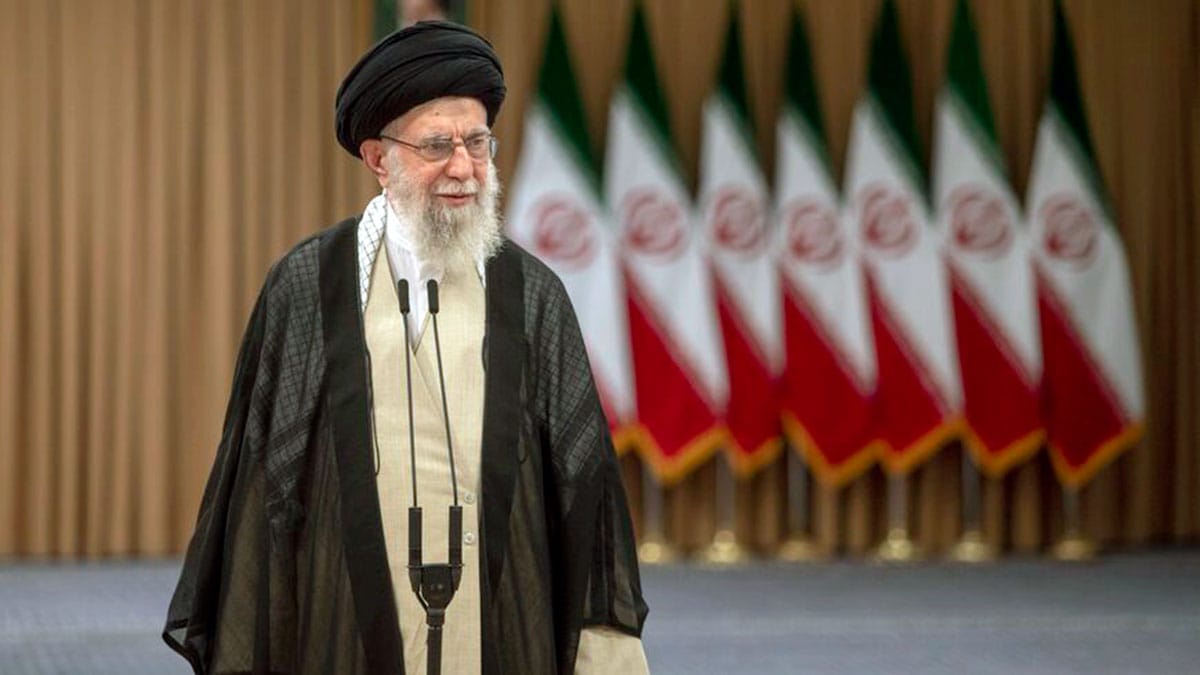
Iran’s Supreme Leader Ayatollah Ali Khamenei on Saturday vehemently condemned what he described as “bullying” tactics, a day after US President Donald Trump threatened military action. “Some bully governments—I really don’t know of any more appropriate term for some foreign figures and leaders than the word bullying—insist on negotiations,” Khamenei stated to officials, referencing Trump’s threat of military intervention if Iran refuses nuclear program talks. “Their negotiations are not aimed at solving problems; they aim at domination,” Khamenei asserted, underscoring Iran’s firm stance and deep-seated distrust towards the United States. This declaration follows a renewed escalation in US-Iran tensions, triggered by the Trump administration’s reinstatement of its “maximum pressure” policy.
Khamenei Brands Trump’s Negotiation Calls as “Bullying”
In his address, Khamenei meticulously detailed Iran’s discontent with U.S. negotiation tactics, branding them as “bullying” and an “attempt at domination.” His words reflect not merely a personal grievance against Trump’s rhetoric but also the Iranian government’s deeply entrenched skepticism towards negotiation processes with Western nations, particularly the United States. Khamenei argues that the West’s objective is not genuine problem-solving but rather to establish dominance over Iran. Such a stance complicates any prospect of resolving the situation, as both sides accuse each other of mistrust and imposing unreasonable demands.
Iran’s Firm Stance Amid “Maximum Pressure” Policy
Iran’s твердая (tvyordaya – твердая in Russian, meaning твердая/firm/rigid in Armenian context) stance is rooted in the return of the Trump administration and the revival of the “maximum pressure” policy. This policy, previously enacted during Trump’s first term, involves imposing sweeping sanctions on Iran to compel negotiations over its nuclear program. Trump’s return to the White House led to Washington’s Thursday announcement of financial sanctions targeting entities and individuals shipping Iranian crude oil to China. Tehran has condemned these sanctions as “illegal” and a “violation of international rules,” emphasizing that Iran will not yield to pressure and negotiate under such conditions.
Eroded Trust: Iran Sees No Point in Negotiations
Khamenei specifically referenced the 2015 nuclear deal, illustrating how the U.S. has breached its commitments and eroded trust. He recalled Tehran’s year-long adherence to the Joint Comprehensive Plan of Action (JCPOA) terms after Trump’s 2018 withdrawal, prior to Iran’s own rollback of commitments. Khamenei also criticized the governments of Britain, France, and Germany, accusing them of “declaring that Iran has not fulfilled its nuclear commitments under the JCPOA.” All these points to Iran’s growing disbelief in the effectiveness of negotiations with the U.S., deeming them pointless.
Economic Hardship and Internal Solutions: Iran Resists Sanctions
Despite acknowledging that “almost most segments of the population have some problems” due to Western sanctions, Khamenei insisted that these issues could be resolved through internal resources. Iran’s Supreme Leader expressed hope that the current “respected government can reduce the livelihood problems of the people.” This statement demonstrates Iran’s resolve to overcome economic hardships using its own capabilities and resist external pressure. Simultaneously, Iran expressed hope that Trump would adopt a “realistic” approach towards Middle Eastern countries, including Iran, which could potentially lay groundwork for future dialogue.
Escalating Tensions: US-Iran Relations at a New Juncture
Tensions between Iran and the U.S. continue to escalate amidst deepening mistrust and animosity on both sides. Khamenei’s жесткий (kharzkhaya – жесткий in Russian, meaning жесткий/harsh/rigid in Armenian context) response to Trump’s threats and calls for negotiation indicates that improved relations are unlikely in the near future. Iran is prepared to withstand the “maximum pressure” policy and declares its readiness to retaliate against any U.S. threat or action. Meanwhile, the international community watches with growing concern, fearing the risk of a new regional conflict outbreak.