


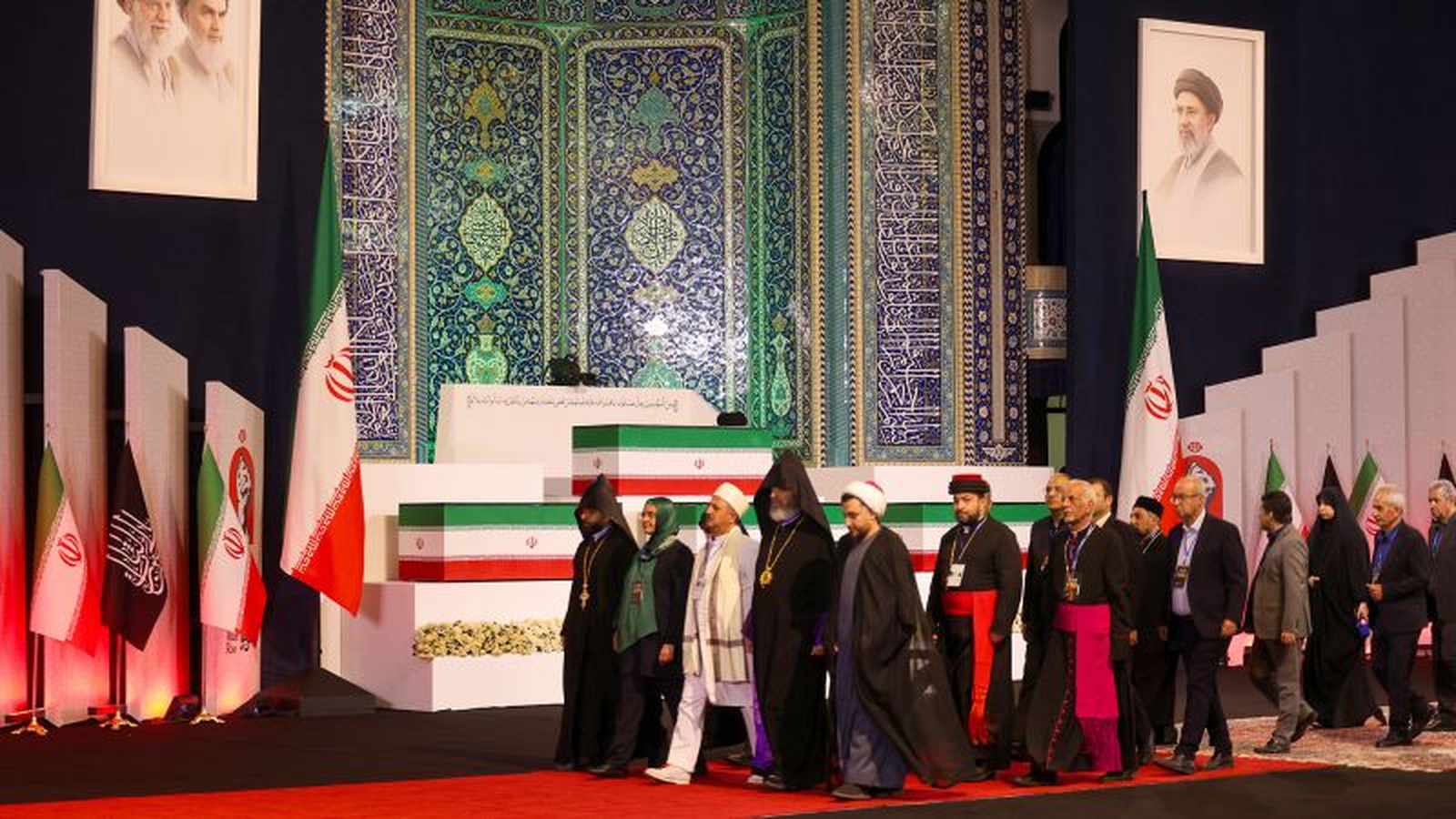
A Staged Referendum on Regime Stability
Tehran has officially commenced several days of public mourning for former Supreme Leader Ayatollah Ali Khamenei, who was killed in joint US-Israeli strikes on February 28. The regime is mobilizing massive logistical resources, including thousands of ambulances and mobile bakeries, to facilitate what officials describe as an expected turnout of 20 million people. The funeral processions, spanning multiple cities in Iran and Iraq, are being framed by the ruling clerics not merely as a farewell, but as a “referendum” on the legitimacy of the Islamic Republic.
The timing of the events is deeply symbolic, aligning with the Islamic month of Muharram and overlapping with the 250th anniversary of US Independence Day. Revolutionary Guards commanders, including the recently re-emerged General Ahmad Vahidi, have utilized the buildup to issue stern warnings to Washington and Tel Aviv, cautioning against any “miscalculation” during the processions, which they claim would trigger “harsh retaliation.”
The Succession Uncertainty
A central point of intrigue remains the potential appearance of Mojtaba Khamenei, the late leader’s son and successor. While the regime has projected an image of continuity, Mojtaba has remained in hiding since the February strikes, communicating only through written statements. His absence at recent private family ceremonies, coupled with the regime’s deflection regarding his funeral attendance, has intensified domestic and international speculation about his health and the actual locus of power within the theocracy.
Geopolitical and Economic Realities
Beyond the pageantry, the state funeral serves as a distraction from a war-ravaged economy and a restless populace. Reports from residents in Tehran suggest that while the state is investing heavily in the spectacle, public enthusiasm is dampened by severe inflation and the memory of the violent crackdown on protests earlier this year. Simultaneously, the broader conflict continues to reshape regional alliances; the Wall Street Journal reports a widening rift between the US and Saudi Arabia over President Donald Trump’s handling of the war, leading to a possible shift in US military positioning toward Israel and Jordan.
Meanwhile, in the Strait of Hormuz, maritime traffic is beginning to normalize as part of the tentative US-Iran agreement. However, Tehran continues to assert its right to control the waterway, maintaining a defiant stance even as it seeks to emerge from the immediate kinetic phase of the conflict. For the regime, the funeral is a calculated effort to project strength to an international audience while struggling to maintain a facade of unity at home.