


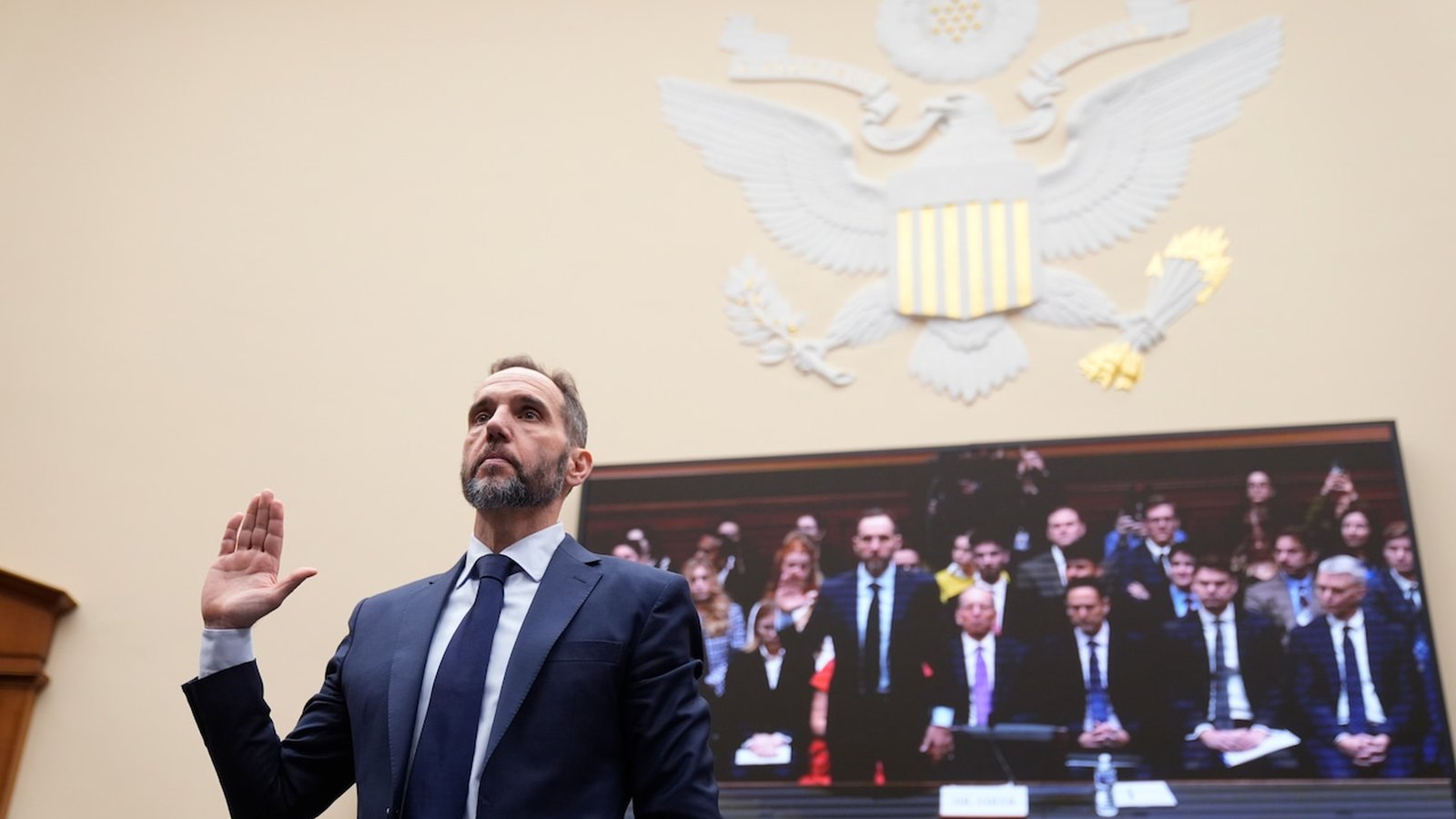
Former Justice Department special counsel Jack Smith appeared before the House Judiciary Committee on Thursday, steadfastly defending his high-profile investigations into President $1 Trump. Smith asserted that his probes uncovered “proof beyond a reasonable doubt” that Trump engaged in criminal activity and insisted his actions were devoid of political bias, a stance that immediately polarized the hours-long hearing along partisan lines.
Smith, a Central New York native appointed by Attorney General Merrick Garland in 2022, faced intense questioning from Republican lawmakers who sought to portray him as an overzealous prosecutor driven by a desire to derail Trump’s political career. Democrats, conversely, utilized the forum to highlight Smith’s findings regarding Trump’s conduct and to accuse their GOP counterparts of attempting to rewrite history. The hearing unfolded as Trump himself, traveling back from the World Economic Forum, took to Truth Social to demand Smith’s prosecution, baselessly alleging perjury.
Smith Defends Independence and Findings
During his testimony, Smith unequivocally stood by his decisions to bring charges against Trump in two separate cases: one alleging a conspiracy to overturn the 2020 presidential election results and another concerning the hoarding of classified documents at his Mar-a-Lago estate post-presidency. “No one should be above the law in our country, and the law required that he be held to account. So that is what I did,” Smith stated, adding, “If asked whether to prosecute a $1 based on the same facts today, I would do so regardless of whether that president was a Republican or a Democrat.”
Smith detailed the extensive evidence collected during his investigations, which shadowed Trump throughout the 2024 presidential campaign. He emphasized the reliance on credible witnesses, many of whom were Republican supporters of Trump. “Some of the most powerful witnesses were witnesses who, in fact, were fellow Republicans who had voted for Donald Trump, who had campaigned for him and who wanted him to win the election,” Smith explained, underscoring the bipartisan nature of the factual basis for his cases.
Partisan Divide Over Prosecutorial Tactics
The hearing quickly devolved into a contentious debate, with Republican lawmakers challenging Smith’s methods and motivations. Rep. Jim Jordan of Ohio, the committee’s Republican chairman, declared, “It was always about politics,” echoing a frequent Trump talking point that the investigations were designed to impede his candidacy. Rep. Brandon Gill, a Texas Republican, criticized Smith for subpoenaing the phone records of several Republican lawmakers, asserting that it showed Smith had “walked all over the Constitution.” These records, which documented incoming and outgoing calls and their duration but not content, were defended by Smith as a common and necessary prosecutorial tactic to understand the scope of the alleged conspiracy related to January 6, 2021. “My office didn’t spy on anyone,” Smith clarified.
Rep. Kevin Kiley of California accused Smith of seeking “maximum litigation advantage at every turn” and “circumventing constitutional limitations to the point that you had to be reined in again and again throughout the process.” Another Republican, Rep. Ben Cline of Virginia, challenged Smith over his team’s request for a court order to restrict Trump from making incendiary comments about prosecutors and witnesses. Smith maintained the order was essential due to Trump’s attempts to intimidate witnesses, while Cline argued it was an attempt to silence Trump during the presidential campaign. Smith vigorously rejected all suggestions that his investigations were politically motivated, asserting instead that “Our investigation revealed that Donald Trump is the person who caused Jan. 6, it was foreseeable to him and that he sought to exploit the violence.”
Broader Implications for Justice and Accountability
Smith’s testimony also touched upon the broader implications for the rule of law and the independence of the Justice Department. He expressed concern about potential retribution, stating he believed a future Trump administration would “do everything in their power” to prosecute him, as they have been “ordered to by the president.” This concern highlights mounting alarm among some that the Justice Department’s institutional independence is eroding under political pressure. Smith underscored the critical importance of holding powerful individuals accountable: “My belief is that if we do not hold the most powerful people in our society to the same standards – the rule of law – it can be catastrophic because, if they don’t have to follow the law, it’s very easy for people to understand why they don’t have to follow the law.”
The special counsel’s investigations ultimately led to indictments against Trump, but the cases were abandoned by Smith and his team after Trump won back the White House. This decision was based on long-standing Justice Department legal opinions that assert sitting presidents cannot be indicted. The public hearing provided Smith with a rare opportunity to directly address Congress and the American public, detailing the breadth of evidence collected and the legal rationale behind his controversial actions.
The public exchange between Jack Smith and congressional Republicans underscores the profound challenge of maintaining perceived impartiality in high-stakes legal proceedings involving $1s, particularly when those investigations intersect with ongoing political campaigns and deeply entrenched partisan divisions. The hearing served less as a fact-finding mission and more as a highly visible battleground for competing narratives about justice, accountability, and the integrity of democratic institutions.