


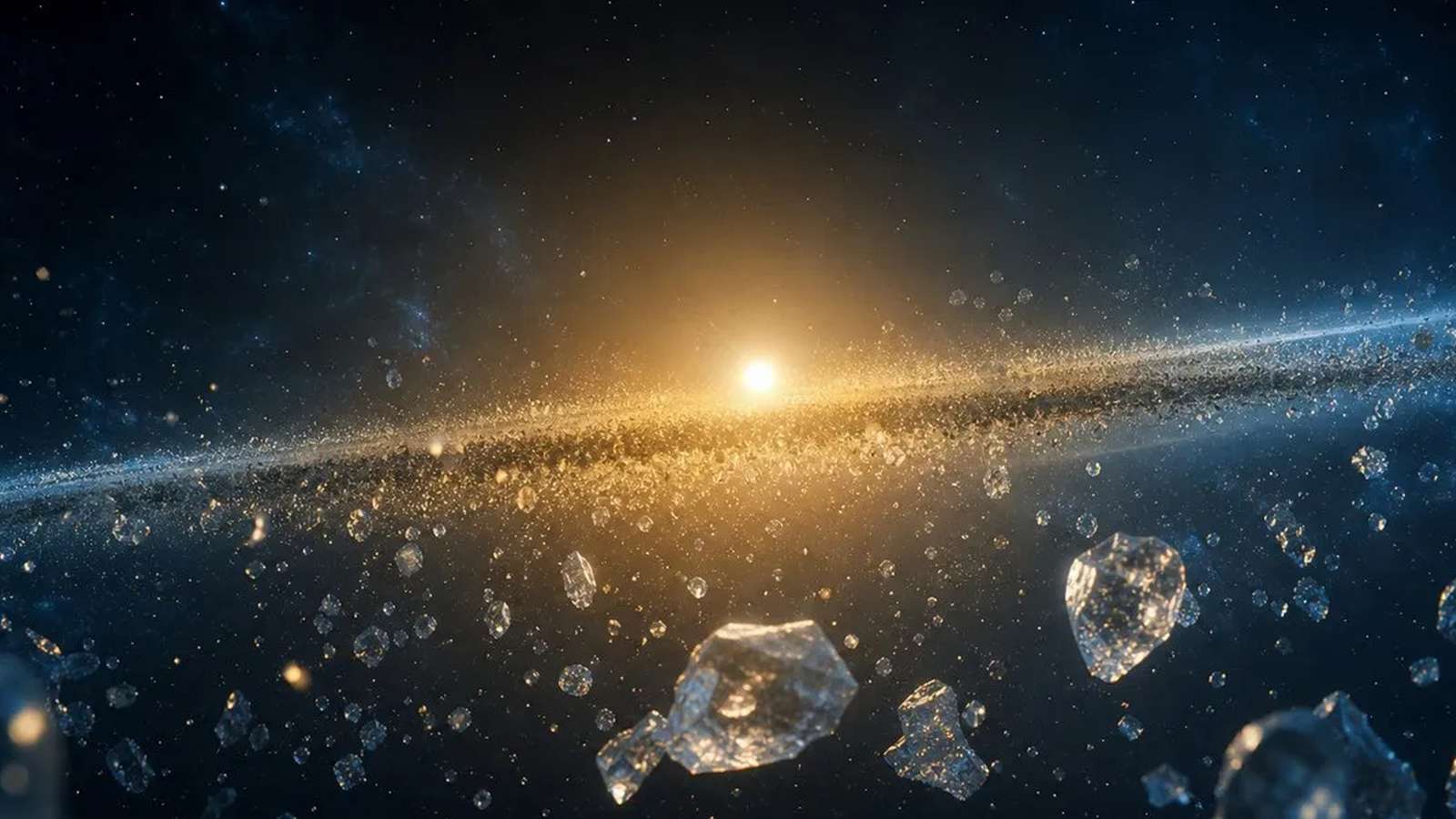
Astronomers utilizing the James Webb Space Telescope have detected both water and carbon dioxide ice within the debris disk surrounding the young star Beta Pictoris, according to a study published on November 14, 2026. The findings offer unprecedented insight into the composition of material around young planetary systems and suggest that key ingredients for water-rich worlds may be widespread in the universe.
Ars Technica reported that the research team, led by Space Telescope Science Institute astronomer Sarah Betti, observed the star system using the NIRSpec near-infrared spectrograph on December 7, 2023. Beta Pictoris is located approximately 64 light-years from Earth and is estimated to be 20 million years old, featuring a vast disk of dust and debris where at least three planets have already formed.
Spectroscopic Discovery in the Debris Disk
By separating the intense light of the central star, the research team analyzed light reflected by dust across a wavelength range from 0.6 to 5.2 micrometers. Water ice absorbs light near a wavelength of 3 micrometers, while carbon dioxide registers near 4.27 micrometers and 4.39 micrometers for its carbon-13 isotopic form. Detailed spectra gathered from two distinct regions located about 100 astronomical units from the star confirmed the presence of both molecules.
Further analysis revealed that the carbon dioxide ice is thoroughly mixed with water ice rather than existing in isolated particles. The researchers estimate that there is slightly more than one carbon dioxide molecule for every ten water molecules, accounting for roughly 11 percent of the ice. This proportion closely mirrors the carbon dioxide fractions recorded in comets within our own Solar System and in disks surrounding other young stars.
Amorphous Structure and Interstellar Origins
The water ice discovered in the system is almost entirely amorphous, possessing a glass-like structure rather than an ordered crystalline lattice. Crystalline ice accounts for less than 7 percent of the total detected. To retain this amorphous state, the ice must remain below roughly 100 kelvins, or minus 173 degrees Celsius, to prevent high-energy ultraviolet radiation, cosmic rays, or particle streams from altering its molecular configuration.
The properties of the ice indicate that the material may have formed within the interstellar medium before Beta Pictoris and its planetary system coalesced. According to the study’s authors, the continuous replenishment of fresh icy dust across the disk is driven by frequent collisions among planetesimals, which unearth protected material and sustain volatile reservoirs.