


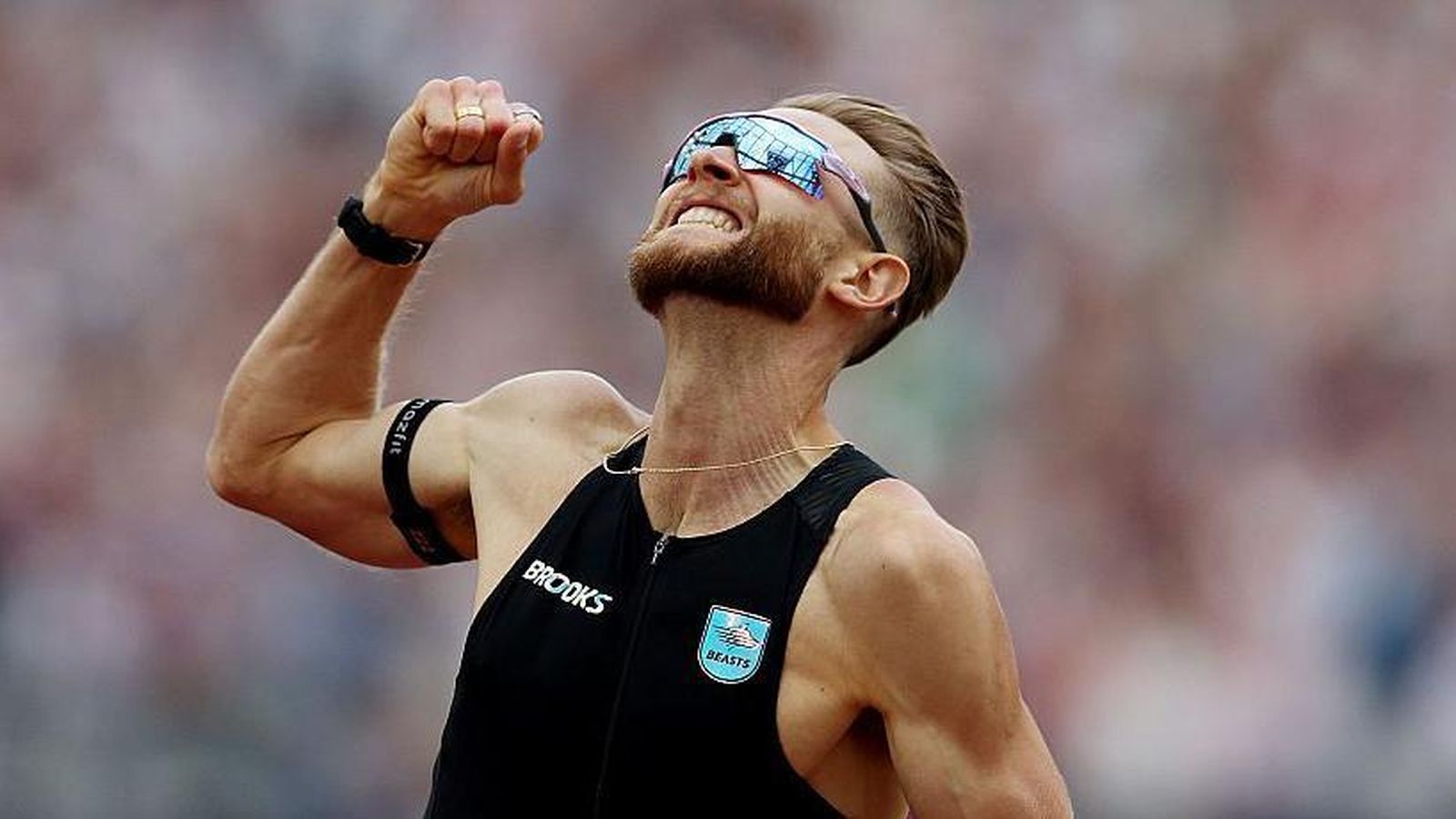
LONDON (Azat TV) – In a performance that bridged nearly three decades of athletic history, Great Britain’s Josh Kerr shattered the men’s mile world record on Saturday at the London Diamond League. Clocking a staggering 3:42.66, the 28-year-old Scotsman erased the 1999 mark of 3:43.13 held by Moroccan legend Hicham El Guerrouj, a record that had stood untouched since Kerr was just one year old.
The Anatomy of a Record
The record-breaking run at the London Stadium was not a product of chance, but the culmination of a high-stakes, four-month public campaign Kerr titled “Project 222.” The name referred to the total number of seconds (3 minutes and 42 seconds) Kerr believed were necessary to secure his place in the history books. Supported by a sell-out crowd of 60,000, Kerr demonstrated a level of dominance rarely seen in middle-distance running, finishing more than three seconds ahead of his nearest rival, American Yared Nuguse (3:45.69).
The race was orchestrated with surgical precision. Kerr was aided by two pacemakers, including his Brooks Beasts teammate Brannon Kidder, who led the field through 800 meters in 1:50.70. When the pacers stepped off at the 1,000-meter mark, Kerr was left to battle the “wavelights”—the electronic pacing system on the track’s curb—and his own physical limits. He passed the 1,500-meter mark faster than his own British record for that distance before unleashing a final lap that left the stadium in a state of collective roar.
The ‘Project 222’ Blueprint
Kerr’s success was built on a foundation of transparency and tactical risk. Unlike many elite athletes who keep their training metrics private, Kerr documented his preparations in a series of YouTube videos. The turning point for many observers was a 1,200-meter time trial conducted at high altitude in Albuquerque, New Mexico. In that session, Kerr clocked 2:42.45—unofficially the fastest time ever recorded for the distance—closing his final 400 meters in a ferocious 51.88 seconds.
His coach, Danny Mackey, noted that the decision to target the world record in 2026 was strategic. With no Olympic Games or World Championships scheduled for this summer, the team identified a rare window to prioritize raw speed over championship tactics. This “gap year” allowed Kerr to recover from a calf injury sustained after the Paris 2024 Olympics and focus entirely on a singular, time-based goal.
Technological and Biomechanical Edge
Beyond the physiological preparation, Kerr utilized bespoke equipment designed specifically for this attempt by his sponsor, Brooks. He wore a custom-engineered speed suit featuring laser-cut perforations for maximum breathability in London’s warm conditions and enhanced aerodynamics.
More critical were his spikes, which featured a specialized carbon plate and an aggressive rocker designed to maximize propulsion. The footwear utilized titanium pins to minimize weight while maintaining grip. Kerr’s feedback during the development phase was central to the design, ensuring the equipment complemented his specific biomechanical needs during the high-force transition of the final 400 meters.
A British Legacy Restored
Kerr’s achievement returns the mile world record to British hands for the first time since Steve Cram held it in 1985. He joins an elite lineage that includes Sir Roger Bannister, Sebastian Coe, and Steve Ovett. The mile, while not an Olympic distance, remains the sport’s most evocative benchmark—a test of speed and endurance that resonates with the general public more than the metric 1,500 meters.
“To join that list of great names—I know when I did it, I so wanted to be in that club,” Steve Cram told BBC Sport following the race. “Welcome to the club, Josh!”
While his rivalry with Norway’s Jakob Ingebrigtsen remains a focal point for the sport, Kerr’s performance in London shifts the narrative. By taking down one of the most resilient records in the record books, Kerr has transitioned from a championship racer to a historical titan. His next objective will be the Commonwealth Games in Glasgow, where he will compete in front of a home Scottish crowd, further cementing his status as the premier miler of the modern era.