


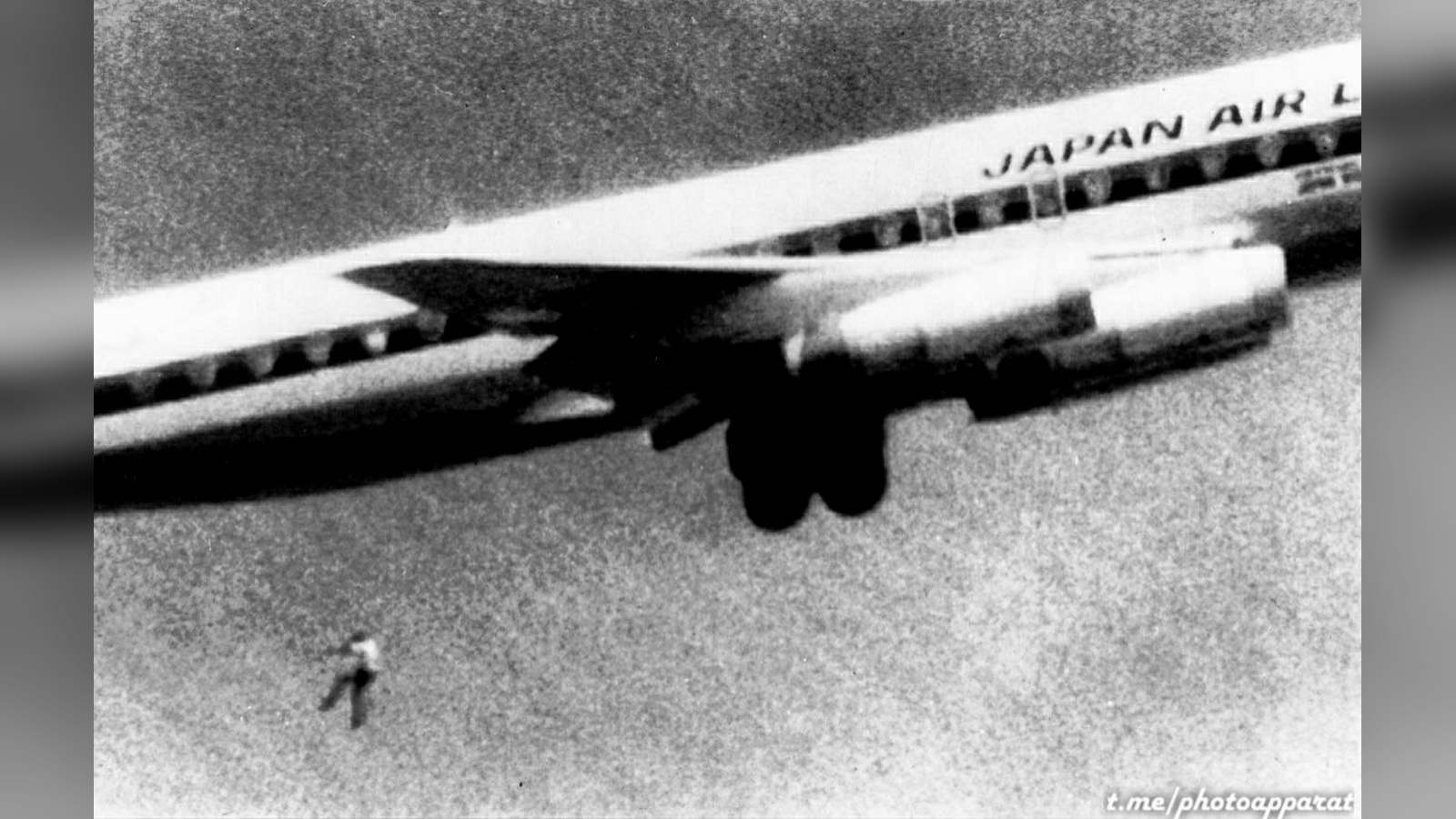
What the photograph shows
The image is a stark, monochromatic frame that captures a small, dark silhouette suspended against the bright, blurred sky above Sydney. The figure, identified as 14-year-old Keith Sapsford, is frozen in mid-air, falling feet-first with his hands positioned near his head, as if bracing for an impact he could not possibly survive. The composition is jarring; the distance and the motion blur emphasize the terrifying reality of the fall, capturing a moment of absolute isolation just seconds after the boy was ejected from the wheel well of a departing Douglas DC-8. The surrounding environment is indistinct, turning the sky into an indifferent backdrop for a tragedy that would not be recognized until long after the shutter had closed. The grain of the 1970s film adds a sense of distance, making the figure appear as a spectral presence caught in a moment of irreversible physics.
The moment behind the image
On February 22, 1970, Keith Sapsford, a teenager from the Sydney suburb of Randwick, managed to bypass the relatively relaxed airport security of the era. Driven by an intense, restless desire to see the world—a wanderlust his parents had struggled to manage—the boy had run away from a Catholic boarding school known as Boys’ Town just days earlier. He believed he could stow away on a flight to Tokyo, a dream born of adolescent naivety. However, as the aircraft climbed and the pilot retracted the landing gear, the compartment doors opened, and Sapsford fell approximately 60 meters to his death. Police later determined that the boy likely did not realize the compartment would open when the airborne plane’s wheels retracted, sealing his fate instantly. The tragedy was not merely a fall; it was a collision between a child’s romanticized view of travel and the cold, mechanical reality of aviation.
Photographer and provenance
The photograph was taken by John Gilpin, an amateur photographer who was at the airport that day specifically to photograph departing aircraft. Remarkably, Gilpin was completely unaware of the tragedy unfolding above him at the moment the shutter clicked. It was only a week later, while developing his film in his home studio, that he discovered the chilling figure in his frames. The image remains one of the most haunting pieces of accidental photography in aviation history. Its survival is a testament to the power of photography to document the invisible; had Gilpin not been in the right place at the right time with his camera, Sapsford’s death would have remained a mere statistic rather than a lasting visual record of a desperate, fatal choice.
Historical context
Sapsford’s death drew international attention to the extreme dangers of stowing away in aircraft wheel wells. Aviation experts have long noted that such attempts are almost universally fatal due to mechanical crushing, lack of oxygen, and extreme sub-zero temperatures at cruising altitudes. Even if Sapsford had remained inside the compartment, he was wearing only a short-sleeved shirt and shorts, making survival impossible. His father, Charles Sapsford, a university lecturer in mechanical and industrial engineering, later revealed that he had actually warned his son about the dangers of such a feat after hearing a similar news story from Spain. The tragedy highlights the disconnect between the romanticized notion of ‘seeing the world’ and the brutal physical realities of aviation. It serves as a grim case study in the desperation that leads young people to attempt the impossible.
Why it still matters
The photograph serves as a haunting reminder of the human cost behind headlines. It captures not just a technical failure of airport security, but a moment of profound personal tragedy that reverberates through the decades. The image has survived as a cautionary symbol, illustrating that while the world may seem accessible, the physical realities of modern travel often exact a price that is too high to pay. It forces the viewer to confront the desperation of a child who felt so disconnected from his life that he would risk everything for a journey that was doomed from the start. Today, the photo remains a somber artifact of 1970s aviation, a time when the innocence of air travel was slowly beginning to give way to the harsh, security-conscious reality we know today. It stands as a silent witness to a life lost in pursuit of a horizon that remained forever out of reach.