


What the photograph shows
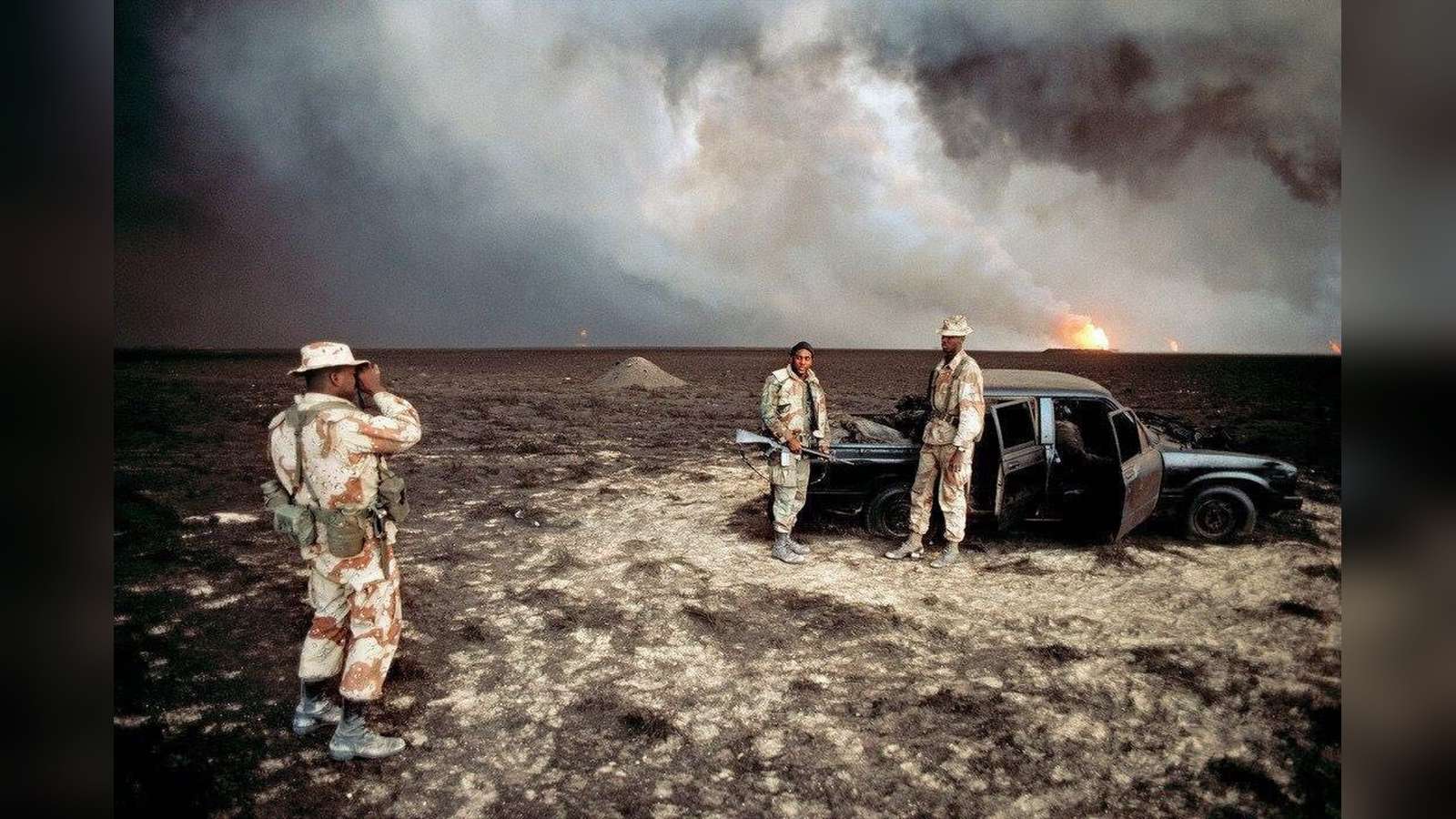
In the frame, a group of United States Marines stands amidst a surreal, dystopian landscape, pausing to take photographs of their own against the twisted wreckage of a burnt-out civilian car. The vehicle is utterly gutted, its metal frame warped and blistered by intense heat, coated in a thick, greasy layer of black soot that clings to every surface. Overhead, the sky is not blue or gray, but an ominous, impenetrable charcoal black. The ambient daylight has been entirely choked out by colossal plumes of smoke, creating an eerie, perpetual twilight that forces people to navigate by artificial light even at noon. The Marines, wearing desert camouflage utilities and tactical gear, exhibit the tense yet nonchalant posture of soldiers who have adapted to an environment resembling the surface of another planet.
Every visual element in the composition reinforces a sense of planetary displacement. The sand beneath their boots is stained with oily residue, blending crushed desert gravel with industrial petroleum to form a hardened crust of tarcrete. The background dissolves into a murky wall of haze where the horizon ought to be, obliterating any sense of distance or orientation. The soldiers’ gestures—holding compact cameras or gesturing toward the wreckage—capture a reflexive human impulse to document the unimaginable. They are recording a landscape transformed so radically by destruction that ordinary reference points have ceased to exist, turning a standard desert roadside into a monument of modern ecological catastrophe.
The moment behind the image
This stark visual record dates to early 1991, captured in the scorching, oil-drenched expanse of Kuwait in the immediate aftermath of the ground campaign of the Gulf War. In August 1990, Iraqi forces under Saddam Hussein invaded and occupied Kuwait. Months later, a US-led coalition of 42 nations launched a massive military operation to liberate the small nation. As coalition forces advanced rapidly in late February 1991, the retreating Iraqi army executed a scorched-earth directive, systematically rigging more than 750 oil wells, refineries, and pipelines with explosives. The resulting inferno unleashed one of the worst man-made environmental catastrophes in modern history, consuming millions of barrels of crude oil daily and turning the desert day into pitch night for over eight months.
The hours leading up to the shutter click were characterized by relentless military momentum and chaotic tactical repositioning. As armored columns of the United States Marine Corps pushed through Kuwaiti territory, they encountered abandoned Iraqi armor, shattered infrastructure, and countless burning wellheads that transformed the atmosphere into a choking furnace. The immediate precursor to this photograph was likely a momentary lull in active combat operations—a brief halt where frontline troops could process the sheer scale of the desolation surrounding them. The air tasted of sulfur and unburnt hydrocarbons, sticking to skin and lungs, while the ground trembled from the distant roar of pressurized oil blasting from ruptured wellheads into towering pillars of fire.
Photographer and provenance
While individual attribution for this specific wartime frame remains uncredited in many archival distributions, images of this genre were typically captured by military public affairs personnel, embedded wire-service photographers, or frontline service members documenting the historic theater of operations. Distributed widely through military archives and international press agencies, the photograph survived as a primary visual testament to the sheer bizarre scale of the Gulf War’s aftermath. It records an environment so altered by pollution that military officers like future general John Kelly described flying low over Kuwait as witnessing a scene straight out of Dante’s Inferno, where ordinary vehicles and desert highways were swallowed by toxic darkness.
The provenance of such imagery reflects the unique working conditions of the 1991 Gulf conflict. Photographers operated under extreme constraints, navigating heavy soot, toxic air, and active military hazards while trying to capture a conflict defined by its vast geographic scale. Official military photographers and civilian photojournalists alike faced the challenge of conveying a darkness that defied conventional exposure meters. The survival and continued circulation of this frame in historical archives owe much to its striking composition, which bridges the gap between official military documentation and the surreal human experience of soldiering through an apocalypse.
Historical context
The strategic sabotage of Kuwait’s oil infrastructure transformed a conventional military conflict into an unprecedented ecological crisis. Giant pillars of smoke rose kilometers high, blocking solar radiation and depositing black rain and soot across regions as distant as the Himalayas. While legendary firefighters like Red Adair and specialized international crews—such as the Hungarian team utilizing MiG-21 jet engines mounted on tanks—labored for months to cap the raging wells, ordinary soldiers lived and worked beneath the fallout. Vehicles like the charred car in the photograph became incidental monuments along roadsides where headlights failed to pierce the heavy, sulfurous smog, and air quality dropped to hazardous levels for thousands of stationed troops and returning civilians.
The broader historical ripples of these fires extended far beyond the borders of Kuwait. Scientific studies conducted by NASA and academic institutions tracked how millions of tons of smoke injected high into the atmosphere altered regional weather patterns and caused black snow and rain to fall across parts of the Middle East, Turkey, and South Asia. The psychological toll on the inhabitants and coalition personnel was equally profound, fostering chronic respiratory ailments and long-term health concerns often grouped under Gulf War illnesses. The environment captured in the photograph was not merely a temporary backdrop of war, but a toxic ecosystem that took nearly a year of international cooperation and billions of dollars to partially stabilize.
Why it still matters
Decades later, photographs capturing the shadowed desolation of Kuwait in 1991 retain a chilling resonance. They serve as historical warnings about the fragility of global energy infrastructure and the devastating collateral damage of modern warfare. As conflicts in the Middle East continue to bring renewed threats to oil installations and refineries, this arresting image of Marines posing before a burnt car beneath a blackened sun reminds observers of the profound, far-reaching toll that scorched-earth tactics inflict upon both human lives and the natural world.
Ultimately, the photograph transcends its specific historical moment to speak to the enduring intersection of human conflict and environmental vulnerability. It challenges viewers to look beyond the strategic and geopolitical gains of military victory and confront the physical scars left upon the earth. By preserving the image of ordinary soldiers pausing amidst extraordinary ruin, the historical record ensures that the true cost of modern industrial warfare—where the sky itself can be extinguished—remains visible to future generations.