


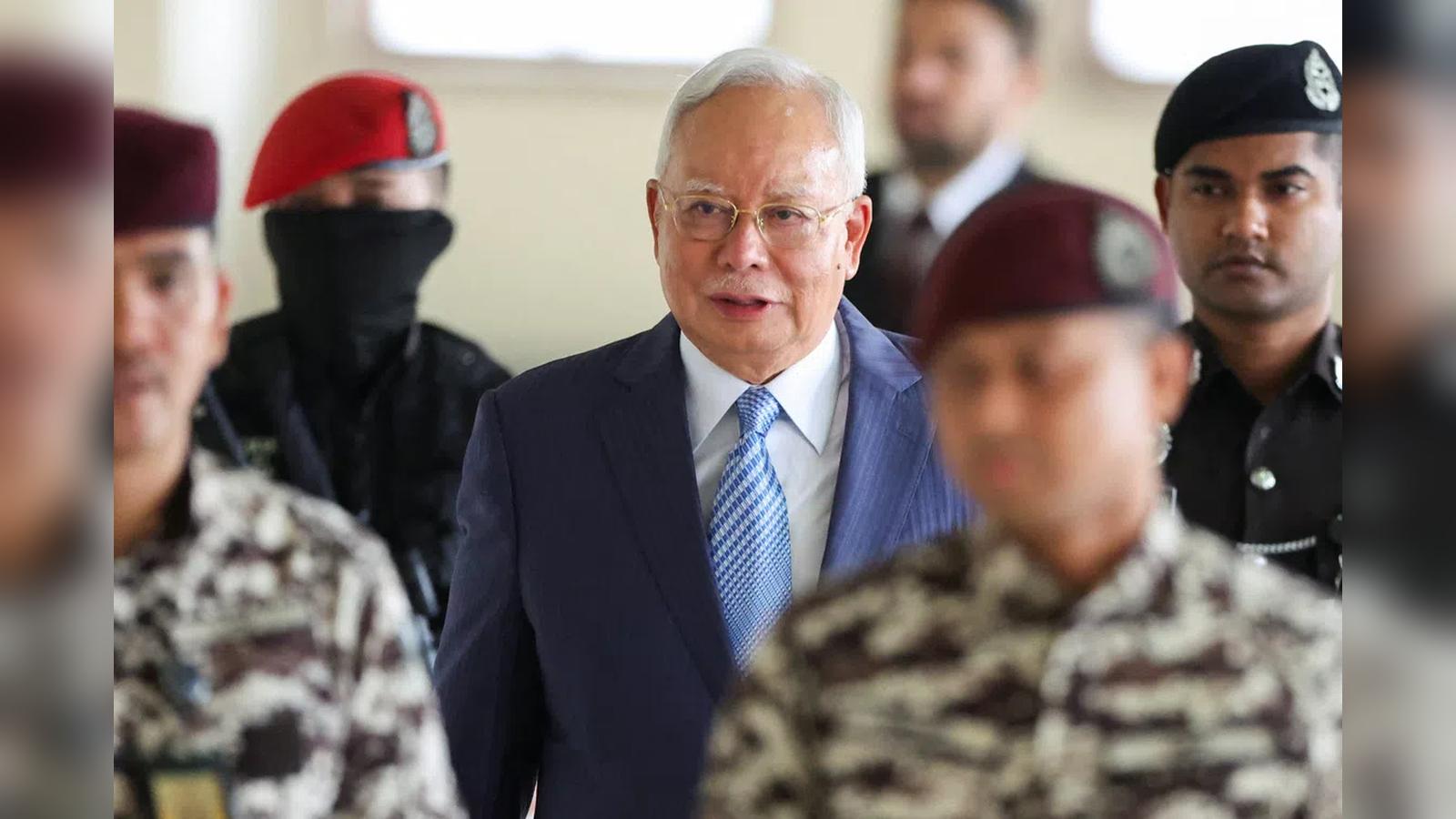
KUALA LUMPUR (Azat TV) – Former Malaysian Prime Minister Najib Razak faced immediate legal limbo on November 6, 2026, when the Attorney General’s office temporarily suspended his transition from Kajang Prison to house arrest, just hours after his political party announced it had settled a mandatory RM50 million ($15.7 million) fine reported by The Straits Times. The sudden reversal highlights an intense institutional clash between royal prerogative and judicial enforcement in Southeast Asia, unfolding around the central figure of the multi-billion-dollar 1Malaysia Development Berhad (1MDB) corruption scandal.
Hours prior to the suspension, Deutsche Welle reported that the United Malays National Organization (UMNO) successfully completed the payment via a public “Solidarity Fund.” Party officials announced that the crowdfunding campaign had achieved its target, prompting legal representatives to secure transfer documentation. Eyewitnesses outside Kajang Prison observed a silver vehicle carrying the 73-year-old former leader departing the compound, while police established security cordons and traffic restrictions near his upscale Kuala Lumpur residence.
However, the Attorney General’s office intervened shortly thereafter, issuing a temporary freeze on the transfer. Authorities cited the necessity to clarify outstanding legal interpretations surrounding the specific conditions attached to the royal pardon granted by King Sultan Ibrahim in September. Consequently, Najib’s detention status at Kajang Prison was maintained, leaving his immediate freedom contingent on subsequent judicial and administrative reviews.
The 1MDB Conviction and Pardon Background
Najib’s legal battle stems from his July 2020 conviction on abuse of power, criminal breach of trust, and money laundering charges involving SRC International, a former 1MDB subsidiary. Prosecutors established that millions were siphoned into personal accounts to finance luxury assets, real estate, and high-end art. Initially sentenced to 12 years behind bars, his prison term was subsequently halved by a pardons board, and his financial penalty was reduced to RM50 million, set to conclude in August 2028.
The conditional royal pardon issued by King Sultan Ibrahim stipulated that Najib could serve the remainder of his shortened sentence under house arrest, provided the financial penalty was fully satisfied. UMNO’s decision to establish the “Solidarity Fund” bypassed initial judicial resistance from late 2025, when a Malaysian court previously rejected a petition allowing him home detention. Party secretary-general Asyraf Wajid Dusuki confirmed the formal closure of the fundraising account following the high court transaction.
Broader Legal Stakes and Outstanding Penalties
The suspension underscores the severe complexities governing high-level political corruption cases in Malaysia. Beyond his current six-year sentence, Najib faces an additional 15-year prison term and an astronomical RM11.4 billion fine handed down in a separate 1MDB-linked trial. That subsequent sentence is slated to commence only after the completion of his primary term, and it remains under active legal appeal.
Investigators and prosecutors continue to track the wider fallout of the 1MDB scandal, which drained approximately $4.5 billion from the state-backed investment vehicle via intricate web structures and shell companies. While domestic proceedings entangle several former officials and Najib’s wife, Rosmah Mansor, fugitive financier Jho Low remains at large as the alleged mastermind of the international financial heist.
Institutional Friction and Next Steps
The Attorney General’s intervention exposes deep fault lines between executive royal decrees and prosecutorial oversight. As legal experts scrutinize the exact wording of the royal pardon conditions, Najib remains confined to Kajang Prison. The coming days will require a definitive legal ruling from government authorities to determine whether the settled fine fulfills all prerequisite terms for home detention, or if further judicial hurdles will prolong his incarceration.