


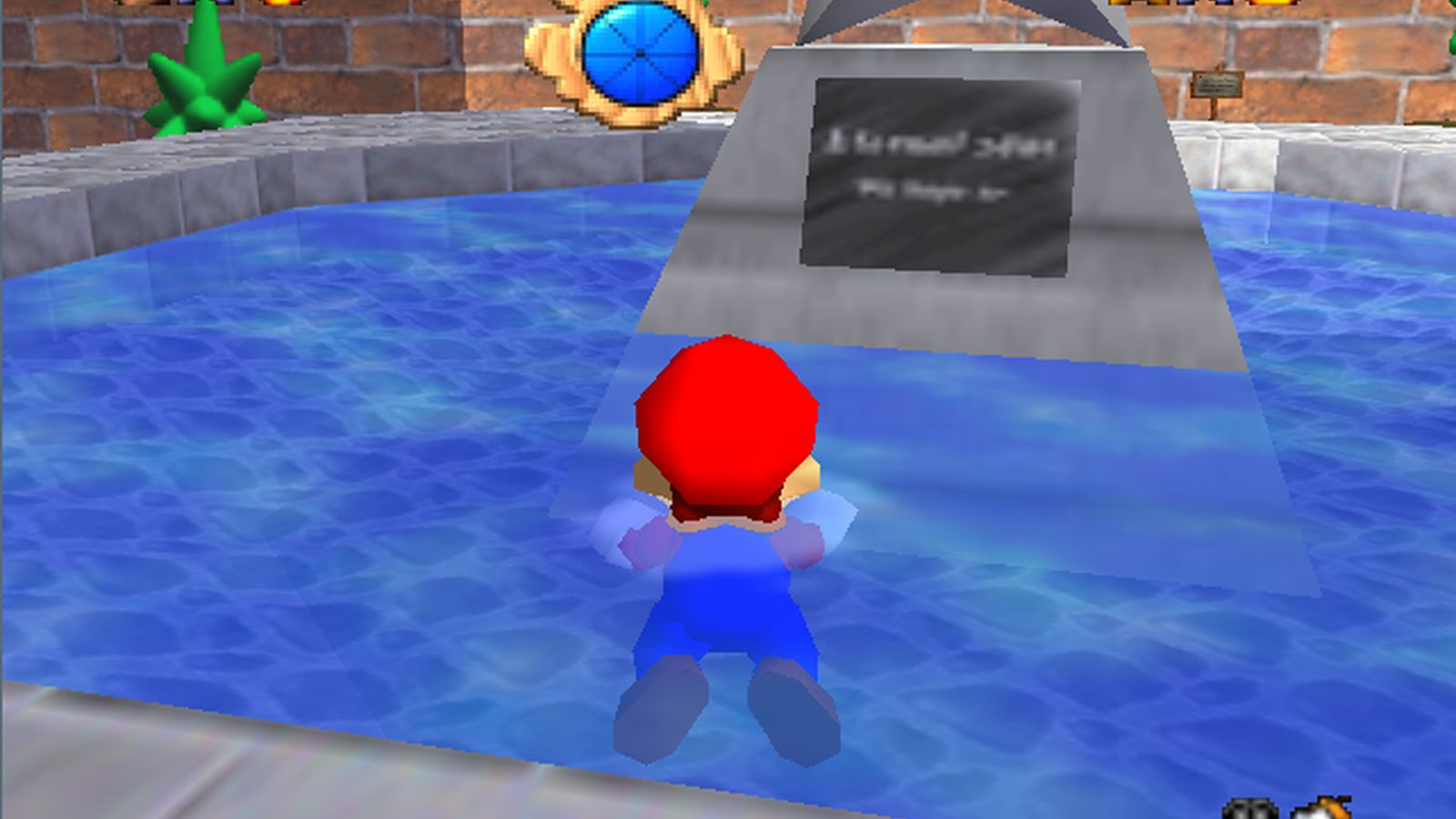
An open-source computational reconstruction developed by independent programmer Mochi64 has systematically resolved a 30-year-old texture mystery on Peach’s Castle courtyard fountain in Nintendo’s landmark 1996 platformer Super Mario 64. Running comparative analysis against an exhaustive database of over 1.2 million words, the algorithm determined that the low-resolution plaque texture reads “Eternal Star” on the top line and “We Hope So” on the bottom line, decisively disproving the long-standing “L is Real 2401” community myth. The revelation delivers technical clarity to retro-gaming archivists and collectors operating across original Nintendo 64 hardware, the Super Mario 3D All-Stars compilation on Nintendo Switch, and PC-based recompilation projects running on handhelds like the Steam Deck and ROG Ally.
Computational Reconstruction of the 32-Pixel Asset
Because the in-game plaque texture is rendered onto a diminutive 32×32 pixel asset where text characters occupy a vertical height of merely 3 to 5 pixels, traditional spatial upscaling techniques produce subjective visual artifacts rather than legible typography. To eliminate artistic conjecture, Mochi64 designed an open-source evaluation suite executing millions of calculations, testing historical font types and downsampling pipelines that Rockstarmedia.com.my reports Nintendo EAD graphic designers deployed in the mid-1990s. The phrase “Eternal Star” paired with “We Hope So” scored a benchmark mismatch index of 1,129, whereas the mythological “L is Real 2401” registered an inferior mismatch penalty of 2,031 on its initial line alone.
Origins of the Luigi Inscription Myth
Players believed the fountain plaque referenced unlocking Luigi because director Shigeru Miyamoto confirmed that Mario’s brother was originally developed as a playable cooperative character until memory bottlenecks forced his removal during the final year of production. The illegible texture was interpreted by fans as an intentional cryptographic clue. The urban legend proliferated across early web hubs, prompting IGN to place a US$100 bounty in 1996 for unlocking Luigi, while Nintendo Power featured the “L is Real 2401” riddle in an April Fool’s feature in 1998. Archival documentation verifies that Luigi was fully functional in pre-release builds, backed by Space World 1995 trade demonstration footage and the monumental 2020 Nintendo source code leak which unearthed the original 64-bit polygonal Luigi asset.
Collector Impact Across Hardware Formats
For collectors, authentic preservation of Super Mario 64 presents stark differences between native cartridge silicon and scalable digital distribution. The native Japanese N64 cartridge, originally retailing for ¥9,800, remains readily obtainable via specialist importers for approximately RM90 to RM160 loose. However, NTSC-J cartridges do not contain English menu text or dialogue, requiring an NTSC-U North American cartridge or regional console tray modification to run on regional composite displays. Modern players prioritize the physical Nintendo Switch compilation, Super Mario 3D All-Stars. While Nintendo retired production of this physical release, regional physical copies retain complete English language support on-cartridge with zero mandatory regional downloads.