


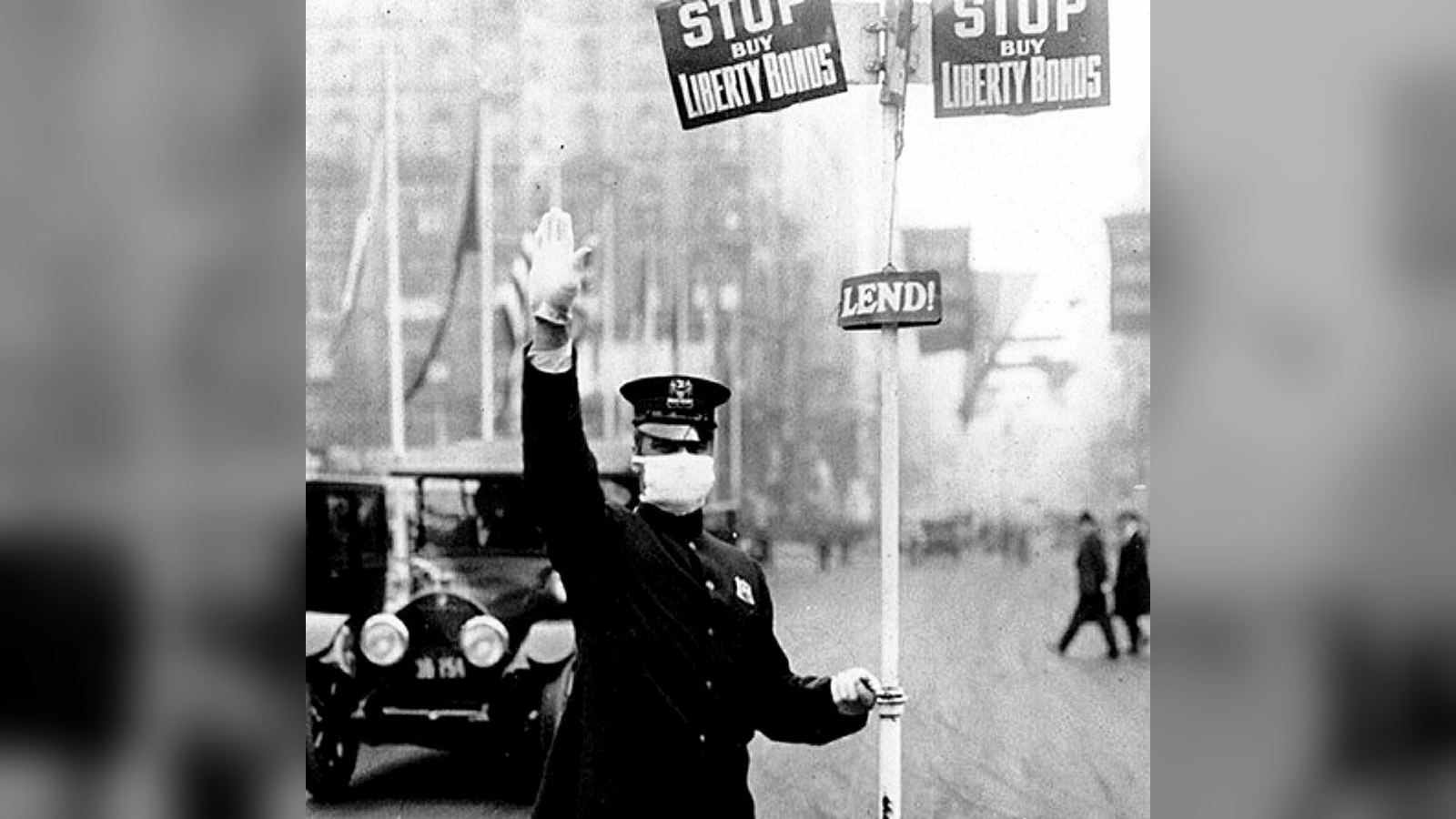
What the photograph shows
The photograph presents a stark, singular image: a New York City traffic policeman standing at his post in the autumn of 1918. His uniform is pristine, reflecting the professional discipline required of a law enforcement officer, yet his face is obscured by a rudimentary, white gauze mask. His posture is rigid and alert, his gaze fixed forward as if scanning the street for potential trouble. The mask, tied behind his ears with simple elastic or tape, serves as the undeniable focal point of the frame, marking this as an artifact of the 1918 influenza pandemic. In the background, the blurred outlines of early 20th-century New York architecture and the presence of street traffic suggest a city desperately trying to maintain its rhythm amidst a global health catastrophe. The contrast between his standard police attire—a symbol of authority—and the medical gauze—a symbol of vulnerability—creates a tension that defines the era.
The moment behind the image
In the autumn of 1918, New York City was in the throes of the second, most lethal wave of the influenza pandemic. The city was navigating a precarious balance: maintaining the war effort while preventing total societal collapse. Policemen were among the most exposed workers, tasked with directing traffic and maintaining order while the virus spread through crowded tenements, public transit, and bustling avenues. This photograph captures a moment of forced adaptation. Before this shutter click, the officer likely spent hours navigating the thick city air, filled with the invisible miasma of the flu. After the image was taken, he would continue his shift, likely unaware that he was being documented as a symbol of public health resilience. He represents the thousands of front-line workers who, despite the lack of vaccines or effective viral treatments, stood at their posts to ensure the city did not descend into chaos.
Photographer and provenance
While the specific identity of the photographer remains uncredited in many archives, such images were frequently commissioned by the city’s Board of Health or captured by wire service photographers tasked with documenting the ‘new normal.’ These photographs were designed to circulate in newspapers and public pamphlets to normalize mask-wearing. The provenance of such images is often tied to the National Archives or the Library of Congress, which house extensive collections of public health records from the era. The lack of a specific name behind the lens reflects the nature of early 20th-century photojournalism, where the mission—documenting the crisis for public safety—often took precedence over individual artistic attribution. The photograph survives today as a testament to an era where the camera was the only tool available to capture the invisible spread of a killer virus.
Historical context
The 1918 influenza pandemic was a global catastrophe, yet New York City’s experience was unique. While cities like Philadelphia were overwhelmed—with bodies piling up in morgues and makeshift hospitals—New York’s death toll was comparatively lower. Historians point to the city’s established public health system, which was already battle-hardened by decades of fighting tuberculosis and other urban diseases. The Board of Health implemented aggressive ventilation strategies, even encouraging schools to keep windows open during winter. The slogan, ‘Better to be ridiculous than dead,’ was a calculated psychological tactic to combat the natural human resistance to wearing face coverings in public. This was a time before the widespread availability of antibiotics or effective flu vaccines, making social mitigation—masking, distancing, and hand-washing—the only defenses available to the population.
Why it still matters
This photograph is more than a relic; it is a mirror. The parallels between the 1918 experience and the COVID-19 pandemic are striking. The debates over mandates, the resistance to masks, and the struggle to balance economic life with public safety have not changed in over a century. By looking at this masked officer, we see the human cost of a crisis that relies on individual compliance for collective survival. The image serves as a permanent reminder that in the face of a pandemic, the most effective tools are often the simplest. The burden of enforcement often falls on those on the front lines, and this anonymous officer stands as an enduring symbol of the quiet, disciplined, and essential labor required to navigate a world in crisis. He reminds us that even in the darkest times, the structures of society—and the individuals who uphold them—must find ways to adapt and persevere.