


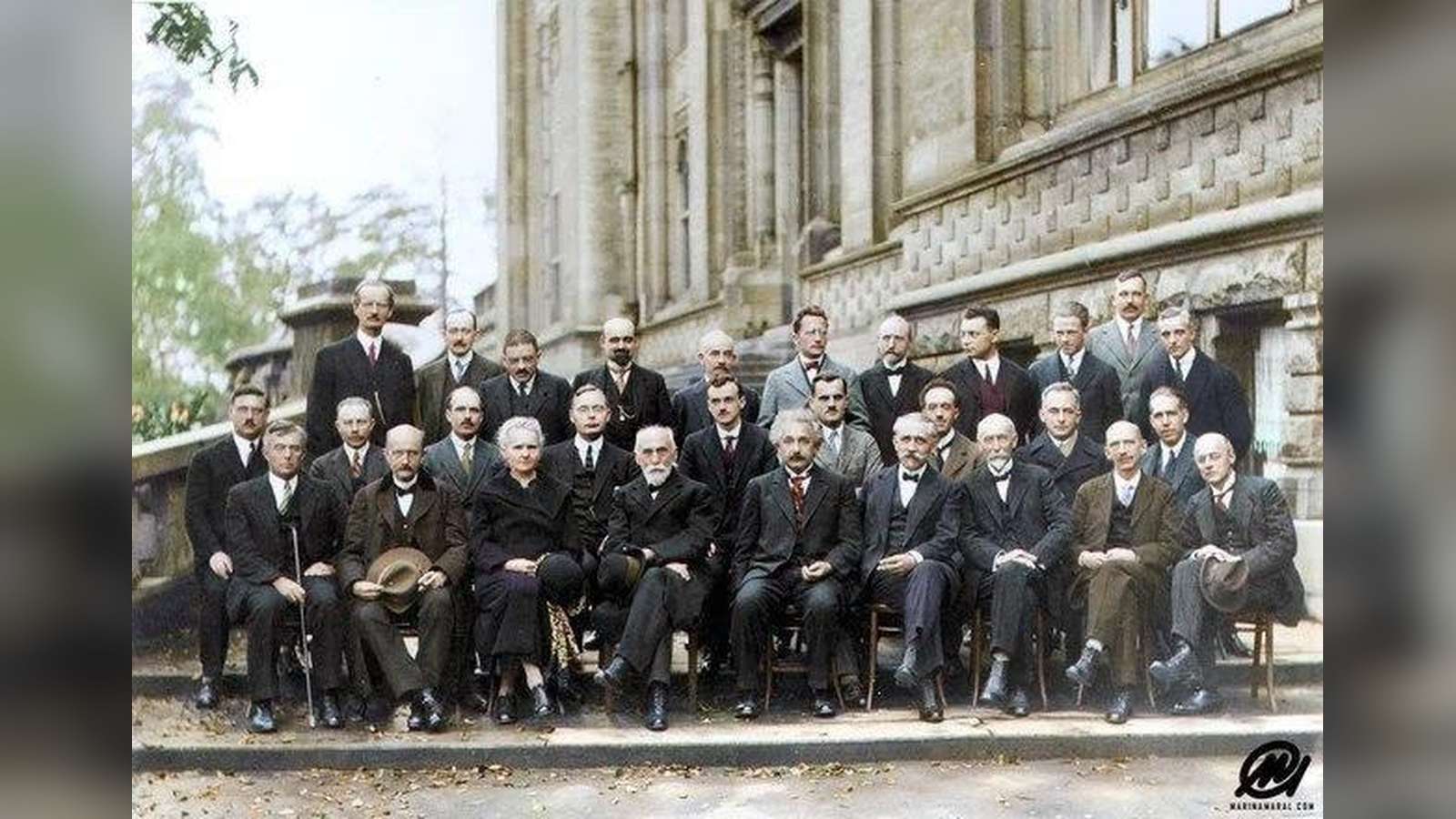
At first glance, the photograph looks like a typical, albeit large, assembly of early 20th-century academics. Twenty-nine individuals dressed in formal dark overcoats, suits, and stiff collars pose against the cold stone facade of a classical building. Yet, this single black-and-white image is widely considered the most intellectually dense photograph ever captured. Taken during a chilly week in October 1927, it captures a fleeting moment of unity among the architects of modern physics just as they were about to permanently fracture into opposing ideological camps. This article will explore the visual details of this historic portrait, the intense intellectual battle that was raging when the shutter clicked, and how this specific image became the defining visual monument of the quantum revolution.
What the photograph shows
The composition of the photograph is structured in three neat rows, a standard format for official group portraits of the era. However, a closer look at the faces and postures reveals a fascinating map of scientific history. In the front row, seated fifth from the left, sits Albert Einstein. He is positioned almost exactly in the center of the frame, wearing a heavy overcoat and sporting his trademark untamed hair, looking directly into the lens with a faint, knowing smirk. To his right sits Hendrik Lorentz, the elder statesman of physics who presided over the conference, and to Lorentz’s right is Marie Curie. Seated third from the left, Curie is the only woman in the photograph. Clad in a simple, dark dress, she sits slightly turned away from the camera, her expression pensive and detached, holding a piece of paper. To her right is Max Planck, the father of quantum theory, looking solemn and resolute.
In the middle row, standing on the far right, is Niels Bohr, his tall frame leaning slightly forward, projecting a quiet but imposing intellectual authority. In the same row, fifth from the left, is Paul Dirac, looking remarkably young and intense, while Louis de Broglie stands seventh from the left, representing the French contribution to the wave-particle duality. The back row features the younger generation of radical theorists who were actively dismantling classical physics. In the center of the back row stands Erwin Schrödinger, recognizable by his round spectacles and bow tie. To his right are Wolfgang Pauli and Werner Heisenberg, the brilliant and fiercely competitive pioneers of matrix mechanics and the uncertainty principle. The contrast between the older, seated generation of classical physicists and the younger, standing generation of quantum rebels is visually striking, capturing a literal passing of the torch.
The moment behind the image
The photograph was taken outside the Institute of Physiology in Leopold Park, Brussels, during the Fifth Solvay International Conference on Physics, which took place from October 24 to 29, 1927. The theme of the conference was “Electrons and Photons,” a topic that lay at the absolute center of the newly formulated quantum mechanics. While the formal sessions inside the lecture halls were highly structured, the true drama unfolded during the informal discussions, lunches, and walks between the hotel and the institute. This was the arena of the legendary Einstein-Bohr debates.
Immediately before and after this photograph was taken, the attendees were locked in a profound philosophical struggle. Einstein, a scientific realist, was deeply unsettled by the probabilistic nature of quantum mechanics, famously arguing that “God does not play dice” (or as he put it, “an inner voice tells me that it is not yet the real thing”). Bohr, leading the “instrumentalists” or the Copenhagen school of thought, countered that physicists should focus on what can be measured rather than speculating on an underlying objective reality. He famously responded to Einstein’s objections by telling him, “Einstein, stop telling God what to do.” The photograph captures these men in the midst of this intellectual chess match, which lasted for days. Bohr used Einstein’s own theory of relativity to systematically dismantle Einstein’s thought experiments designed to disprove the Heisenberg Uncertainty Principle, ultimately winning the intellectual consensus of the conference.
Photographer and provenance
The photograph was taken by Benjamin Couprie, a prominent Belgian portrait photographer who was regularly commissioned by the International Solvay Institutes to document their gatherings. Couprie operated under the constraints of early 20th-century outdoor group photography, utilizing a large-format camera that required the subjects to remain perfectly still for several seconds. The overcast Belgian sky provided a soft, diffused light, preventing harsh shadows on the faces of the scientists but adding to the serious, almost somber atmosphere of the image.
The photograph was commissioned by the Solvay Institutes, which had been founded in 1912 by the wealthy Belgian industrialist Ernest Solvay. Solvay’s goal was to facilitate elite, invite-only conferences to tackle the most pressing questions in physics and chemistry. After the 1927 conference, the image was distributed to the participants and preserved in the Solvay archives in Brussels. Over the decades, as the theories formulated during that week became the bedrock of modern technology—from semiconductors to lasers—the image transitioned from a private institutional record to a globally recognized symbol of human genius. In recent years, high-resolution digital restorations and colorized versions of Couprie’s photograph have gone viral online, introducing a new generation to the faces behind the quantum revolution.
Historical context and the quantum split
To understand the gravity of the 1927 photograph, one must realize that the scientific world was undergoing its most violent paradigm shift since Isaac Newton. Classical physics, which assumed a predictable, deterministic universe, was failing to explain the behavior of matter at the subatomic level. The 29 scientists in the frame were not merely discussing abstract math; they were redefining the very nature of reality.
Of the 29 individuals captured by Couprie, 17 were already or would soon become Nobel Prize laureates. Marie Curie had already won two (Physics in 1903, Chemistry in 1911). Einstein had won his in 1921, Planck in 1918, and Bohr in 1922. In the years following the photograph, the younger men in the back row would dominate the Nobel stage: Heisenberg in 1932, Schrödinger and Dirac in 1933, and Pauli in 1945. The intellectual concentration in this single space was unprecedented. The conference marked the moment where the Copenhagen interpretation of quantum mechanics, championed by Bohr, Heisenberg, and Born, became the dominant scientific paradigm, despite Einstein’s lifelong reservations.
Why it still matters
The 1927 Solvay Conference photograph remains memorable because it humanizes a scientific revolution. It places faces, expressions, and personal dynamics onto formulas that students now memorize in textbooks. We see Schrödinger’s polite smile, Einstein’s skeptical gaze, and Curie’s quiet dignity. It stands as a monument to a brief era when the world’s greatest minds could gather in a single room to debate the fundamental laws of the universe, resolving their profound disagreements through rigorous, civil, and face-to-face discourse. In an era of hyper-specialized and highly decentralized science, the 1927 portrait remains a powerful, nostalgic reminder of what collective human intellect can achieve when focused on a single, transcendent question.