


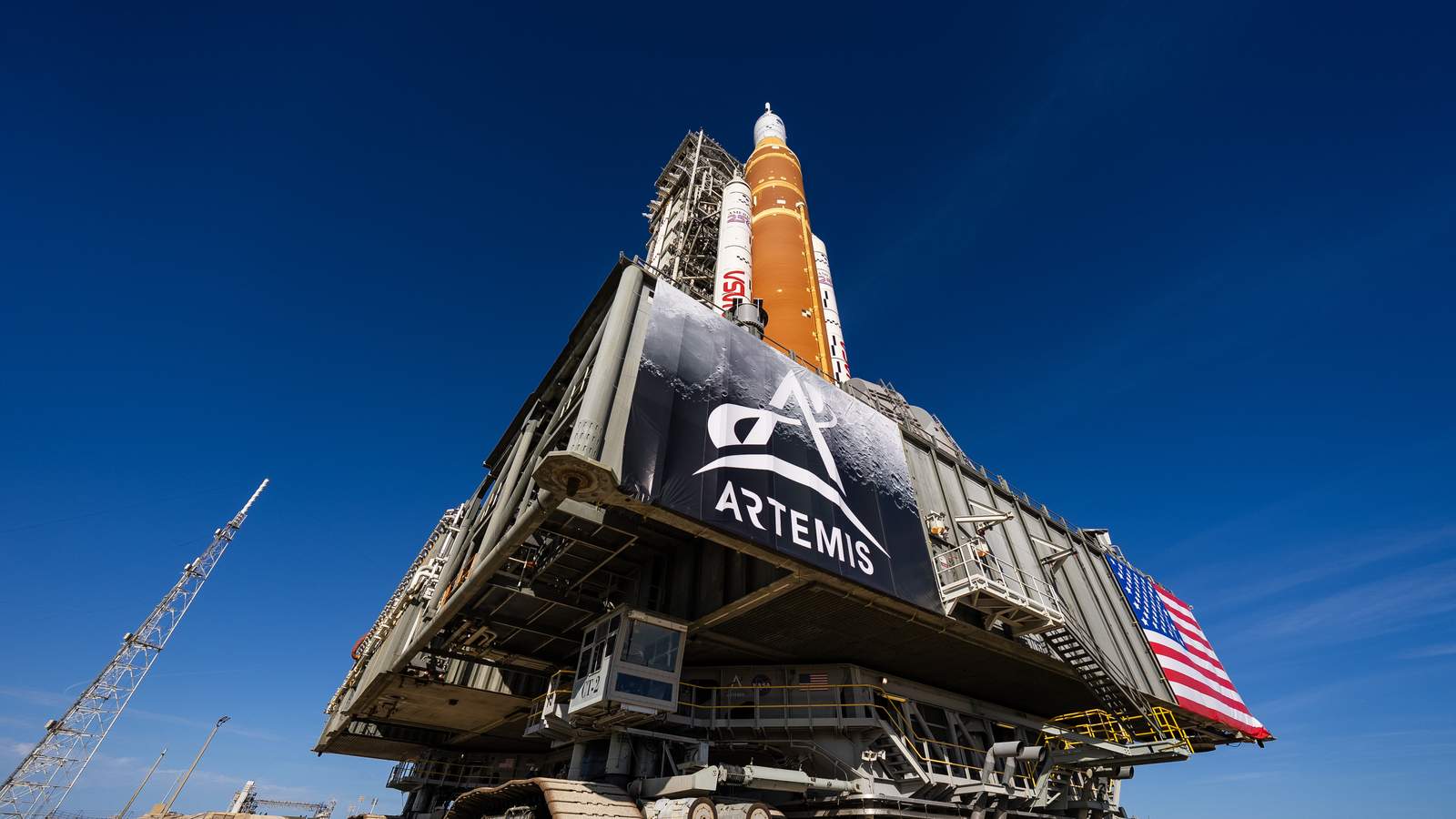
WASHINGTON (Azat TV) – NASA’s Artemis II mission, the first crewed journey around the Moon in over half a century, is poised for launch as early as February 6, 2026, following a critical fueling test this week at Florida’s Kennedy Space Center. This landmark mission, carrying four astronauts, is set to rigorously test the Space Launch System (SLS) rocket and Orion capsule together for the first time with humans aboard, marking a vital step toward establishing a long-term human presence on the Moon and eventually Mars.
The 10-day flight will send Commander Reid Wiseman, Pilot Victor Glover, Christina Koch, and Canadian Space Agency astronaut Jeremy Hansen farther than any astronauts before them, reaching approximately 4,600 nautical miles beyond the Moon. Their Orion capsule, which the crew has named Integrity, is designed to push the boundaries of human spaceflight, testing systems and procedures crucial for subsequent lunar landings and deep-space exploration.
Artemis II: A Return to Lunar Orbit
Artemis II represents a pivotal moment in NASA’s ambitious Artemis program, which aims to return humans to the lunar surface and build a sustainable presence there. Unlike the Apollo missions, which landed astronauts on the Moon, Artemis II will orbit the Moon without landing, focusing instead on validating the Orion spacecraft’s life support systems and the SLS rocket’s performance in a crewed environment. The mission will also allow the crew to practice operations essential for future missions, including Artemis III, which is slated to land astronauts on the lunar south pole.
The crew, currently in quarantine at the Johnson Space Center in Houston to avoid illness before flight, will conduct a series of tests and checks, including the critical Trans-Lunar Injection (TLI). This maneuver will place Orion on a free-return trajectory, a key safety feature that would allow Earth’s and the Moon’s gravity to swing the spacecraft back home even if later engine burns fail, as noted by Judd Frieling, the Artemis II ascent flight director.
The SLS, built by Boeing and Northrop Grumman, stands at 322 feet and is one of the most powerful rockets in the world, capable of sending more than 27 metric tonnes of payload to the Moon. The Artemis II mission will be the first time humans experience its immense power.
Addressing Artemis II’s Deep Space Challenges
The journey beyond Earth’s orbit presents significant risks that NASA engineers and the crew have meticulously prepared for. One primary concern is radiation exposure. As Orion travels beyond the protective Van Allen belts, astronauts will be exposed to a far more hostile environment, especially with the sun nearing the peak of its 11-year activity cycle. Radiation sensors are installed in Orion, and astronauts will wear personal measurement devices. In the event of a solar eruption, the crew can shelter in a shielded compartment beneath the capsule’s floor, using stowage bags for added protection, according to Mark Clampin, NASA’s deputy associate administrator for science.
Communication blackouts are another challenge. During Orion’s closest pass around the Moon, the spacecraft will temporarily lose radio contact with Earth for about 45 minutes as it passes behind the lunar far side. While planned, unexpected communication losses, like the 4.5-hour blackout during the uncrewed Artemis I mission due to aging hardware at the Goldstone Complex, remain a concern. NASA officials affirm that modifications and backup systems are in place, and a major antenna offline since an accident will not affect Artemis II communications.
The re-entry phase also carries scrutiny. During Artemis I, portions of Orion’s heat shield showed unexpected charring. An investigation concluded the shield performed its function, but gases built up faster than anticipated in some areas. While officials like Amit Kshatriya, a senior NASA official, stated it would not have harmed a crew, NASA has adjusted Artemis II’s re-entry plan. By targeting a splashdown closer to San Diego, California, instead of Baja California, engineers aim to reduce stress on the heat shield during the hottest portion of descent, as explained by John Honeycutt, who leads NASA’s mission management team.
Final Preparations and Launch Window for Artemis II
Committing to an official launch date for Artemis II hinges on the successful completion of several critical pre-flight milestones. A key event is the wet dress rehearsal, a mock launch countdown involving the fueling of the SLS rocket with 700,000 gallons of cryogenic propellants. This test was scheduled to begin operations on January 29, 2026, with a simulated liftoff on January 31. If this test proceeds smoothly, NASA could proceed toward the earliest launch window.
Following the wet dress rehearsal, mission engineers must complete a flight readiness review, assessing various factors including the spacecraft’s status. NASA has outlined several potential launch windows for Artemis II:
- Launch period Jan. 31-Feb. 14, with opportunities Feb. 6-8 and Feb. 10-11
- Launch period Feb. 28-March 13, with opportunities March 6-9 and March 11
- Launch period March 27-April 10, with opportunities April 1 and April 3-6
The earliest possible launch date is February 6, according to official statements from NASA and reports from USA Today.
Beyond Artemis II: Paving the Way for Lunar Settlements
Artemis II is more than just a trip around the Moon; it is a foundational mission for NASA’s long-term vision of establishing a continuous human presence on the lunar surface. The program aims to create a lunar settlement, potentially at the Moon’s south pole, where abundant water ice could be extracted for drinking, breathing, and as a source of hydrogen and oxygen for rocket fuel.
The inclusion of a Canadian astronaut, Jeremy Hansen, underscores the international collaborative nature of the Artemis program. The Artemis Accords, an international agreement framework, emphasize that cooperation in space exploration not only bolsters scientific discovery but also enhances peaceful relationships among nations, a necessity highlighted by Gordon Osinski, a Professor in Earth and Planetary Science at Western University.
The successful execution of Artemis II will validate crucial technologies and operational procedures, providing invaluable data and experience that will directly inform and enable the more complex crewed lunar landings planned for Artemis III and beyond, thereby accelerating humanity’s return to and sustained presence on the Moon and opening pathways for future missions to Mars.