


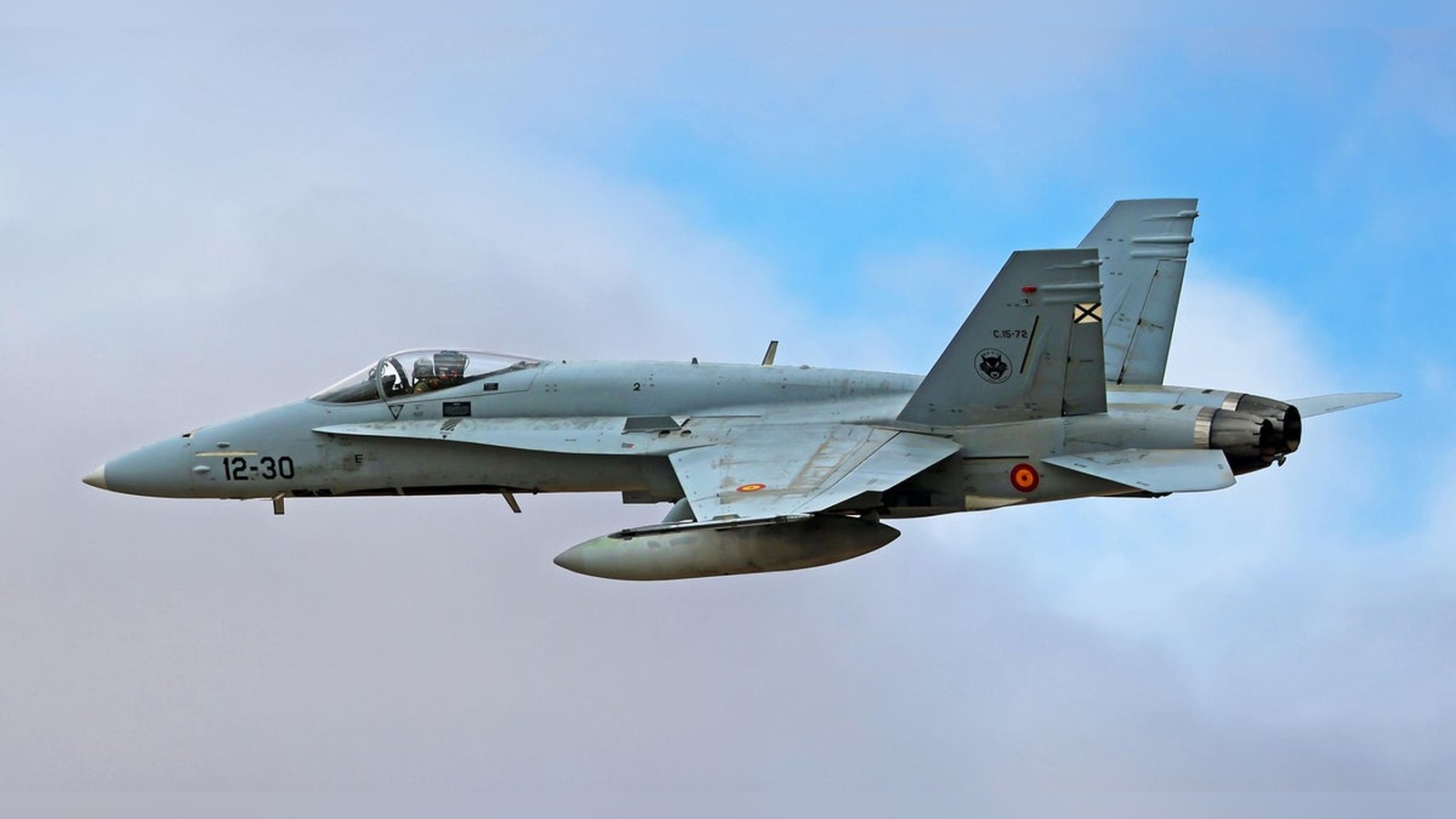
A Spanish F-18 fighter jet operating under NATO’s air policing mission intercepted and shot down an unmanned aerial vehicle early Sunday morning after it violated Romanian airspace near the borders of Moldova and Ukraine. According to Romania’s Ministry of National Defence, the aerial breach occurred shortly before dawn, prompting air defense tracking systems to launch active countermeasures in the eastern frontier region.
Military radars detected the target entering Romanian airspace from neighboring Moldova at approximately 5:01 a.m. local time (0201 GMT), roughly 24 kilometers north of Galati, a southeastern Romanian city near the Danube River. The Spanish jet, stationed in the region as part of NATO’s enhanced air surveillance capabilities, successfully engaged the drone. Defense officials confirmed that wreckage from the destroyed aircraft fell into an unpopulated rural zone between two local villages, resulting in no reported casualties or structural damage on the ground.
Rising Frequency of Airspace Incursions
While Romanian authorities did not immediately release formal technical specifications regarding the downed craft, regional security officials indicated that preliminary assessments point to a Russian-origin drone. The incident reflects a persistent pattern of spillover from ongoing military operations along the Black Sea corridor and Ukrainian river ports, where long-range strike drones frequently operate in close proximity to NATO sovereign territory.
Romania shares a 614-kilometer (381-mile) border with Ukraine and has experienced recurring airspace disruptions over the past four years. In May 2026, a Russian strike drone crashed directly into a residential apartment building in Galati during an overnight raid against Ukrainian infrastructure across the river, injuring two civilians. Last month, Romanian air defense forces executed their first active kinetic downing of an intruding drone since 2022 after tracking an unidentified craft nearly 100 kilometers inland toward Bucharest.
Regional Air Defense and Electronic Warfare Complexities
The interception follows similar high-altitude encounters across NATO’s eastern periphery. Just two days prior, Italian fighter jets participating in the alliance’s Baltic air-policing network downed an intruding drone over Latvian airspace. Additionally, neighboring Bulgaria launched an official inquiry after an unmanned aerial vehicle crossed from Romanian airspace and exploded near an international natural gas pipeline, an event Ukrainian military authorities attributed to intense electronic warfare and signal spoofing near combat zones.
Defense analysts note that severe electronic jamming along the Ukrainian frontline frequently disrupts satellite navigation systems, causing both Russian strike munitions and Ukrainian defense drones to veer off course. Military officials emphasize that whether incursions stem from deliberate targeting, navigational drift, or signal hijacking, the presence of foreign armed drones over alliance airspace requires immediate identification and neutralization by quick-reaction interceptor flights.
NATO Defense Posture on the Black Sea Flank
The successful interception highlights NATO’s heightened operational readiness along its southeastern border. Alliance air policing assets, including rotated fighter squadrons from Spain, Italy, and other member states, maintain continuous radar coverage and scramble readiness across the Black Sea littoral to protect civilian airspace and strategic energy corridors.
Romanian military specialists and allied defense teams are conducting recovery operations at the crash site in Galati to retrieve telemetry equipment and structural debris. The recovered fragments are expected to undergo forensic analysis to determine the drone’s specific flight trajectory, launch origin, and payload configuration as NATO reviews its border protection protocols along the eastern front.