


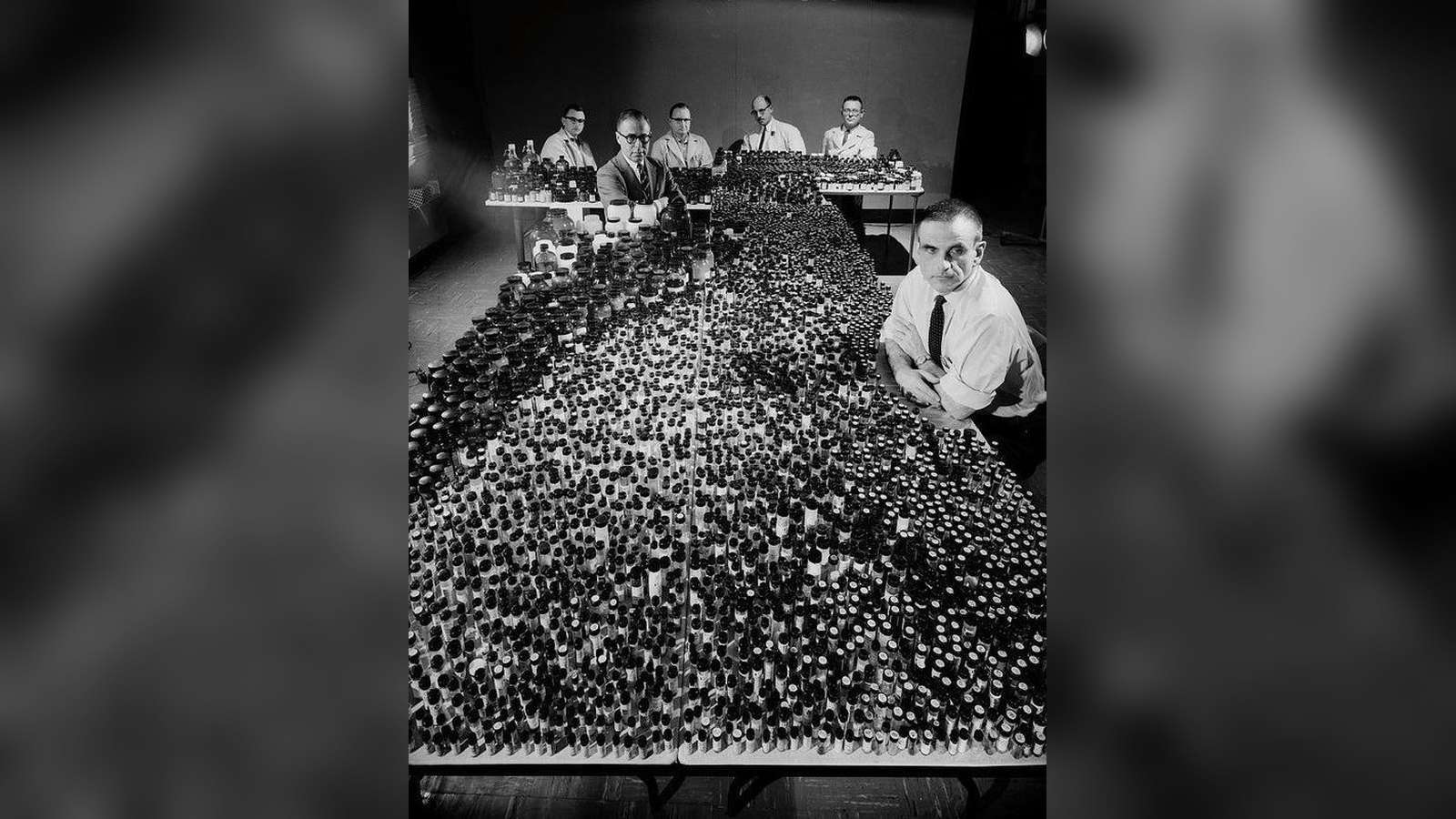
In this extraordinary studio portrait from 1963, Polaroid Corporation’s Director of Research, Howard G. Rogers, stands surrounded by a staggering sea of small glass bottles. Arranged in neat rows that stretch across tables and shelving into the background, the five thousand chemical containers represent fifteen years of relentless laboratory experimentation. The image is not merely a portrait of an engineer; it is a conceptual landmark that turns abstract scientific persistence into a dramatic visual spectacle, asking the viewer to consider how much invisible labor goes into making an instant color photograph possible.
What the photograph shows
The photograph presents a meticulously staged visual archive of scientific trial and error. In the foreground and middle distance, thousands of small brown and clear reagent bottles are organized in tight grid formations. Standing calmly among these thousands of vials is Howard G. Rogers, dressed in mid-century laboratory attire—a suit, crisp white shirt, and necktie—looking directly toward the camera with understated pride. The illumination highlights the repetitive glass shapes, creating a pattern of light and reflection that emphasizes scale. Every bottle in the frame contained a distinct chemical compound, reaction attempt, or dye formulation synthesized during Polaroid’s journey to break past black-and-white instant photography into full color.
The moment behind the image
By 1963, Polaroid had already achieved world fame for its instant black-and-white cameras, but bringing vibrant, stable color prints out of a camera in sixty seconds remained one of industrial chemistry’s most formidable challenges. Black-and-white instant processing relied on a single layer of silver halide, whereas color required three distinct light-sensitive layers—sensitive to blue, green, and red light—plus matching dyes that had to migrate precisely without muddying one another. Rogers proposed a revolutionary concept: tethering a dye molecule directly to a developer molecule, creating what became known as a ‘dye developer.’ Testing this idea required synthesizing and evaluating over 5,000 separate molecular variants over a decade and a half to ensure correct timing, color brilliance, and structural stability.
Photographer and provenance
The image is attributed to Fritz Goro, the famed photojournalist for Life magazine who was widely regarded as the master of science photography in the mid-20th century. Goro was renowned for his technical ingenuity and ability to transform dense scientific achievements into vivid visual narratives that general magazine readers could grasp immediately. Taken in 1963 to coincide with Polaroid’s public rollout of its groundbreaking ‘Polacolor’ film, the photograph was commissioned to explain the sheer physical scale of the invention. Preserved in corporate and magazine archives, the photograph has frequently recirculated in historical retrospectives as an iconic symbol of mid-century industrial research.
Historical context: From B&W to Polacolor
The origin of Polaroid’s instant technology dates back to 1943, when company co-founder Edwin H. Land was on vacation and his three-year-old daughter asked why she could not see the picture he had just taken right away. Land launched black-and-white instant cameras in 1948, creating a commercial phenomenon. However, as traditional color prints became the consumer standard in the late 1950s, Polaroid faced intense pressure to adapt. Solving color was not just a chemistry problem, but a physical one inside the film pack. Beyond finding the right dye developers, Rogers’ team had to solve image permanence: residual alkaline developer solution threatened to destroy the final print. They solved this by incorporating a polymer acid layer that neutralized the alkali the moment development finished, forming pure water in the sheet and permanently locking the color dyes in place.
Why it still matters
Today, the 1963 image of Howard Rogers and his 5,000 chemical bottles stands as a powerful testament to the physical nature of early technology. In an era where digital image processing happens invisibly through software algorithms, Goro’s photograph reminds us that analog instant photography was an astonishing feat of micro-engineering and organic chemistry. The thousands of glass vials preserved in the frame serve as an enduring tribute to trial-and-error innovation, capturing the precise moment human patience successfully converted five thousand chemical questions into a single, instant color photograph.