


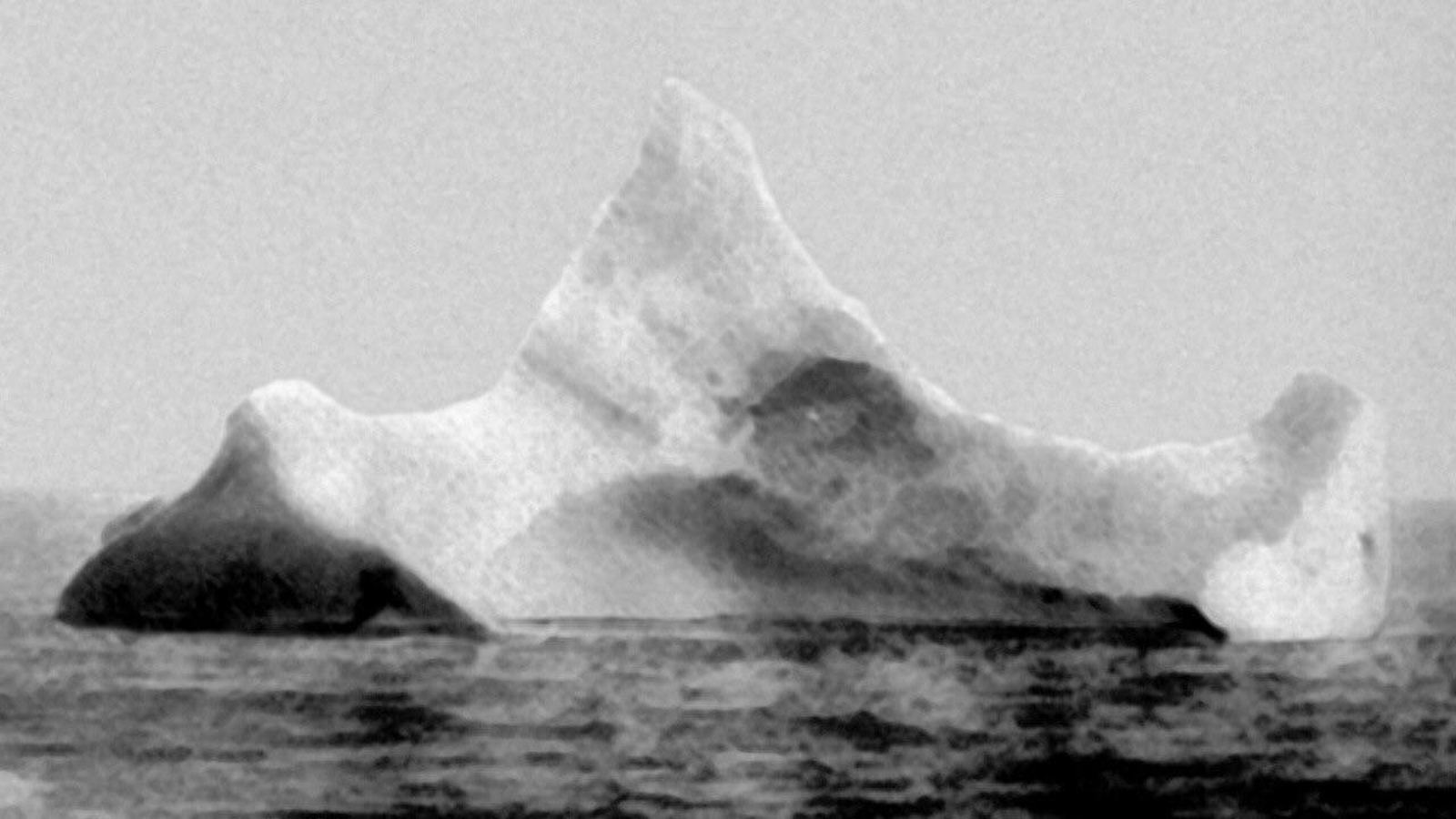
A solitary, jagged mass of ice rises from the dark, unforgiving swell of the North Atlantic, captured through the lens of a shipboard camera just hours after history’s most famous maritime catastrophe. This stark black-and-white photograph preserves a chilling sight: an imposing iceberg floating quietly in the open ocean currents, bearing an unmistakable crimson smudge along its waterline. This photograph asks the eternal question of visual evidence: can a single inanimate object encapsulate the immense human tragedy of a luxury liner that claimed over 1,500 lives?
What the photograph shows
In the center of the frame, a massive tabular and ridged iceberg cuts a sharp, jagged silhouette against the overcast horizon. The composition is stark and unadorned, highlighting the cold, indifferent majesty of the North Atlantic environment. Most crucially, a visible streak of dark red paint scars the lower flank of the ice structure near the waterline. According to the original documentation and signed statements accompanying the print, this reddish smear corresponds precisely in texture and color to the anti-fouling paint used on the hulls of large transatlantic ocean liners. This visual anomaly provides compelling forensic testimony suggesting that a massive vessel had scraped against this exact frozen barrier shortly before the camera shutter clicked.
The moment behind the image
The photograph was taken on the morning of April 15, 1912, by the chief steward of the German passenger steamer SS Prinz Adalbert. At the precise moment the shutter clicked, the crew and passengers of the Prinz Adalbert were entirely unaware that the RMS Titanic had struck an iceberg and sunk just hours earlier at approximately 02:20 that same morning. The steward noticed the strange red discoloration smeared across the ice face and, recognizing its unusual nature amidst the endless sea of white icebergs, decided to photograph the hazard. Surviving passengers of the Titanic later estimated that the iceberg responsible for the disaster stood roughly 98 feet high and 394 feet long, having broken off from a glacier in Greenland and drifted south into the busy shipping lanes.
Photographer and provenance
While the individual personal name of the chief steward remains unrecorded in mainstream public historical registries, his identity and the circumstances of the snapshot were verified by a formal, signed statement from himself and three other crew members aboard the Prinz Adalbert. The photograph’s long journey from a shipboard curiosity to a prized historical artifact is remarkably well-documented. Shortly after the Prinz Adalbert docked in port, the image was acquired by Burlingham, Montgomery & Beecher, a prominent New York law firm retained as legal counsel for the White Star Line, the parent company of the Titanic. Generations of maritime lawyers at the firm regarded the piece with reverence, hanging “The Titanic Iceberg” proudly on their office walls from 1913 until the firm finally closed its doors in 2002. In October 2015, the framed photograph and its accompanying signed crew statement were put up for public auction by Henry Aldridge & Son in Wiltshire, England, ultimately selling to a private collector for over $32,000.
Historical context
The sinking of the RMS Titanic on her maiden voyage from Southampton to New York remains a defining watershed of the 20th century. Striking an iceberg at 23:40 on April 14, 1912, just 37 seconds after it was spotted by lookouts in the crow’s nest who had been denied binoculars, the supposedly “unsinkable” luxury liner plunged beneath the waves in less than three hours. While numerous icebergs drifted across the North Atlantic shipping lanes that historic spring, few attracted the intense scrutiny, forensic interest, and cultural myth-making that surrounded this specific piece of ice. The Prinz Adalbert’s photograph stands as a rare intersection where casual maritime observation meets harrowing forensic evidence of human error, technological overconfidence, and elemental natural force.
Why it still matters
Over a century after the disaster, photographs from the immediate aftermath continue to command profound public fascination because they bridge the gap between abstract historical statistics and tangible reality. The red paint scraped against frozen water turns an invisible historical tragedy into a visceral, tactile encounter. It reminds contemporary viewers of the sheer vulnerability of human engineering when faced with the unforgiving and indifferent elements of the natural world.