


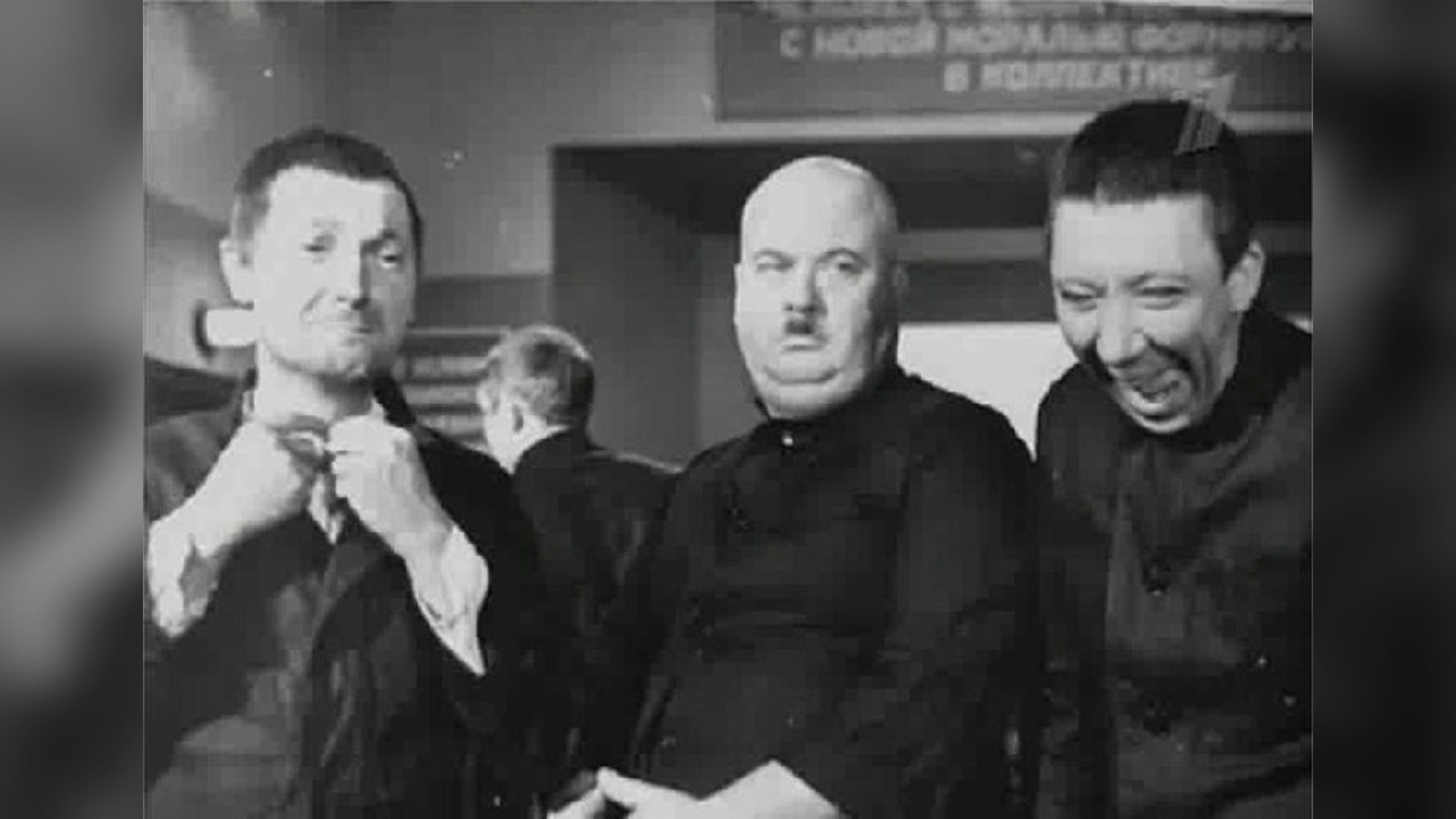
This rare, black-and-white archival photograph from the late 1960s offers a fleeting glimpse into one of the most intriguing “what-ifs” of Soviet cinema history. The image captures a set design and screen test for an unrealized sequel to Leonid Gaidai’s legendary comedy, “Kidnapping, Caucasian Style, or Shurik’s New Adventures” (Кавказская пленница, или Новые приключения Шурика). In the frame, we see the stark, simulated environment of a Soviet prison cell or courtyard, designed not for a grim drama, but as the backdrop for a sharp satirical comedy. The composition, characterized by dramatic studio lighting and institutional textures, was intended to house the next adventures of the iconic comedic trio—the Coward (Georgy Vitsin), the Fool (Yuri Nikulin), and the Pro (Evgeny Morgunov)—alongside their corrupt instigator, Comrade Saakhov (Vladimir Etush).
What the photograph shows
The photograph displays a meticulously constructed set representing a Soviet corrective facility. Unlike the vibrant, sun-drenched landscapes of the Caucasus that defined the original 1967 film, this visual document presents a confined, structured space. The geometric lines of the cell walls, the institutional doors, and the stark play of shadows create a visual irony: the ultimate space of state control transformed into a stage for slapstick and social satire. The image serves as the only physical evidence of a cinematic world that was fully conceived in the minds of its creators but never allowed to come to life on the silver screen.
The moment behind the image
Following the monumental success of “Kidnapping, Caucasian Style” in 1967, which attracted over 76 million viewers, screenwriters Yakov Kostyukovsky and Moris Slobodskoy, along with director Leonid Gaidai, began drafting a sequel. The proposed plot was daring: Comrade Saakhov, having been convicted for his crimes in the first film, is sent to a model Soviet penal colony—famously described in the treatment as “the most humane prison in the world.” In this facility, Saakhov rises to become the director of the prison’s amateur theatrical group. By a twist of comedic fate, the beloved criminal trio of Coward, Fool, and Pro are also incarcerated in the same prison, forced to perform under Saakhov’s theatrical direction. The photograph was taken during the early pre-production phase at Mosfilm studios, as the team tested the visual aesthetics of this controversial setting.
Photographer and provenance
The photograph originates from the production archives of the Mosfilm film studio in Moscow. Taken by an official unit photographer during the late 1960s, the image was intended for internal production records, casting considerations, and set design approvals. Because the project was abruptly canceled, the photograph was archived and remained largely unseen by the public for decades. It survived as part of the private collections of the film’s crew and official studio archives, eventually circulating among film historians as a testament to the lost treasures of Soviet cinema.
Historical context and censorship
Two major obstacles prevented this sequel from entering full production. The first was the formidable wall of Soviet state censorship. The State Committee for Cinematography (Goskino) was highly sensitive about any depiction of the Soviet penal system. Even though the script framed the prison as an idealized, highly educational, and “humane” institution, censors feared that making a comedy about Soviet incarceration would trivialize the state apparatus and invite unwanted political subversion.
The second, and perhaps more decisive, blow came from within the creative team itself. During the filming of the original “Kidnapping, Caucasian Style,” a severe personal and professional rift occurred between Leonid Gaidai and Evgeny Morgunov (who played “Pro”). Morgunov, known for his difficult temperament, reportedly showed up to a closed screening with a group of friends and behaved rudely toward the director. Furious, Gaidai cut several of Morgunov’s remaining scenes from the film and swore never to work with him again. Without the complete legendary Trio, and facing immense pressure from state censors, Gaidai chose to abandon the project entirely, turning his attention to his next masterpiece, “The Diamond Arm” (Бриллиантовая рука).
Why it still matters
This photograph remains a poignant relic of a lost cinematic masterpiece. It highlights the delicate balance Soviet filmmakers had to maintain between creative freedom, personal relationships, and state ideology. For fans of Gaidai’s work, the image offers a tantalizing look at an alternative history where the beloved characters continued their journey, proving that even behind the iron bars of a simulated prison, Soviet comedy knew no bounds.