


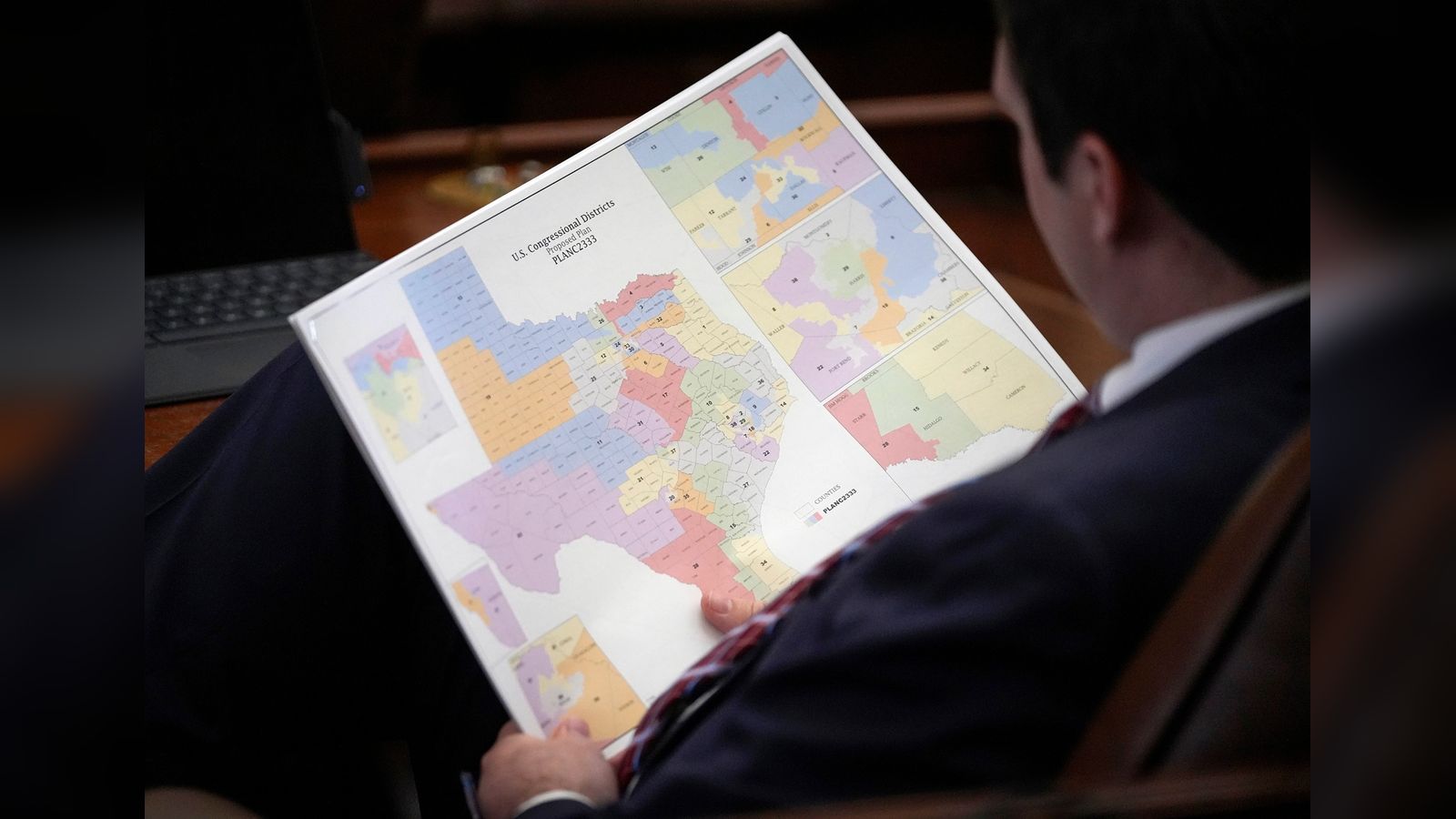
WASHINGTON – An unprecedented wave of mid-decade congressional redistricting has altered the U.S. House map for nearly one-tenth of all Americans, significantly reshaping representative boundaries ahead of upcoming elections, according to a report published by ClickOnDetroit.
The study by nonpartisan advocacy group Protect Democracy found that 34.8 million people — approximately 10 percent of the U.S. population — now live in a different congressional district than they did during the 2024 election cycle. Furthermore, roughly one-fifth of all Americans now reside in a district where more than 25 percent of the electorate is entirely new to the area.
Partisan Escalation Across Key States
The widespread redrawing of district boundaries stems from an escalating partisan battle over control of the U.S. House of Representatives. The conflict intensified last year when former President Donald Trump urged Republican lawmakers in Texas to enact a new congressional map designed to expand the party’s seat advantage. In response, California — the nation’s most populous state — passed a voter referendum that adjusted its own boundaries to favor Democrats, effectively suspending its previous nonpartisan districting framework.
Subsequent map changes in several other states have positioned Republicans to potentially gain up to nine House seats strictly through redistricting. Legal scholars and policy analysts warn that drawing boundaries to maximize national party advantage rather than reflecting local communities undermines the fundamental link between lawmakers and their constituents.
“If this trend continues, it really brings into question whether or not elected officials are really representing their constituents anymore, or if the voters are being randomly picked by mapmakers to squeeze out partisan advantage,” said Ben Raderstorf, a policy advocate at Protect Democracy and co-author of the study.
Voter Confusion and Judicial Interventions
The rapid shift in boundaries has generated operational hurdles and confusion for voters in several jurisdictions. In Missouri, conflicting lower court rulings regarding a Trump-backed mid-decade map created uncertainty over district lines and candidate eligibility shortly before primary elections. The U.S. Supreme Court eventually intervened, blocking the newly drawn map and instructing the state to revert to its previous district boundaries for the November general election.
According to the Protect Democracy report, mid-decade map adjustments exacerbate voter cynicism, insulate incumbent politicians from public accountability, and disrupt grassroots political organizing. The authors warn that without structural barriers, both major political parties risk entering a self-reinforcing cycle of aggressive redraws to avoid yielding electoral territory.
Structural Proposals and Institutional Limits
To curb partisan gerrymandering, the report outlines potential structural interventions, including proportional representation systems and national agreements to implement nonpartisan redistricting panels. While nine states currently utilize independent commissions to establish congressional boundaries, state-level protections remain vulnerable to political overrides, as demonstrated by California’s referendum response to Texas.
Passing comprehensive redistricting reform faces steep legislative hurdles in Congress and state legislatures. However, researchers emphasize that institutional reform represents the primary mechanism to stabilize congressional mapmaking.
“This is only going to get worse until somebody stops it,” Raderstorf noted in the report. “The logic of gerrymandering points inevitably towards maximalist partisan advantage on both sides. There is no off-ramp other than reform.”