


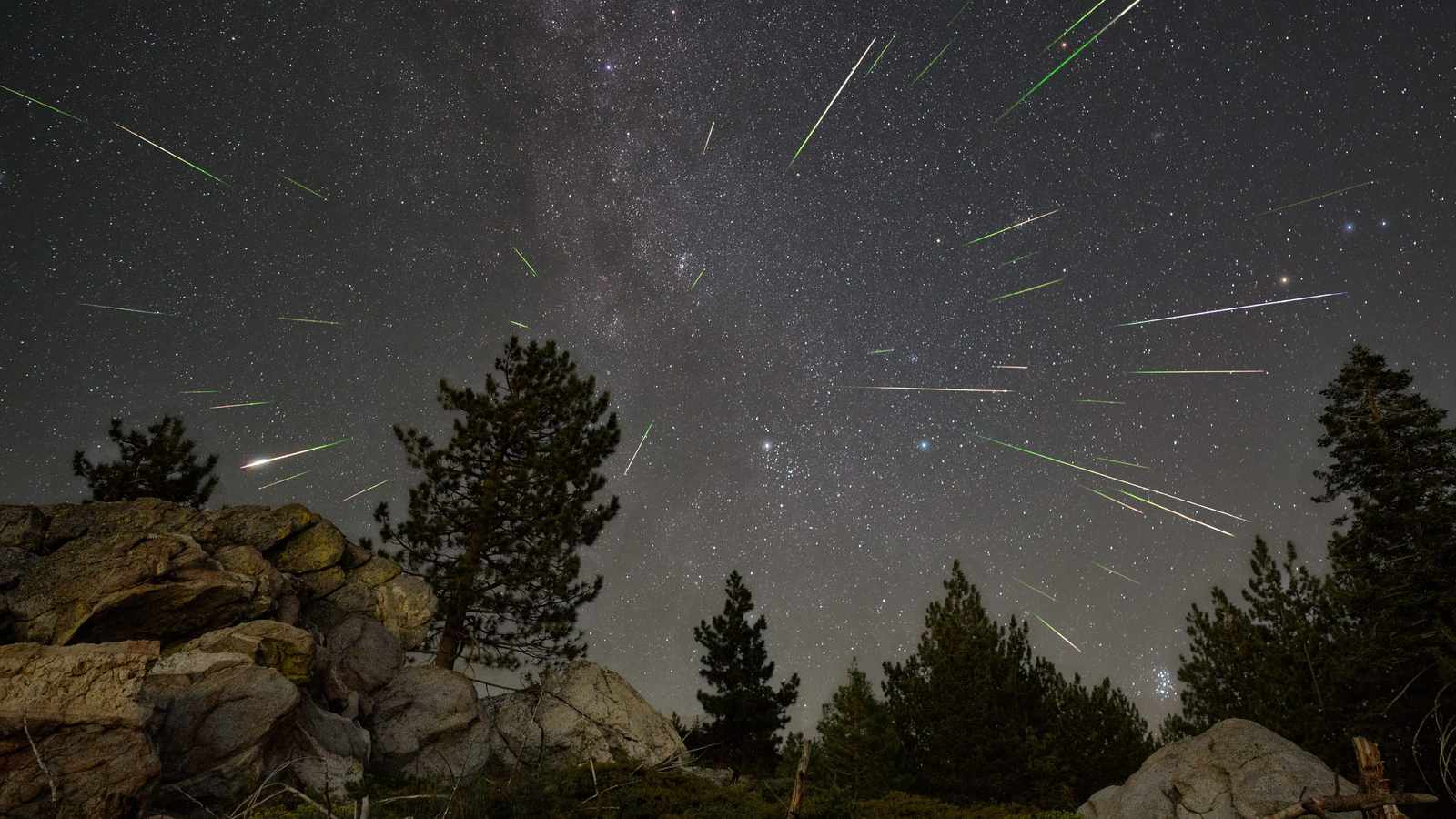
On August 12, 2026, skywatchers around the globe will witness a spectacular and rare astronomical coincidence. According to reports from NASA, the American Meteor Society, and prominent astronomical publications including Sky at Night Magazine, the annual Perseid meteor shower will reach its peak on the exact same day that a total solar eclipse sweeps across parts of the Northern Hemisphere. This celestial double feature offers a rare opportunity for the public to experience two major astronomical events within a single 24-hour window.
While the two events are entirely unrelated from a physical standpoint, their simultaneous occurrence is highly unusual. Compounding the excitement for astronomers is the moon phase: the peak of the Perseids will coincide with a dark new moon. This lack of moonlight will provide pristine, pitch-black skies, creating the absolute best possible conditions for observing faint shooting stars and brilliant fireballs.
The Path of Totality: The Eclipse of August 12
The daytime portion of this celestial double feature is a total solar eclipse. A total solar eclipse occurs when the Moon aligns perfectly between the Sun and Earth, completely blocking the Sun’s face. While the Moon passes between the Earth and Sun during every lunar cycle, its orbit is tilted slightly, meaning it rarely blocks the Sun completely from any given vantage point. On average, a specific spot on Earth experiences totality only once every 375 years, such as the major eclipse that crossed North America in 2024.
For the August 12, 2026 event, the path of totality will sweep across Greenland, Iceland, and Spain. In these regions, observers within the path will experience a few minutes of daytime darkness as the Moon completely covers the Sun. Meanwhile, a significant partial eclipse will be visible across Northeast Africa and most of Western Europe, where a large portion of the Sun will be obscured.
Parts of North America will also witness a partial eclipse. Nearly all of Canada, with the exception of Vancouver, and the northeastern corner of the United States will see varying degrees of coverage. For instance, northern Maine is projected to see approximately 29% coverage of the Sun during the peak of the eclipse. Further west, Sault Ste. Marie in Michigan will experience 7% coverage, while East Lansing will see just 2.4% coverage.
Astronomers emphasize that proper eye protection is mandatory for anyone attempting to view the eclipse. Looking directly at the Sun without certified solar eclipse glasses or indirect viewing projectors can cause permanent, irreversible eye damage. Standard sunglasses, binoculars, and telescopes without professional solar filters must never be used to look at the Sun.
The Science of the Perseids: Swift-Tuttle’s Cosmic Trail
As darkness falls on August 12, the focus will shift from the Sun to the night sky. The Perseid meteor shower, which is active annually from July 17 through August 24, will enter its most intense phase during the night of August 12-13. This shower is widely considered one of the top two meteor events of the year, famous for producing bright, fast-moving streaks of light and highly visible fireballs.
The Perseids originate from the debris field left behind by Comet 109P/Swift-Tuttle. Discovered in July 1862 by American astronomers Lewis Swift and Horace Tuttle, this comet has an orbital period of roughly 133 years. Comets are composed primarily of water ice, dust, and rock. Each time Swift-Tuttle passes near the Sun, solar heating causes it to shed material. This leaves behind a dense stream of particles ranging in size from tiny sand grains to small pebbles.
Every August, Earth’s orbit carries it directly through this debris stream. As these tiny particles collide with Earth’s upper atmosphere at a tremendous speed of approximately 133,000 miles per hour, they heat up due to friction and vaporize, creating the glowing streaks of light we recognize as meteors. Although the particles are incredibly small, their extreme velocity endows them with immense kinetic energy, allowing them to produce brilliant flashes. The Perseid shower is particularly famous for its high concentration of fireballs—unusually bright meteors that can light up the entire sky—ranking first in fireball production ahead of almost all other annual showers.
The Perfect Dark-Sky Conditions of 2026
What elevates the 2026 Perseid shower from a standard annual event to an extraordinary viewing opportunity is the complete absence of moonlight. In many years, a bright gibbous or full moon washes out all but the brightest meteors, significantly reducing the visible count. However, the American Meteor Society highlights that the 2026 peak coincides with a new moon, meaning the night sky will be exceptionally dark.
Under ideal, light-pollution-free conditions, the Perseids have a theoretical Zenith Hourly Rate (ZHR) of about 100 meteors per hour. The ZHR is an estimate of how many meteors a single observer could see under a perfectly dark sky with the radiant directly overhead. In practice, most observers under dark rural skies can expect to see a highly impressive 30 to 50 shooting stars per hour. In urban and suburban areas affected by light pollution, that number will be lower, though the shower’s bright fireballs will still be visible.
The meteors appear to radiate from a single point in the sky, known as the radiant, located in the constellation Perseus (just below the distinctive “W” shape of the constellation Cassiopeia). However, skywatchers do not need to look directly at the constellation Perseus to see them; meteors can and will appear anywhere across the entire night sky. What distinguishes a Perseid from a random sporadic meteor is that tracing its path backward will lead directly to the radiant point in Perseus.
Practical Guide for Stargazers
To get the most out of this astronomical double feature, experts offer several key recommendations for preparation and viewing:
- Ditch the Optics: Telescopes and binoculars are highly discouraged for meteor watching. Because meteors travel rapidly across vast expanses of the sky, your own eyes are the single best tool, offering the widest possible field of view.
- Escape Light Pollution: Drive away from city lights to a dark rural location, such as a state or national park. The darker the sky, the more faint meteors will become visible.
- Allow Dark Adaptation: It takes approximately 20 to 30 minutes for human eyes to fully adjust to the dark. Avoid looking at bright objects, especially smartphone screens, as even a brief glance can ruin your night vision.
- Patience is Key: Meteor activity typically builds throughout the night, reaching its peak in the hours just before dawn. Observers should settle into a comfortable reclining lawn chair, dress warmly for the cool night air, and spend at least an hour looking up. Meteors often arrive in clusters, followed by brief lulls.
Ultimately, the alignment of a total solar eclipse and a pristine, moonless Perseid meteor shower peak on August 12, 2026, represents a rare natural spectacle. Whether viewing the daytime eclipse safely through solar filters or lying back under a pitch-black night sky to watch cometary debris vaporize in the atmosphere, skywatchers are in for an unforgettable 24 hours of cosmic wonder.