


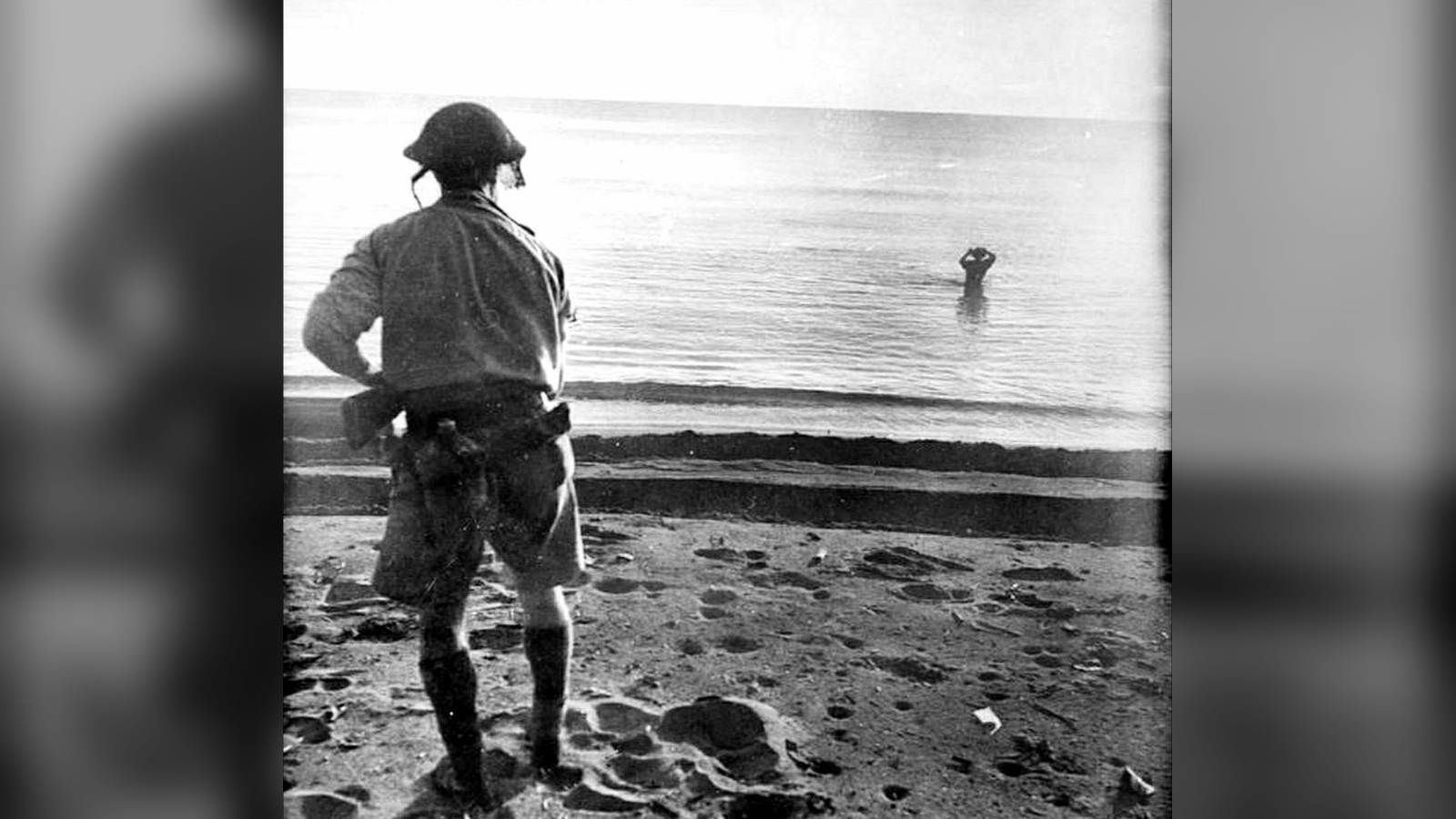
This haunting photograph captures a Japanese soldier standing waist-deep in the surf off the coast of Cape Endaiadere, New Guinea, in late 1942. In his right hand, he holds a grenade pressed firmly against his head, a final, desperate act of defiance and resignation. The composition is stark: the man is isolated in the water, his posture rigid yet weary, while the vast, indifferent expanse of the ocean stretches out behind him. On the nearby shore, an Australian soldier watches the scene unfold, having previously attempted to communicate with the man and urge him to surrender. The photograph does not just record a death; it captures the precise, chilling intersection of two opposing forces—one offering mercy, the other rejecting it—in a landscape defined by the relentless violence of the Pacific theater.
The moment behind the image
The image is one of a series taken during the brutal fighting in the New Guinea campaign, specifically around the Battle of Buna-Gona. The soldier in the water had been cornered by Allied forces near the cape. The Australian troops on the beach had made clear efforts to offer him a chance to live, even demonstrating with hand signals—as documented in related archival images (AWM 013967)—that he should put down his weapon and walk toward them. Instead, the soldier chose to end his life. This act was not an anomaly but a reflection of the intense indoctrination and the cultural stigma surrounding surrender that defined much of the Japanese military experience in the Pacific. For many soldiers, the choice was not between life and death, but between a dishonorable capture and a final, self-inflicted sacrifice. The stillness of the water contrasts sharply with the violent internal conflict of the man, who stands as a singular, tragic figure against the backdrop of an unforgiving tropical environment.
Photographer and provenance
The photograph is part of the official collection of the Australian War Memorial (AWM), cataloged as item 013968. In the chaos of the New Guinea campaign, official military photographers were tasked with recording the grim reality of the conflict for military records and historical memory. While the specific photographer is often credited to the official military units documenting the campaign, the identity of the individual behind the lens remains largely anonymous in public records. The image survived the war, was preserved in the AWM archives, and has since become a powerful piece of historical evidence. It was captured under the intense, unpredictable conditions of an active battlefield, where photographers had to balance the duty of documentation with the immediate, visceral trauma of the front lines. The existence of a preceding photo (013967) confirms that the photographer spent significant time documenting this specific encounter, suggesting a deliberate attempt to capture the interaction between the Australian forces and the isolated Japanese soldier.
Historical context
Cape Endaiadere was the site of fierce, grinding fighting during the Buna-Gona campaign. By late 1942, Japanese forces were faced with overwhelming Allied pressure, dwindling supplies, and the realization that their expansionist goals were collapsing. The intensity of the fighting was legendary for its brutality, characterized by dense jungle, disease, and a willingness by Japanese defenders to fight to the death. The photograph serves as a visceral reminder of the human cost of the Pacific War. It stands as a testament to the isolation and hopelessness experienced by soldiers on both sides, illustrating the profound psychological barriers that prevented surrender even when the outcome of the battle was already decided. The strategic importance of the cape, as a landing point, meant that the fighting here was particularly close-quarters and desperate, leading to scenes that were often captured by combat photographers as grim warnings of the war’s trajectory.
Why it still matters
Beyond its grim subject matter, the image remains a significant historical document that forces a reflection on the nature of total war. It documents the tragic end of a single human life, but it also speaks to the larger, systemic tragedy of the Pacific War. The image is a silent witness to the breakdown of communication and the triumph of ideology over survival. By preserving this moment, the Australian War Memorial has ensured that the reality of the conflict—the individual choices made in the heat of battle—remains accessible to future generations. It remains a stark, silent witness to the tragic human cost of 1942, challenging viewers to confront the brutal finality of war. As we analyze the frame, we see the ripple of the water around the soldier’s waist, the tension in his arm as he holds the grenade, and the stillness of the shoreline. The photograph is more than a record of an event; it is a profound study in the psychology of combat. It forces the viewer to confront the reality that for some, the ideological weight of the Imperial Japanese Army’s code was stronger than the instinct for self-preservation. When looking at this image, we are not just looking at a soldier; we are looking at the culmination of a military culture that demanded absolute loyalty, even in the face of certain death. The Australian soldier’s presence on the beach serves as a bridge between the viewer and the subject, highlighting the futile attempt to bridge the gap between two worlds that, in that moment, were fundamentally incompatible.