


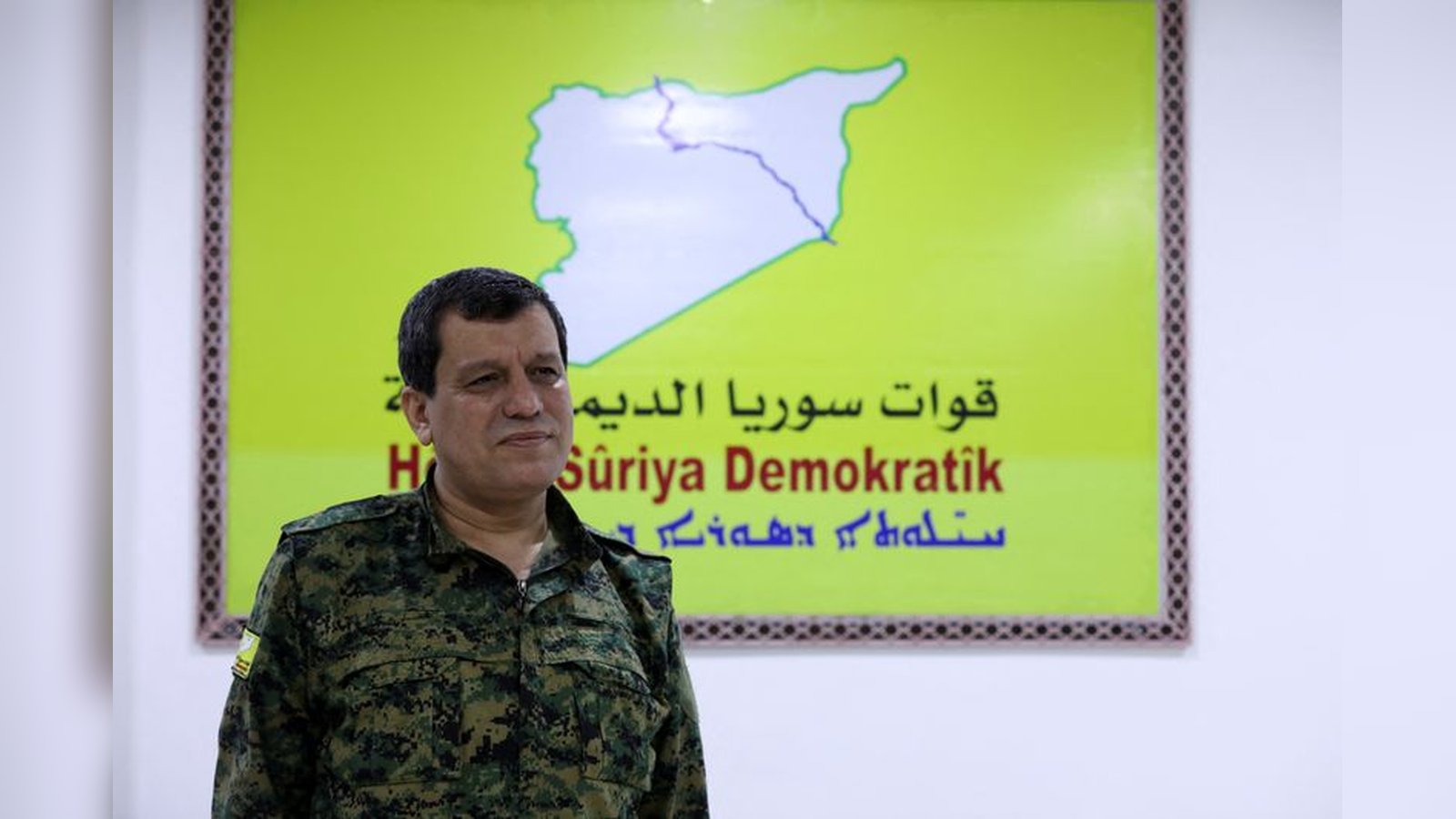
DAMASCUS (Azat TV) – The Kurdish-led Syrian Democratic Forces (SDF) have formally announced their total dissolution as an independent armed coalition, finalizing a long-negotiated integration agreement with the national government of President Ahmed al-Sharaa. Speaking at the presidential palace in Damascus on Tuesday, SDF Commander-in-Chief Mazloum Abdi declared that the force—which served for years as the primary ground component in the international campaign against ISIL (ISIS)—has concluded its distinct military mission and will fully merge into Syria’s national armed forces.
The agreement marks a momentous shift in Syria’s post-conflict governance landscape. For nearly a decade, the SDF maintained a de facto autonomous zone across northeastern Syria, governing resource-rich areas east of the Euphrates River. However, following the collapse of Bashar al-Assad’s regime in December 2024 and a subsequent Damascus military offensive in January, the SDF lost significant territory. The resulting balance of power compelled Kurdish leaders to negotiate a political and military compromise that guarantees minority cultural rights in exchange for ending military autonomy.
Terms of Integration and Civic Guarantees
Addressing state officials in Damascus, Abdi framed the merger as a transition from military confrontation to state reconstruction. Under the terms negotiated over seven months, the central government in Damascus officially recognizes the civil, cultural, and educational rights of Syria’s Kurdish population. Crucially, the agreement secures the formal preservation and state implementation of Kurdish-language education in public schools beginning in the current academic year, addressing decades of institutional exclusion suffered by Kurds under previous administrations.
The deal also incorporates high-level administrative appointments for prominent Kurdish leaders within the national governance framework. According to local reports and statement details confirmed by US diplomats, Commander Mazloum Abdi is set to be appointed as a senior adviser to President al-Sharaa, while Ilham Ahmed, the co-chair of the Kurdish-led civilian administration in the northeast, will assume a senior role in the administrative structure of the Syrian Parliament. These positions are structured to ensure Kurdish representation during state rebuilding efforts.
Structural Friction: Heavy Arms and the Status of female Fighters
Despite the formal ceremonial announcement in Damascus, the seven-month negotiation process highlighted severe operational and political hurdles that delayed the final merger. A primary point of friction involved the technical surrender and integration of heavy weaponry previously supplied by foreign partners. Command structures had to negotiate how heavy artillery, armored vehicles, and air-defense equipment would be absorbed into state arsenals without compromising central military command.
A secondary issue centered on the status of the Women’s Protection Units (YPJ), the famed all-female military wing of the SDF that played a central role in anti-ISIL battles. Operational sources indicated that YPJ command insisted on preserving their identity as professional soldiers integrated directly into the Syrian Ministry of Defence. Conversely, officials in Damascus initially proposed absorbing female combatants into the Ministry of Interior as civil police officers. Resolving this institutional division required extensive mediation regarding command roles and operational deployment across northeastern security sectors.
Washington’s Pivot and Geopolitical Realignment
The dissolution of the SDF reflects a fundamental realignment of United States foreign policy in the Middle East. Under President Donald Trump’s administration, Washington shifted its strategic focus toward supporting President al-Sharaa’s central government as the primary guarantor of Syrian stability and regional counter-terrorism efforts. US Special Envoy to Syria Tom Barrack publicly commended the transition, attributing the orderly integration process to diplomatic coordination between Washington, Damascus, and Kurdish commanders.
The timing of the announcement coincided directly with a major diplomatic concession from Washington: the official removal of Syria from the US State Sponsor of Terrorism list. The removal of this decades-old designation dismantles severe financial and trade restrictions, clearing the pathway for international investment and state reconstruction. President al-Sharaa welcomed the decision, characterizing it as the closure of a dark chapter that allows Syria to begin comprehensive economic recovery.
Ankara’s Response and Regional Security Stakes
In Ankara, Turkey’s ruling Justice and Development Party (AK Party) publicly endorsed the SDF’s disbandment. AK Party spokesman Omer Celik stated on Wednesday that the dissolution represents a crucial threshold toward consolidating Syria’s territorial integrity and national sovereignty. Turkey, a NATO member bordering Syria, had long viewed the SDF’s armed presence along its southern border as an unacceptable national security threat due to the group’s historical ties with the Kurdistan Workers’ Party (PKK).
The integration aligns with broader security developments in the region following the 2025 announcement by jailed PKK leader Abdullah Ocalan calling for his group to disarm, leading to ceremonial weapon destructions in northern Iraq. However, Turkish officials reaffirmed that several thousand Turkish military personnel stationed in northern Syria will remain deployed until Damascus fully demonstrates its capability to eliminate all residual security threats and secure the border region effectively.
Institutional Outlook and Civic Consolidation
For Syria’s political landscape, the absorption of the SDF provides a precedent for centralizing military authority under Damascus. Regional analysts note that the successful integration of Syria’s largest non-state military force without prolonged civil conflict creates significant momentum for bringing remaining autonomous factions in the country’s south and west into the state fold.
However, the long-term success of the agreement hinges on execution. Millions of Syrian Kurds, as well as Arab, Turkmen, and Assyrian populations in the northeast, are monitoring whether the central government will consistently honor linguistic freedoms, economic commitments, and political power-sharing assurances. As military units transition into regular state brigades, the focus now pivots from wartime alliances to the complex work of constitutional governance and national reconciliation.