


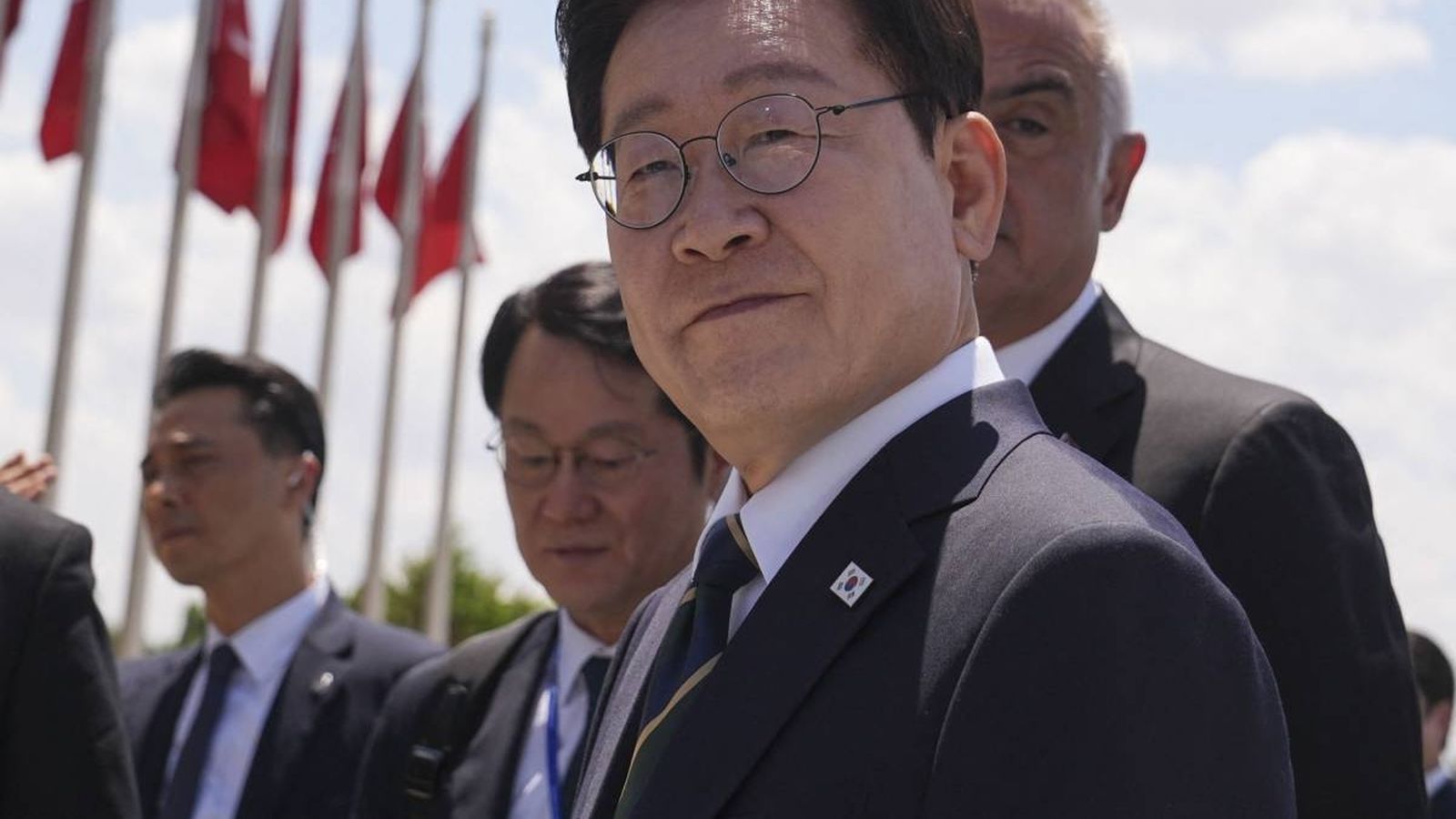
SAN FRANCISCO — South Korean President Lee Jae Myung has launched a major diplomatic and economic offensive in Silicon Valley, hosting a landmark artificial intelligence summit to position Seoul as the indispensable cornerstone of the global AI hardware supply chain. The summit, held on Friday, July 24, 2026, culminated in the signing of the “San Francisco AI Declaration” and the announcement of a massive $500 billion-plus initiative between US chip giant Nvidia and South Korea’s SK Group.
Securing the Global AI Supply Chain
The high-stakes gathering brought together the chief executives of the world’s most prominent AI developers with the heads of South Korea’s top conglomerates. Prior to the main summit, President Lee held private, back-to-back meetings with Nvidia CEO Jensen Huang, OpenAI CEO Sam Altman, Anthropic CEO Dario Amodei, and Broadcom CEO Hock Tan.
Representing South Korea’s industrial elite were Samsung Electronics Executive Chairman Jay Y. Lee, SK Group Chairman Chey Tae-won, Hyundai Motor Group Executive Chair Euisun Chung, and Naver founder Lee Hae-jin. According to South Korean officials, the summit was attended by approximately 150 executives, investors, researchers, and startup founders.
The “San Francisco AI Declaration” outlines Seoul’s strategic ambitions to deepen technological cooperation with the United States. “I’d like to present a vision for the future of AI and propose global cooperation to make it happen,” President Lee stated, offering South Korea’s “dynamic AI ecosystem” to expand the global market for both industrial and personal AI applications.
The $500 Billion Nvidia-SK Partnership
The summit’s most concrete economic milestone was the unveiling of a $500 billion-plus initiative between Nvidia and SK Group on the sidelines of the conference. The sprawling alliance aims to build massive, state-of-the-art AI data centers and secure next-generation memory supply chains.
Under the deal, SK Telecom plans to construct a massive 2-gigawatt data center powered by Nvidia’s advanced Vera Rubin graphics processing units (GPUs) and SK Hynix’s next-generation HBM4 high-bandwidth memory chips. Officials confirmed the data center is scheduled to go online in 2027.
This partnership addresses the critical bottleneck in the AI revolution: the severe shortage of specialized semiconductors and memory chips required to train and run large language models. As demand outpaces supply, global tech firms are increasingly forced to forge direct, deep alliances with South Korean memory leaders.
‘I Want More’ — The Insatiable Demand for Memory
SK Group Chairman Chey Tae-won emphasized that AI developers are demanding exponentially more memory than previously forecasted. Reflecting on his discussions with the CEOs of Nvidia, Anthropic, OpenAI, and Broadcom, Chey noted that even current projections are likely conservative.
Chey recalled his discussions with Nvidia’s Jensen Huang, predicting that memory requirements would continue to spiral upward. “I wouldn’t be surprised if, the next time I see him, he’ll tell me those figures were too low and say, ‘I want more,’” Chey told the forum.
He added that Broadcom CEO Hock Tan expressed similar concerns, indicating that Broadcom’s memory demand is poised to outstrip available supply. Furthermore, OpenAI has reportedly urged SK Group to supply high-bandwidth chips directly to the ChatGPT creator to support its massive computing infrastructure requirements in the coming years.
Anthropic’s Expansion and Custom Silicon Rumors
Anthropic, the creator of the Claude AI model, also took center stage at the summit. CEO Dario Amodei confirmed that the startup has signed major supply agreements with both Samsung Electronics and SK Hynix, though he declined to provide specific financial or volume details.
The deals follow a highly successful funding round in May, where Anthropic raised capital at a post-money valuation of $965 billion. The company explicitly named Samsung, SK Hynix, and Micron as critical partners whose technologies are vital for its memory, storage, and logic chip needs.
During the forum, SK Group’s Chey sparked industry speculation by mentioning that Anthropic was working on developing its own “computing power.” This comment aligned with recent reports that the AI lab is exploring designing its own custom chips to bypass the Nvidia-dominated supply chain.
An Anthropic spokesperson did not confirm or deny the custom silicon reports, stating only that the startup is “always exploring options, drawing on a range of chips for a diversified approach to computing.” Amodei himself declined to comment on the matter.
The aggressive moves by South Korea and its tech champions signal a new phase in the global technology race, where geopolitical alignment and hardware dominance are inextricably linked.