


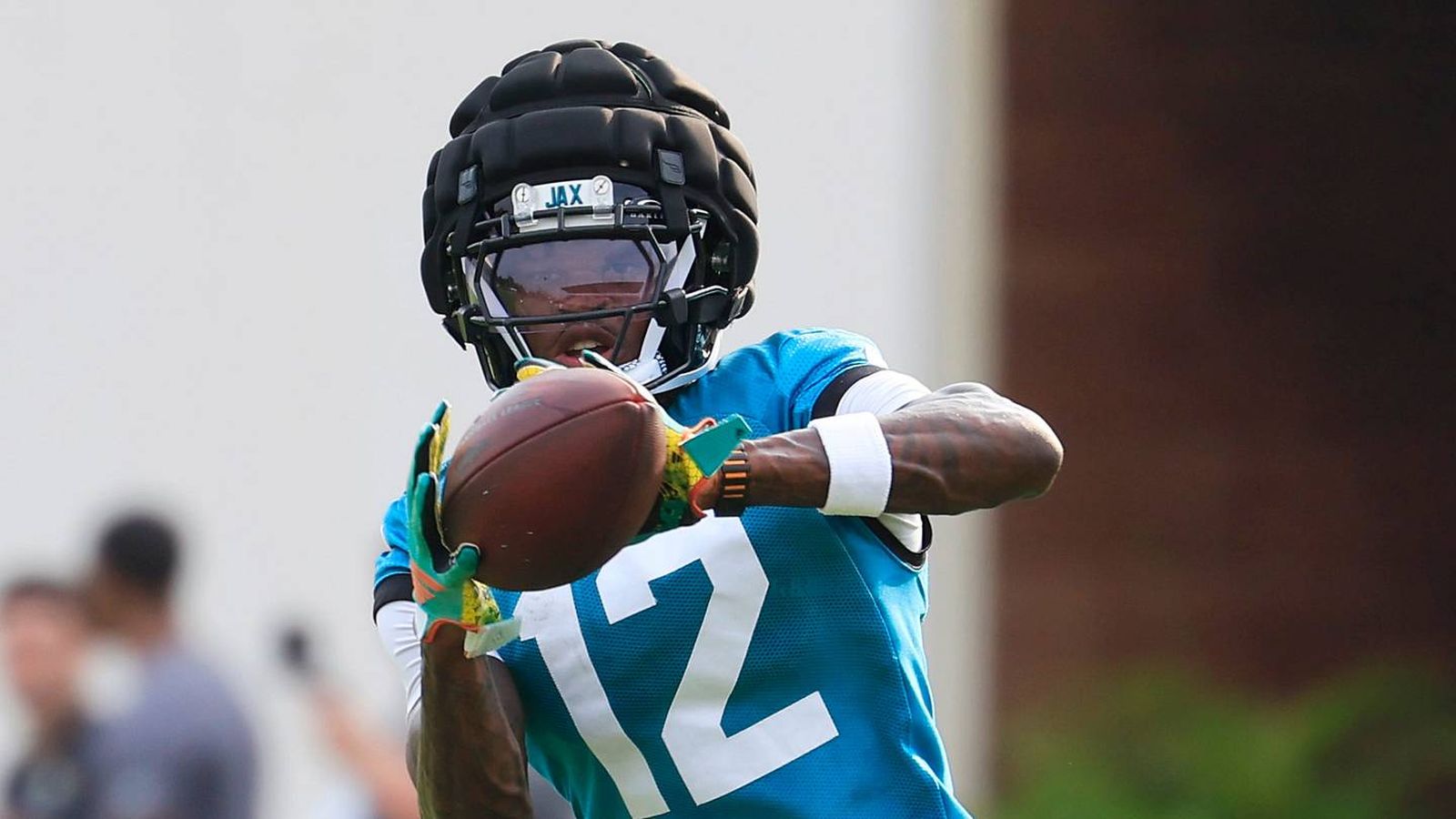
JACKSONVILLE, Fla. (Azat TV) – The physical and cognitive demands of operating as a two-way player in the modern National Football League (NFL) represent one of the most complex developmental challenges in professional sports. For Jacksonville Jaguars wide receiver and cornerback Travis Hunter, the journey back to the gridiron has been defined by rigorous rehabilitation, physical transformation, and technological adaptation. Speaking to the media on Friday, August 1, 2026, following the third day of Jaguars training camp at the Miller Electric Center, Hunter made his first public comments since a devastating, season-ending knee injury in Week 9 of his rookie campaign in November 2025. His return not only marks a crucial milestone in his recovery but also signals a strategic shift in how the Jaguars intend to utilize their prized 2025 No. 2 overall draft pick.
Physical Reconstruction: Gaining Muscle to Endure the NFL Grind
During his rookie season, Hunter’s raw athletic ability was undeniable, but his slender frame—weighing approximately 185 pounds based on his collegiate metrics at Colorado—raised persistent concerns about durability over an 18-week NFL schedule. Those concerns materialized in November 2025 when a knee injury sidelined him for the final ten games of the regular season. Following nine months of intensive post-surgery rehabilitation, Hunter arrived at the 2026 training camp visibly transformed.
Jaguars head coach Liam Coen revealed earlier in the week that Hunter had successfully added 10 pounds of pure muscle during his recovery process. Hunter addressed this physical transition during his Friday press conference, admitting that the prospect of playing at a heavier weight initially caused him some apprehension. “I was a small guy coming in. Everybody was like, ‘Gain weight, gain weight.’ Coach Coen was like, ‘Hey, play at whatever weight you’re happy at,’” Hunter explained. “I was scared at first… I’m going to feel heavy, not going to be able to do what I do.”
However, Hunter noted that the combination of structured strength training and on-field acclimation dissipated those fears. “Training and being able to put those months in, not just on the grass, but in the weight room too, just putting in extra work, it made me feel lighter on my feet when I finally touched the grass,” Hunter said. This physical enhancement is critical for a player tasked with absorbing hits from NFL safeties on offense while simultaneously sustaining the lateral quickness required to cover elite wideouts on defense.
The Restructured Offense: Integrating Into a New-Look Receiver Room
When Hunter last played in November 2025, he operated in an offense where he was immediately thrust into a starting role alongside rookie teammate Brian Thomas Jr. and veteran Dyami Brown. In his absence, the Jaguars’ front office actively remodeled the wide receiver corps. The most significant acquisition occurred at the 2025 trade deadline, when Jacksonville traded for veteran Jakobi Meyers from the Las Vegas Raiders. Concurrently, second-year receiver Parker Washington stepped into a prominent role, establishing himself as a reliable target in the slot.
As training camp progresses, Hunter is returning to a far more competitive and structured offensive environment. Instead of carrying an unsustainable volume of snaps, Hunter is being integrated into a rotational system alongside Thomas, Washington, and Meyers. This depth allows the coaching staff to optimize Hunter’s offensive usage without overexposing him to injury.
Hunter spoke highly of the cultural standards established by his veteran teammates. “Park [Parker Washington] and Kob [Jakobi Meyers], they’re going to always do their thing. They’re going to always be there. They’re the first people in the building. Me and B.T. [Brian Thomas Jr.] are chasing that,” Hunter remarked. He emphasized that this supportive environment has eased his transition back into the offense, with teammates constantly reviewing schemes and responsibilities with him to ensure his conditioning aligns with the team’s tactical evolution.
Cognitive Repetitions: The Miller Electric Center’s Virtual Room
Because Hunter’s physical rehabilitation prevented him from participating in on-field activities during the Jaguars’ spring offseason program, the coaching staff had to rely on alternative methods to keep him mentally sharp. The solution was found in the Jaguars’ state-of-the-art virtual reality room located at the Miller Electric Center.
The virtual room allowed Hunter to log mental snaps, simulating complex pre-snap reads and coverage adjustments from both the offensive and defensive playbooks. For a dual-threat player who must master two entirely different schemes, this technological resource proved indispensable. “It’s perfect for me. I’ve got first priority for that room because I’m playing both sides of the ball,” Hunter said. “Just going in there every day, learning, learning new plays… knowing everybody’s job, just not mine, has really helped me get on the field and play fast.”
This cognitive conditioning was put to the test during Day 3 of training camp. When the defense suddenly initiated a hurry-up drill, Hunter was forced to sub back onto the field without prior huddle instructions. “I just had to jump back in and learn to play on the fly,” Hunter recalled. “It had me more comfortable. I didn’t panic. I was able to guard who I had to guard.” The seamless transition from virtual simulation to high-tempo practice suggests that the Jaguars’ investment in cognitive training technologies is yielding tangible on-field benefits.
Strategic Load Management and the Path to Week 1
As the Jaguars approach the end of their early acclimation period, the coaching staff is maintaining a disciplined approach to Hunter’s workload. According to snap-count data compiled by Michael DiRocco of ESPN, Hunter logged a total of 39 snaps during the first three days of training camp: 24 on the defensive side of the ball as a cornerback, and 15 on the offensive side as a wide receiver.
This 61-to-39 percent ratio in favor of defense aligns with modern NFL developmental philosophies. Cornerback is a position that demands extreme reactive athleticism, where missed steps can immediately result in big plays for the opponent. Conversely, wide receiver routes can be more easily managed and sequenced within Coen’s offensive rotation. By prioritizing Hunter’s defensive reps early in camp, the Jaguars are ensuring his coverage instincts are fully restored before introducing the physical toll of padded practices.
The ultimate test of this dual-threat blueprint will arrive in Week 1, when the Jacksonville Jaguars host the Cleveland Browns. With a bulked-up frame, a sophisticated mental grasp of both playbooks, and a deep supporting cast in the wide receiver room, Hunter is positioning himself to fulfill the immense potential that made him the second overall pick in 2025. For Liam Coen and the Jaguars’ front office, managing this unique talent will be a defining storyline of the 2026 NFL season.