


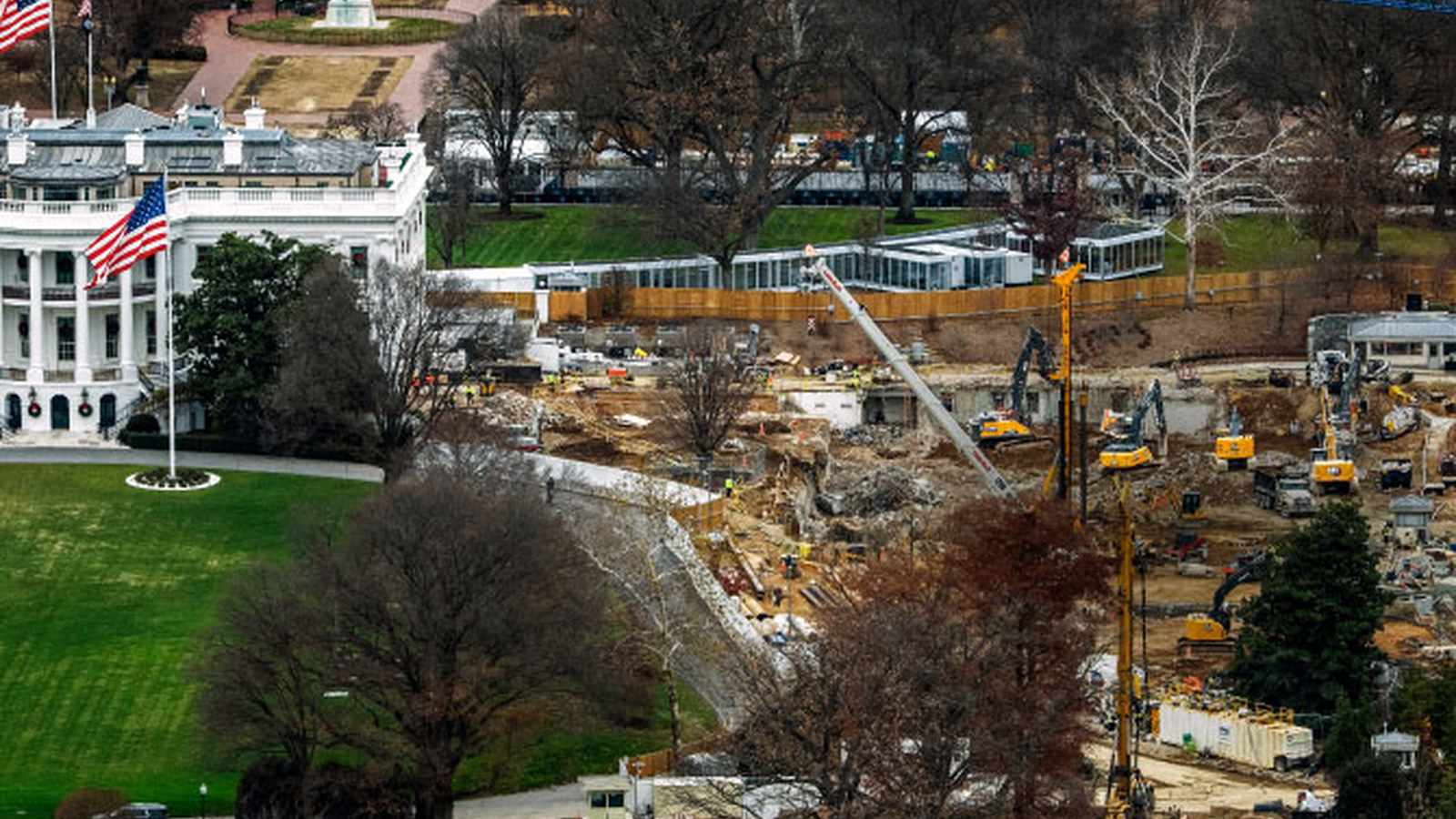
Construction Progress and Legal Standoff
The Trump administration is rapidly advancing construction on a controversial 90,000-square-foot ballroom project at the White House. Recent site photography reveals that the framing of the first floor of the East Wing is now visible above ground, marking a significant transition from the initial excavation and bunker-related work. Despite an ongoing legal challenge, the project—which has seen its estimated cost climb from an initial $200 million to $600 million—continues to move forward at an accelerated pace.
The administration’s aggressive construction timeline appears designed to establish a “fait accompli” before the D.C. Circuit Court of Appeals can issue a definitive ruling on whether the project violates federal law. At the center of the dispute is the question of whether President Trump has the unilateral authority to demolish historic portions of the White House and initiate massive structural additions without explicit congressional approval.
The Constitutional and Security Arguments
During oral arguments in June, the Department of Justice (DOJ) maintained that the executive branch holds broad authority over federal property. Yaakov Roth, representing the DOJ, argued that the government’s power to renovate the White House is extensive, even suggesting in a hypothetical scenario that the government would not be legally constrained from altering iconic federal structures without legislative oversight. This stance was met with skepticism from the three-judge panel, particularly Judge Patricia Millett, who questioned whether the administration had adopted a strategy of acting too quickly to be constrained by judicial intervention.
The administration has officially justified the project as a critical national security measure, asserting that the ballroom will sit atop an advanced underground bunker complex, including a hospital and an emergency operations center. While the National Trust for Historic Preservation has led the legal opposition, arguing that the project lacks proper oversight and statutory authorization, the government has successfully secured temporary stays to continue work throughout the appeals process.
Next Steps and Judicial Uncertainty
The project’s future remains tied to the upcoming ruling from the appellate court. While a negative ruling against the administration could theoretically halt construction, the government has signaled it may appeal to the Supreme Court if necessary. As the legal battle unfolds, the physical structure continues to rise, complicating any potential judicial order to reverse the demolition of the original East Wing or halt the current build. For now, the administration shows no sign of pausing, maintaining that the project is vital and “well underway” toward completion.