


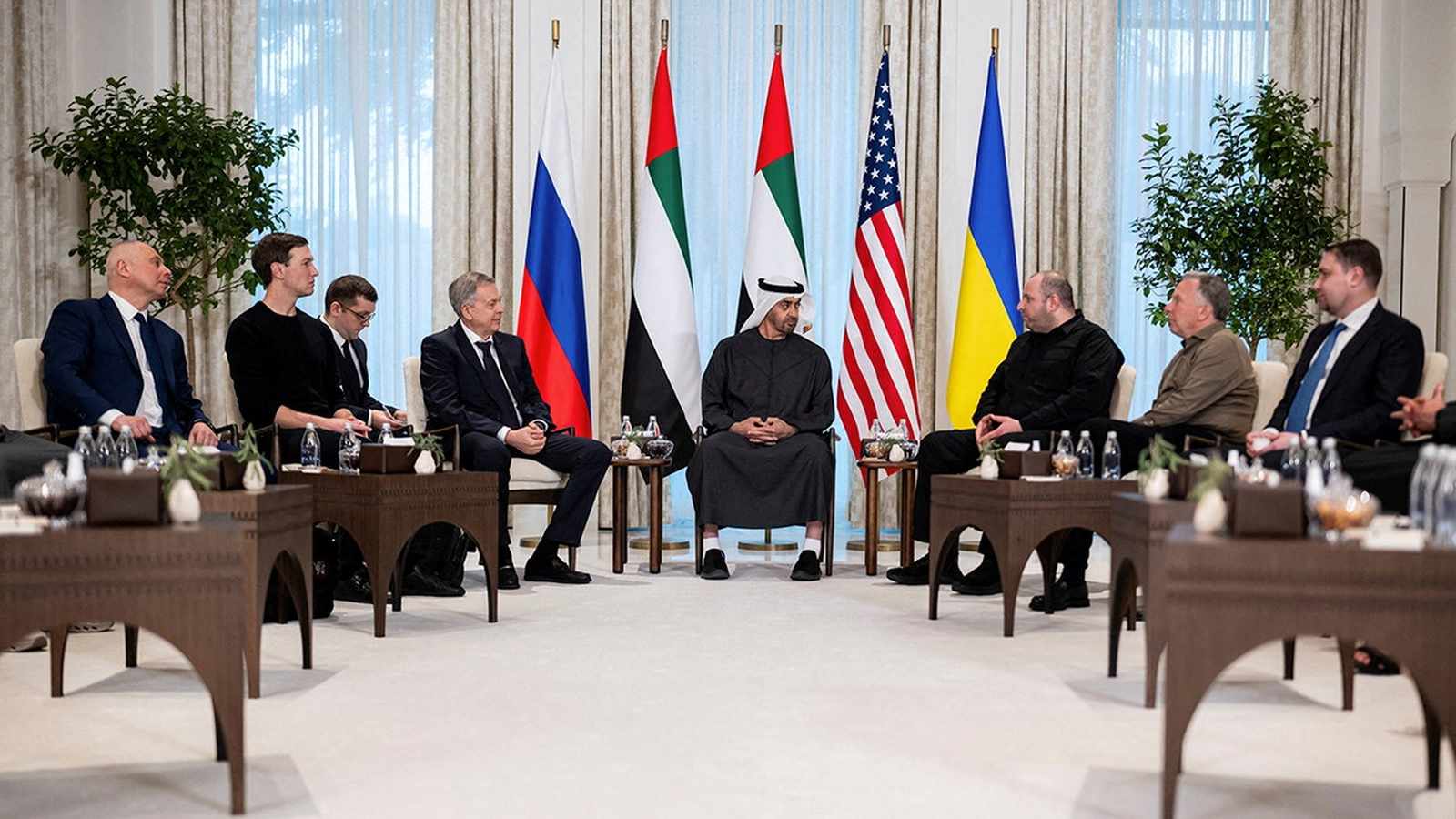
Renewed Diplomatic Efforts in Abu Dhabi
Russian, Ukrainian, and U.S. negotiators are meeting in Abu Dhabi, United Arab Emirates, for a two-day session starting Tuesday, November 11, 2026, to discuss security guarantees aimed at ending the nearly five-year-long conflict. This marks the first trilateral meeting between the three parties since February, according to reporting by WISN. The negotiations are taking place against a backdrop of intensified long-range drone and missile strikes, even as regional localized truces, such as the one around the occupied city of Oleshky, have provided limited humanitarian relief.
U.S. involvement, led by negotiators Steve Witkoff and Jared Kushner, seeks to establish a framework for long-term stability. Kushner stated on X that the objective is to develop practical arrangements that address the security concerns of all sides and create a more predictable environment. The U.S. side aims to focus on permanent security consultations, military transparency, and reciprocal measures to reduce escalation risks, as reported by ABC News.
Divergent Security Demands
The core challenge remains a fundamental gap between Russian and Ukrainian requirements for peace. President Volodymyr Zelenskyy has pushed for security guarantees modeled after NATO’s Article 5, which would clarify the concrete actions Western allies would take in the event of a renewed Russian invasion. Conversely, Moscow continues to demand that NATO roll back its deployments of troops and weapons from member states in Central and Eastern Europe, a condition it has maintained since the start of the full-scale invasion in 2022.
President Vladimir Putin’s delegation, led by Vladimir Medinsky, maintains that Russia will achieve its objectives by force if its conditions—including the abandonment of Ukraine’s NATO aspirations and the acceptance of territorial losses—are not met. The Kremlin has explicitly rejected the inclusion of European envoys in these specific Abu Dhabi talks, with adviser Yuri Ushakov stating that European participation would only be considered at a later, broader stage of negotiations. This stance highlights the ongoing friction between Russia and the European Union, which has struggled to establish a unified diplomatic voice in these proceedings.
Stakes for European Security
The negotiations are viewed by the U.S. as part of a potential “grand deal” regarding European security. While specifics remain limited, President Donald Trump indicated following a meeting with Russian envoy Kirill Dmitriev that any agreement might eventually encompass a broader European framework. As the conflict nears its fifth year, the immediate focus of the Abu Dhabi sessions remains on establishing reliable crisis communication channels and preventing further escalation along the 1,200-kilometer front line, where combat persists despite the diplomatic window.