


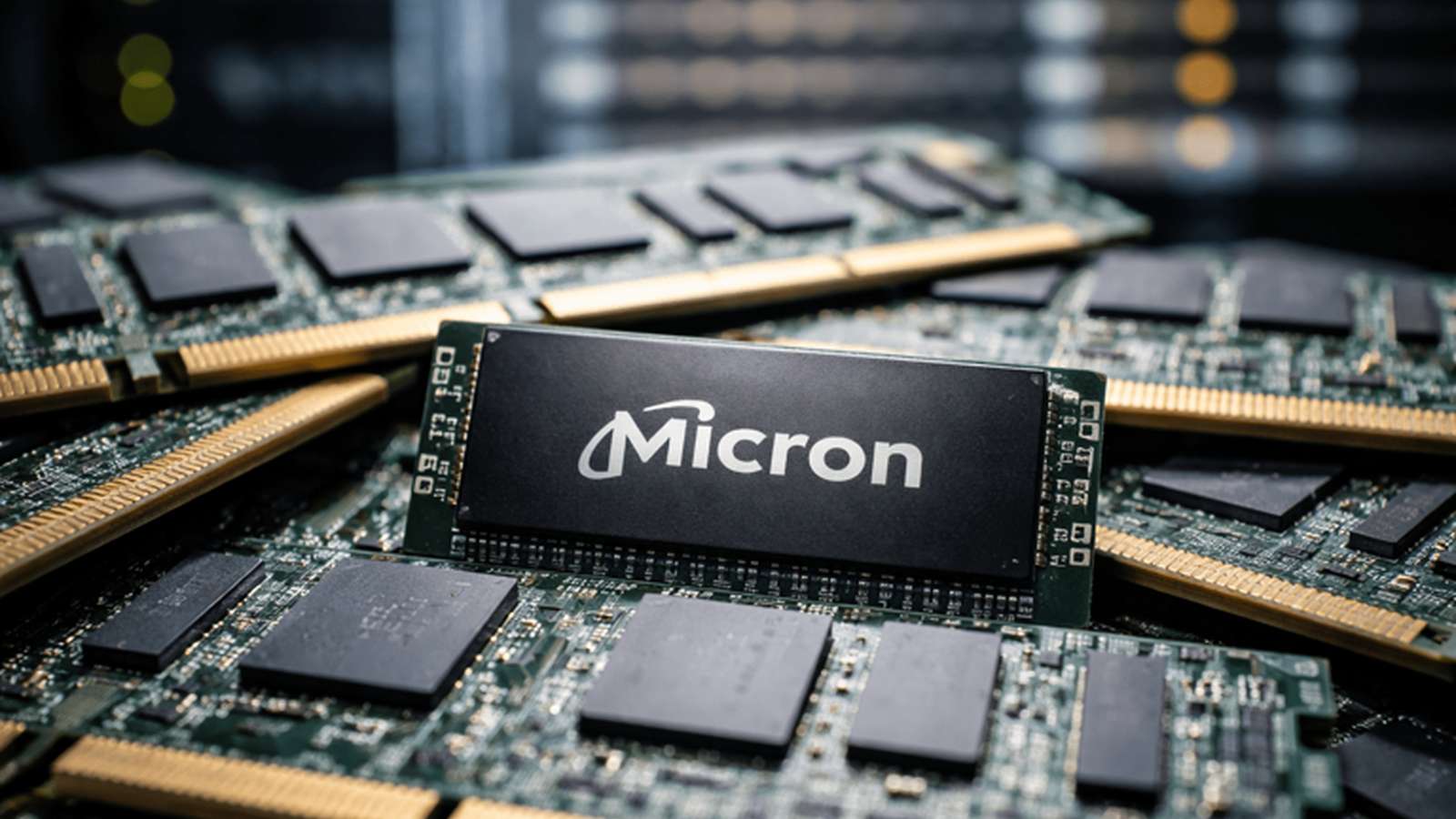
Micron Technology shares rose in extended trading after the memory chip maker reported fiscal fourth-quarter financial results that comfortably surpassed Wall Street expectations, propelled by historic demand for artificial intelligence hardware infrastructure, according to CNBC.
The company posted adjusted earnings per share of $33.42 on revenue of $54.23 billion for the quarter ending in late September 2026. Those figures easily outperformed the LSEG consensus estimates of $31.61 in adjusted earnings per share and $51.07 billion in revenue. Revenue surged nearly fourfold from $11.32 billion reported in the same period a year earlier, highlighting the explosive growth trajectory of data center hardware components.
Looking ahead to the fiscal first quarter, Yahoo Finance reported that Micron expects revenue of approximately $61.5 billion with adjusted earnings per share reaching $38.15. Analysts surveyed by LSEG had anticipated $35.40 in adjusted earnings per share on $57 billion in revenue. Net income for the fourth quarter jumped sharply to $37.7 billion, or $32.87 per share, compared to $3.2 billion, or $2.83 per share, a year prior.
AI Infrastructure Bottlenecks and High-Bandwidth Memory
The extraordinary financial expansion reflects a worldwide supply crunch driven by intense demand for memory chips essential for training and running complex artificial intelligence models. Advanced graphics processing units and central processors from market leaders like Nvidia and AMD require substantial quantities of high-bandwidth memory (HBM) to minimize latency during heavy AI workloads.
As the sole U.S.-based manufacturer of HBM—which consists of stacked general-purpose dynamic random-access memory (DRAM)—Micron reported that fourth-quarter DRAM revenue soared 343% year-over-year to $39.8 billion, accounting for 73% of total sales. Overall, memory industry dynamics have pushed standard DRAM and NAND prices upward as major producers concentrate production capacity on high-margin HBM components.
To capture sustained long-term demand, Micron is investing $250 billion to construct two major domestic manufacturing campuses. The largest facility broke ground in Clay, New York, in January, while a new fabrication plant in Boise, Idaho, is slated to begin operations next year. These domestic expansions mirror aggressive capacity buildouts by industry rivals SK Hynix and Samsung in South Korea.
Broader Market Impacts and Consumer Tech Inflation
While artificial intelligence infrastructure spending has enriched memory producers, the ensuing component shortages have exerted upward cost pressures across other technology sectors. Consumer electronics manufacturers have adjusted device pricing upward to absorb the rising expense of memory and storage flash chips. Apple, for instance, raised retail pricing on its newer device iterations to offset elevated production costs.
Furthermore, policy and regulatory scrutiny surrounding advanced technology continues to intersect with corporate leadership. Micron CEO Sanjay Mehrotra participated in a Washington summit on artificial intelligence regulation hosted by U.S. President Donald Trump, following discussions involving trade and technology policy.
Long-Term Valuation and Cyclical Vulnerabilities
Despite record-breaking quarterly metrics, market analysts continue to debate whether current valuation levels fully account for the inherently cyclical nature of the memory sector. Historically, memory markets transition from acute boom periods into oversupplied down-cycles as expanded manufacturing capacity catches up with demand.
According to analysis from The Motley Fool, Micron maintains a smaller HBM market share than dominant South Korean competitors SK Hynix and Samsung, leaving its financial performance more directly exposed if conventional DRAM and NAND pricing experiences a correction. While current consensus estimates project strong earnings peaks through fiscal 2028, long-term projections highlight the necessity of monitoring through-cycle supply adjustments as global fabrication capacity gradually expands.