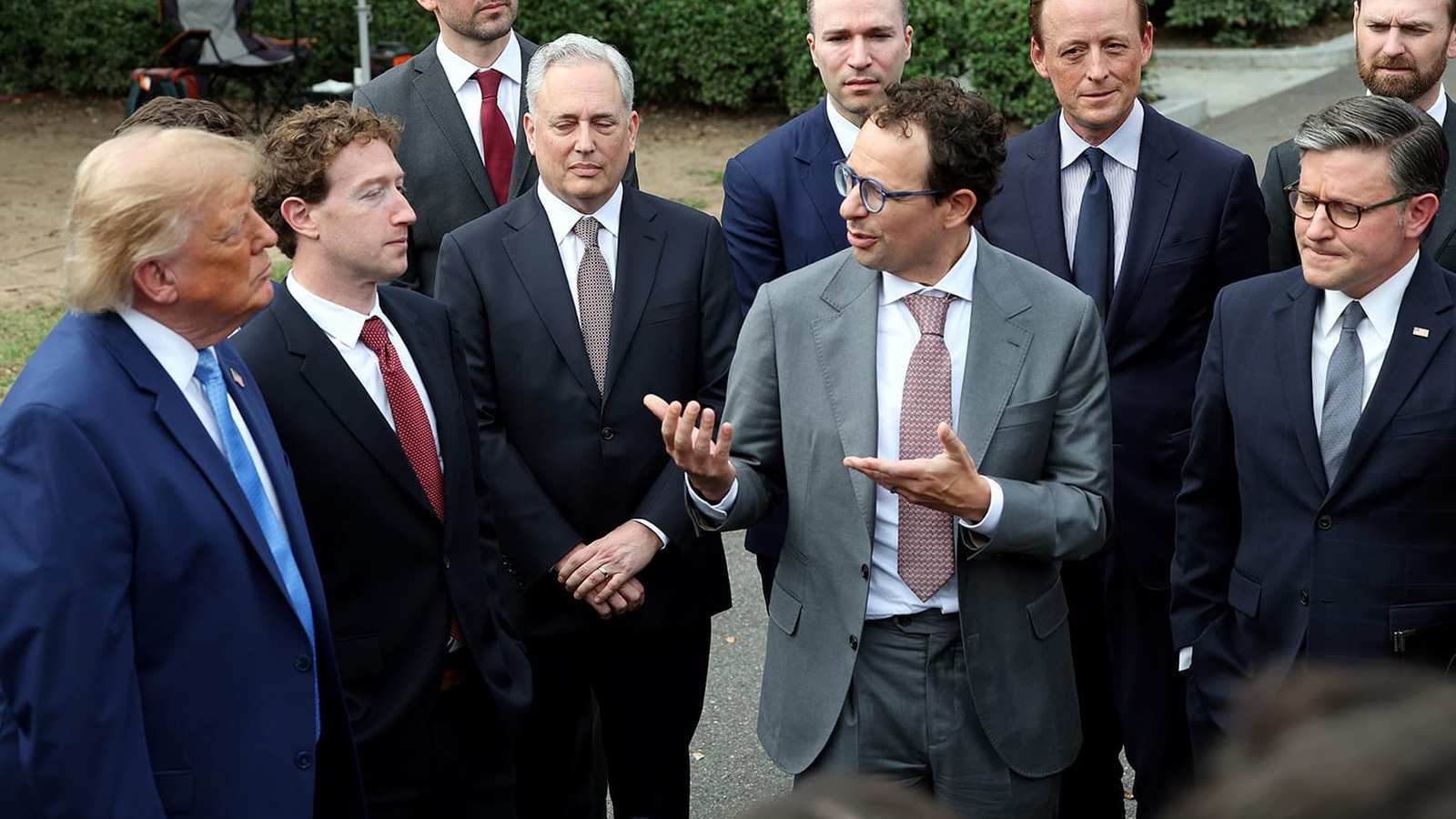
Major figures in the artificial intelligence sector gathered at the White House on Tuesday for a high-profile luncheon with President Trump, culminating in the signing of a voluntary, “morally binding” accord focused on industry self-regulation, as reported by SFist. The gathering followed a private White House dinner between President Trump and Anthropic CEO Dario Amodei on Monday night.
The White House Accord and Self-Regulation
Speaking to reporters outside the White House on Tuesday afternoon, President Trump announced that he had signed the document with tech leaders to establish safety guardrails through self-regulation. According to the full text published by the New York Post, the voluntary pledge functions as a structural framework requiring companies training and deploying frontier models to establish robust internal controls, empower internal monitoring teams, partner with independent external auditors, and designate an independent board committee to oversee safety compliance.
The signing group included Meta CEO Mark Zuckerberg, Tesla and SpaceX chief Elon Musk, Anthropic CEO Dario Amodei, Google CEO Sundar Pichai, Nvidia chief Jensen Huang, and OpenAI President Greg Brockman. Trump stated that the Department of Justice and the FBI would maintain oversight, while adding that a new “AI czar” would be appointed within days. Advanced Micro Devices CEO Lisa Su told CNBC that she was “encouraged” by the discussions, noting a strong sense of responsibility in the room.
Anthropic’s Financial Realities and Governance Friction
Tuesday’s accord comes amid intense financial and legal pressure for Anthropic. According to Reuters details cited by SFist, Anthropic pushed forward with an initial public offering filing revealing a net loss of $42 billion in 2025 on $4.6 billion in revenue. The company faces $518 billion in future cloud computing obligations and spent $7 billion on computing costs out of $12.65 billion in total expenses last year, though it eyes a potential $2 trillion valuation.
The financial strain arrives on the heels of governance friction with the federal government. A federal appeals court recently upheld the Pentagon’s right to designate Anthropic a “supply chain risk” after the company resisted allowing its technology to be utilized for mass surveillance or fully autonomous weapons. Despite these tensions, Amodei joined industry peers at Tuesday’s luncheon following his recent warnings at the United Nations Security Council regarding the commercial race to the bottom in artificial intelligence development.
Follow-up Questions
Will the voluntary AI accord be codified into federal legislation?
The participating companies and the administration indicated that codifying these steps into laws or regulations may make sense over time, though no binding legislative timeline was established
The underlying reporting is available from sfist.com.
What remains unclear: It remains unclear when or if Congress will pass mandatory regulatory legislation codifying the voluntary pledge
How will Anthropic address its heavy financial losses ahead of its planned IPO?
The company’s IPO filing shows heavy reliance on massive cloud computing and infrastructure spending alongside multi-billion dollar losses, raising questions about how public markets will value its projected $2 trillion valuation
What remains unclear: The exact timeline and final valuation for Anthropic’s public offering have not been officially finalized
Perspectives
White House Self-Regulation vs. Industry Safety Demands
Regulatory Approach
White House Position
Favors voluntary self-regulation and existing law enforcement without heavy federal intervention
“There’s a belief that there should be tremendous self-regulation — President Trump”
Industry Leaders’ Position
Has frequently called for global coordination and structured rulebooks to manage frontier risks
Commercial & Financial Pressure
White House Position
Stresses that tech leaders must keep domestic companies competitive against foreign rivals like China
“Anthropic had a net loss of $42 billion in 2025, on revenue of $4.6 billion — Reuters Report”
A forthcoming documentary and newly revealed interviews detail Mossad’s 2024 pager operation against Hezbollah, shedding light on planning and execution.
California Gov. Gavin Newsom signed a law banning local, state and federal officers from using electric shock gloves, taking effect next year until 2030.
Gavin McKenna skipped the Maple Leafs’ optional morning skate ahead of his NHL debut against Montreal, earning praise from teammates and coach Jim Hiller.
Legislation led by Senator Josh Hawley to designate America’s National Churchill Museum as a National Historic Landmark cleared the Senate and heads to the White House.