


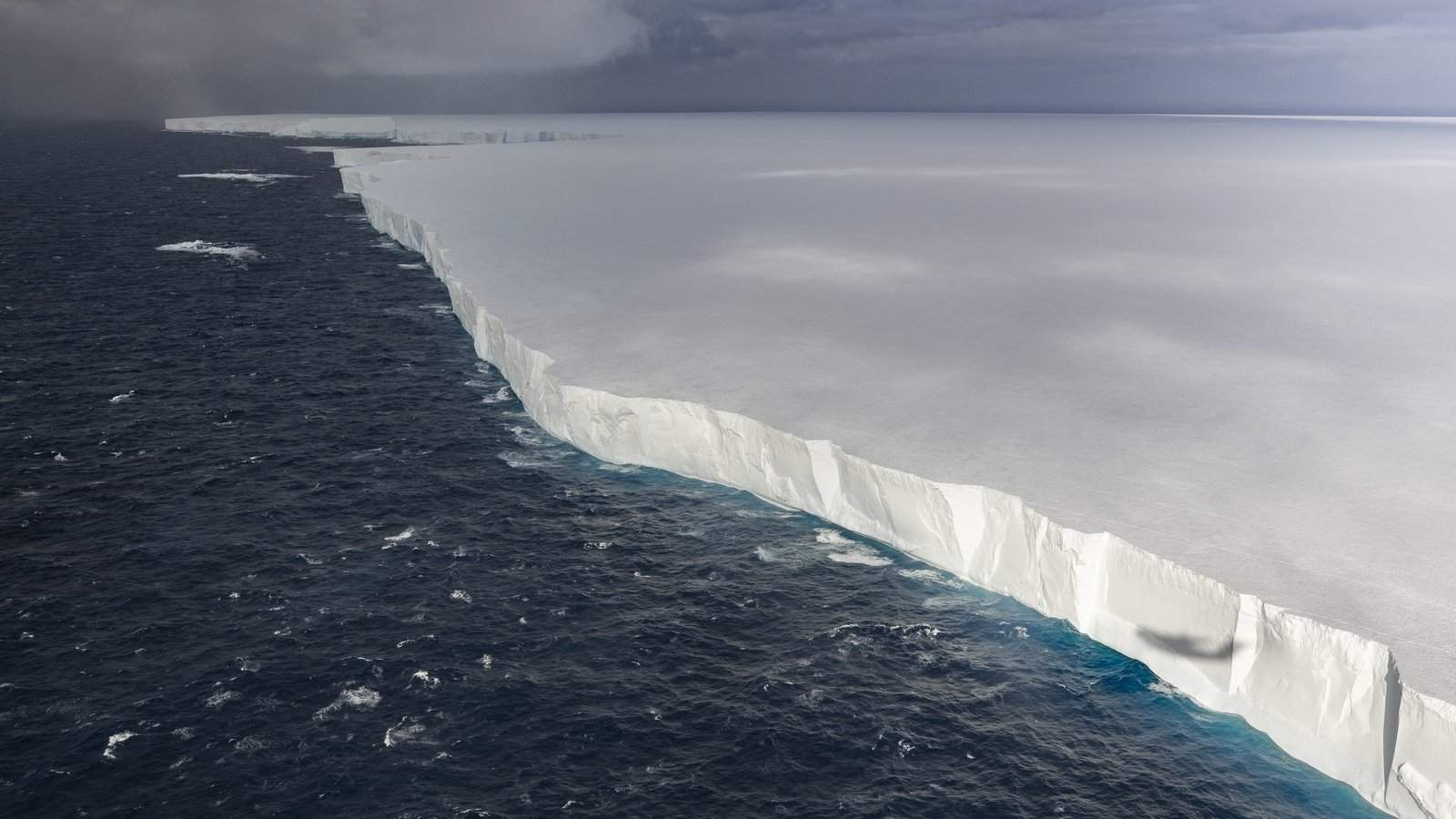
The world’s largest and most enduring iceberg, known as A23a, is on the brink of disappearing entirely. Nearly 40 years after calving from Antarctica in 1986, this massive slab of ice, which once spanned over 4,000 square kilometers—more than twice the size of Greater London—has been reduced to less than half its original size. Scientists warn that its complete disintegration is likely within weeks due to exposure to warmer waters and relentless ocean currents.
A Colossal History: The Journey of A23a
A23a’s story began in 1986 when it calved from the Antarctic ice shelf. For more than three decades, it remained grounded in the Weddell Sea, unable to drift freely. In 2020, the iceberg finally broke free, entering the turbulent waters of the South Atlantic. Guided by the Antarctic Circumpolar Current, it traversed the area famously known as ‘Iceberg Alley.’ Earlier this year, the iceberg ran aground near South Georgia Island, raising concerns about its impact on local wildlife. Fortunately, it dislodged in May 2025, avoiding significant ecological disruption to penguins and seals in the region.
Rapid Disintegration in Warmer Waters
Since its release from South Georgia Island, A23a has been drifting northward, picking up speed—traveling up to 20 kilometers in a single day. This journey has exposed it to increasingly warm waters, accelerating its disintegration. According to Andrew Meijers, a physical oceanographer with the British Antarctic Survey, the iceberg is “breaking up fairly dramatically” as it essentially “rots underneath.” Recent satellite imagery has shown chunks as large as 400 square kilometers breaking off, leaving behind smaller fragments that pose potential hazards to marine navigation.
University of Colorado ice scientist Ted Scambos noted that A23a’s demise is part of a natural cycle but emphasized that the increasing frequency of such events is likely linked to human-induced climate change. He remarked that A23a is unlikely to survive past November 2025, with its final collapse expected to be sudden and dramatic, resembling an avalanche of ice at sea.
Climate Change and the Fate of Icebergs
Iceberg calving is a natural process where chunks of ice break away from glaciers or ice shelves. However, scientists have observed an alarming trend: the rate of ice loss from Antarctica has been accelerating, likely due to rising global temperatures. A23a’s longevity and size were initially remarkable, as most icebergs do not survive long after leaving the protective cold waters of Antarctica. Yet, as it drifted farther into warmer regions, its fate became inevitable.
Experts like Meijers have highlighted that the iceberg’s prolonged existence offers valuable insights into the behavior of large ice masses in changing climates. However, its impending disappearance serves as a stark reminder of the broader implications of global warming on polar regions and sea levels worldwide.
What Lies Ahead?
As A23a continues its northward journey, its fragments are expected to disperse further, eventually melting into the surrounding ocean. While its immediate impact on marine ecosystems appears minimal, the iceberg’s story underscores the need for urgent action to mitigate climate change. The scientific community will continue to monitor its final days, using this case as an opportunity to better understand the dynamics of large icebergs and their interactions with warming oceans.
The dramatic disintegration of A23a is not just the end of a decades-long journey but a symbol of the profound changes occurring in Earth’s polar regions. Its story calls attention to the urgent need for global efforts to address climate change and its far-reaching consequences.