


What the photograph shows
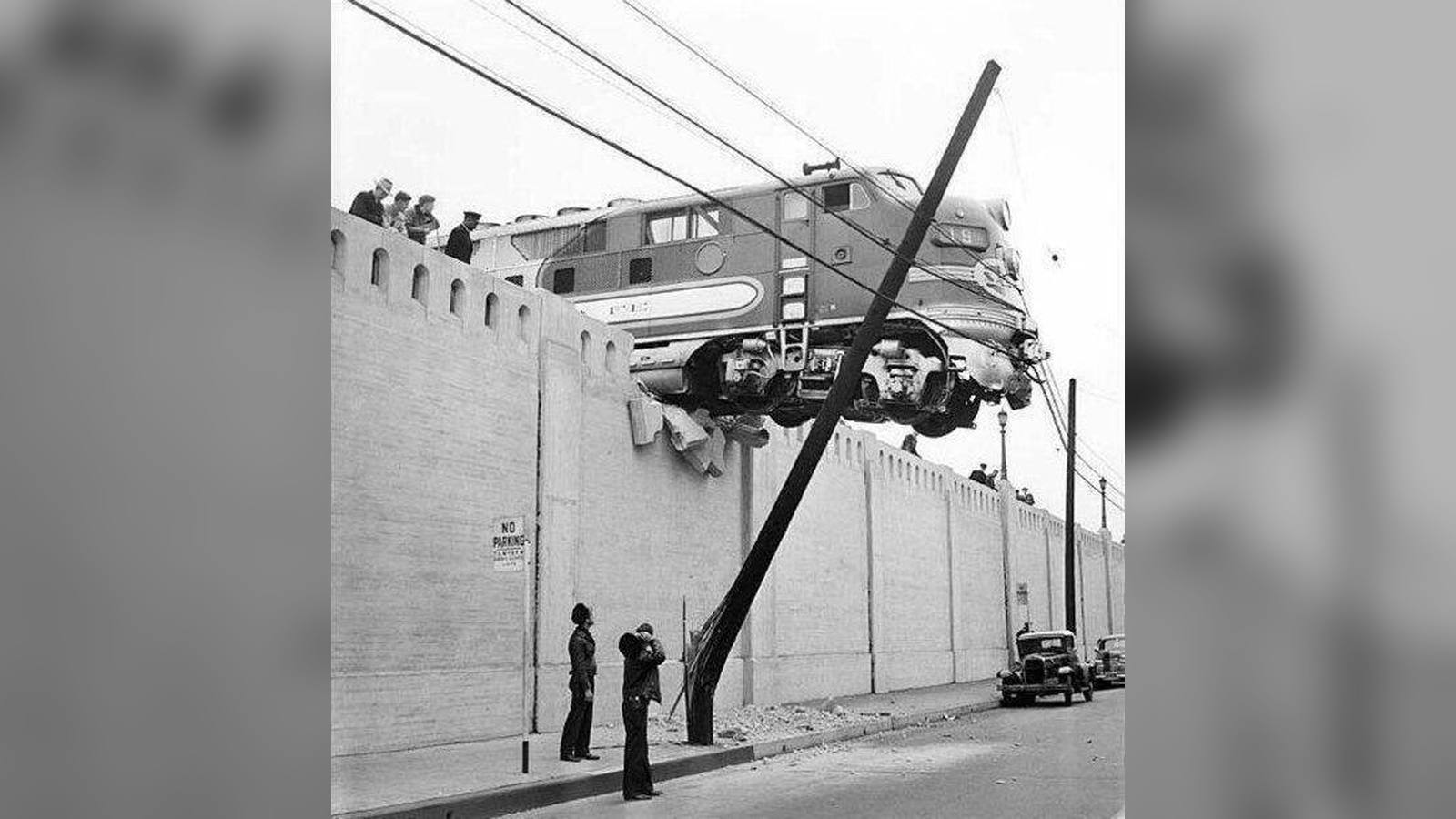
In this striking archival image, the massive, dark iron form of locomotive #19L looms over a city street, its front half suspended in mid-air. The scene is one of surreal mechanical failure: the heavy engine has breached a concrete wall and a steel bumper post at the terminus of a track, leaving it dangling 20 feet above the pavement below. The composition captures the sheer weight of the machine against the fragile, open space of the street, a stark reminder of the kinetic energy that defines rail travel. Bystanders, though blurred in some versions of the event’s documentation, provide a sense of scale, emphasizing how the colossal machine has suddenly become a static, looming object in a residential and commercial neighborhood. The light, typical of a bright Southern California morning, casts long shadows that highlight the jagged edges of the broken masonry and the twisted metal of the terminal’s boundary, creating a high-contrast image that feels both cinematic and terrifyingly real.
The moment behind the image
The accident occurred on the morning of January 25, 1948. The locomotive had just finished its service, having pulled the streamliner El Capitan from Chicago into the Los Angeles Union Passenger Terminal at 8:45 a.m. According to reports from the time, the engine was unhooked from the passenger cars and was in the process of backing onto a switch to head toward the roundhouse for maintenance. As it maneuvered, the engineer discovered that the locomotive had lost its braking ability. Unable to stop, the engine surged through the end of the dead-end track, crashing through the terminal’s boundary and coming to a rest with its nose protruding over the street, dangerously close to the historic Philippe the Original sandwich shop on Aliso Street. The silence that followed the crash was reportedly broken only by the hiss of escaping steam and the stunned reactions of onlookers who witnessed the mechanical behemoth come to a standstill over the abyss. The immediate aftermath involved a tense period of securing the site, as the locomotive’s precarious position threatened to shift, potentially causing it to fall completely into the street below.
Photographer and provenance
While the specific photographer remains uncredited in many archival circulations of this image, the photograph gained notoriety as a vivid piece of Los Angeles history. It was documented by news photographers on the scene, and the event was extensively covered by the Los Angeles Times in their January 26, 1948, edition under the headline “End of the Line, But it Kept on Going.” The image has since become a staple of local archives and historical photography collections, often appearing in the Los Angeles Public Library collections and online archives like Calisphere. The provenance is typical of mid-century news photography: a quick, on-the-spot assignment where the photographer’s role was to capture the sheer absurdity of the scene for the morning edition, ensuring the visual impact would resonate with readers who might otherwise struggle to believe the mechanical failure was possible. The lack of a single, definitive photographer attribution is common for news wire images of that era, which were often shared between publications and syndicated without the strict copyright metadata seen in modern digital journalism.
Historical context
In 1948, the Los Angeles Union Passenger Terminal was the absolute heart of the city’s rail transit. The incident involved the Super Chief, one of the most prestigious trains of the era, representing the pinnacle of American locomotive engineering. The fact that the locomotive was unoccupied by passengers at the time of the crash prevented what could have been a catastrophic tragedy. It took five hours for crews to bring in a 250-ton crane to hoist the engine back onto the tracks, a spectacle that drew crowds and solidified the event in the city’s collective memory. The era was defined by a transition in rail technology, and such accidents were not merely news items; they were warnings of the limitations of heavy machinery in the increasingly dense urban environments of Southern California. The proximity to Philippe the Original—a landmark established in 1908—adds a layer of cultural resonance to the story, as the shop was already a fixture of the city’s identity, making the near-miss a topic of local conversation for decades.
Why it still matters
This photograph survives not only as a record of a mechanical failure but as a frozen moment of “what if.” The image captures the precarious intersection of heavy industry and everyday urban life. For modern viewers, it serves as a startling visual narrative of an era when the sheer scale of railroad technology dominated the landscape of American cities. It reminds us that even the most powerful machines are subject to the fallibility of human control and mechanical integrity, leaving a permanent mark on the history of Los Angeles transit. The image remains a testament to the power of photography to transform a singular, frightening event into a piece of shared historical heritage, preserved long after the tracks have been modernized and the specific locomotive has been retired to the scrap heap of history.