


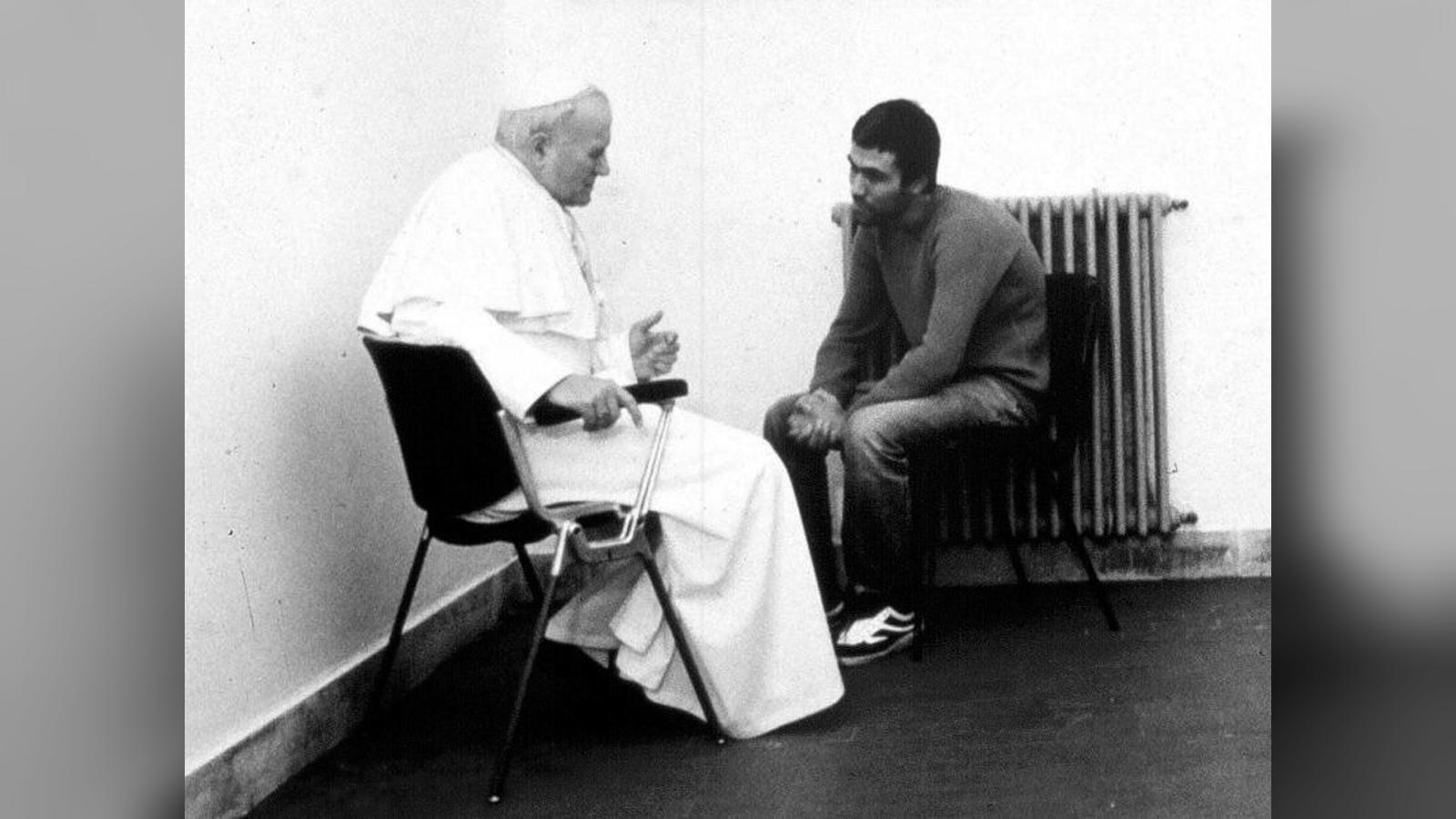
Captured inside the stark confines of Rome’s Rebibbia Prison on December 27, 1983, this powerful photograph records an extraordinary and unprecedented encounter between Pope John Paul II and Mehmet Ali Agca, the Turkish extremist who had attempted to assassinate him more than two years earlier. The image freezes a quiet, intense twenty-minute dialogue that stunned a Cold War-era world gripped by bitter ideological divisions and perpetual hostility. This article examines the provenance of the photograph, the visual details of the prison cell meeting, the dramatic historical events that preceded it, and the lasting legacy of a gesture rooted in radical forgiveness.
What the photograph shows
The frame centers on two men seated close together on molded plastic chairs in the corner of a narrow prison cell. Pope John Paul II, dressed in his traditional white papal cassock, leans forward attentively, his expression solemn yet serene as he engages his visitor. Opposite him sits 25-year-old Mehmet Ali Agca, wearing an unbuttoned blue crewneck sweater, casual jeans, and blue-and-white running shoes from which security guards had removed the laces. Agca appears unshaved and visibly subdued, his posture reflecting a mixture of tension and bewilderment in the presence of the pontiff. Prison guards and Vatican officials watched from a corridor just outside the open door, but the two men spoke in such low, hushed tones that their actual words remained completely inaudible to observers. As the meeting concluded, Agca would respectfully kiss the Pope’s ring, while John Paul II presented his former attacker with a small white box containing a silver and mother-of-pearl rosary.
The moment behind the image
The immediate catalyst for this photograph harks back to Wednesday, May 13, 1981, in St. Peter’s Square, Vatican City. As John Paul II was being driven through an open crowd of 10,000 attendees during his weekly general audience, Agca drew a pistol at close range and fired multiple bullets, striking the Pope in the abdomen and hand. Critically wounded, the pontiff was rushed to Gemelli Hospital, where surgeons fought to save his life. Yet, even from his hospital bed just four days after the shooting, John Paul II publicly declared his forgiveness for his assailant, famously urging the faithful to “pray for my brother… whom I have sincerely forgiven.” The December 1983 prison meeting was not planned or prepared by diplomatic channels; it was initiated as an act of personal pastoral outreach during the Holy Year of Redemption. When the Pope rose to leave the cell, cameras recorded a fleeting look of profound uncertainty on Agca’s face—a poignant human reaction from a man serving a life sentence who had just been treated not as a criminal, but as a brother.
Photographer and provenance
Unlike many clandestine prison photographs, this historic image was captured by accredited media professionals—specifically distributed via the Associated Press and preserved across international archives—because Pope John Paul II explicitly requested that photographers and cameramen accompany him into the cell. Recognizing the visual power of the moment, the pontiff wanted the scene to be broadcast globally as a counter-narrative to a world dominated by unforgiving hatred and geopolitical conflict. The working conditions inside Rebibbia Prison were tightly controlled by Italian security and Vatican handlers, yet access was granted precisely to ensure public transparency. The resulting photographs and newsreel footage circulated rapidly in newspapers and television broadcasts worldwide, cementing the visual record of the encounter in twentieth-century journalism.
Historical context
The 1980s geopolitical landscape was defined by high tension between Western democracies and the Soviet bloc, regional terrorism, and pervasive societal violence. Against this turbulent backdrop, the assassination attempt on John Paul II shocked the international community, sparking intense speculation about possible conspiracies involving Eastern European intelligence agencies—though definitive proof linking state sponsors to Agca remained elusive. Agca, a Turkish national and member of the ultra-nationalist Grey Wolves militant group, had already been convicted of murder in Turkey before carrying out the Vatican shooting. Following his Italian trial and life sentence, he remained incarcerated in Italy until his 2000 presidential pardon, after which he served additional time in Turkey for prior crimes. Throughout his decades behind bars, Agca’s motivations and psychological state remained complex and frequently shifting, punctuated by erratic public statements and his eventual conversion to Christianity in 2007.
Why it still matters
Decades after the shutter clicked in Rebibbia Prison, the photograph endures as a transcendent icon of mercy intersecting with justice. It challenges viewers to look past political enmity and see the shared humanity beneath ideological divides. By opening the cell door to the man who nearly ended his life, Pope John Paul II transformed a brutal act of political violence into an enduring testament of grace. The image continues to resonate in historical studies, theological discussions, and journalism as a rare visual proof that even under the harshest conditions of human malice, reconciliation remains possible.