


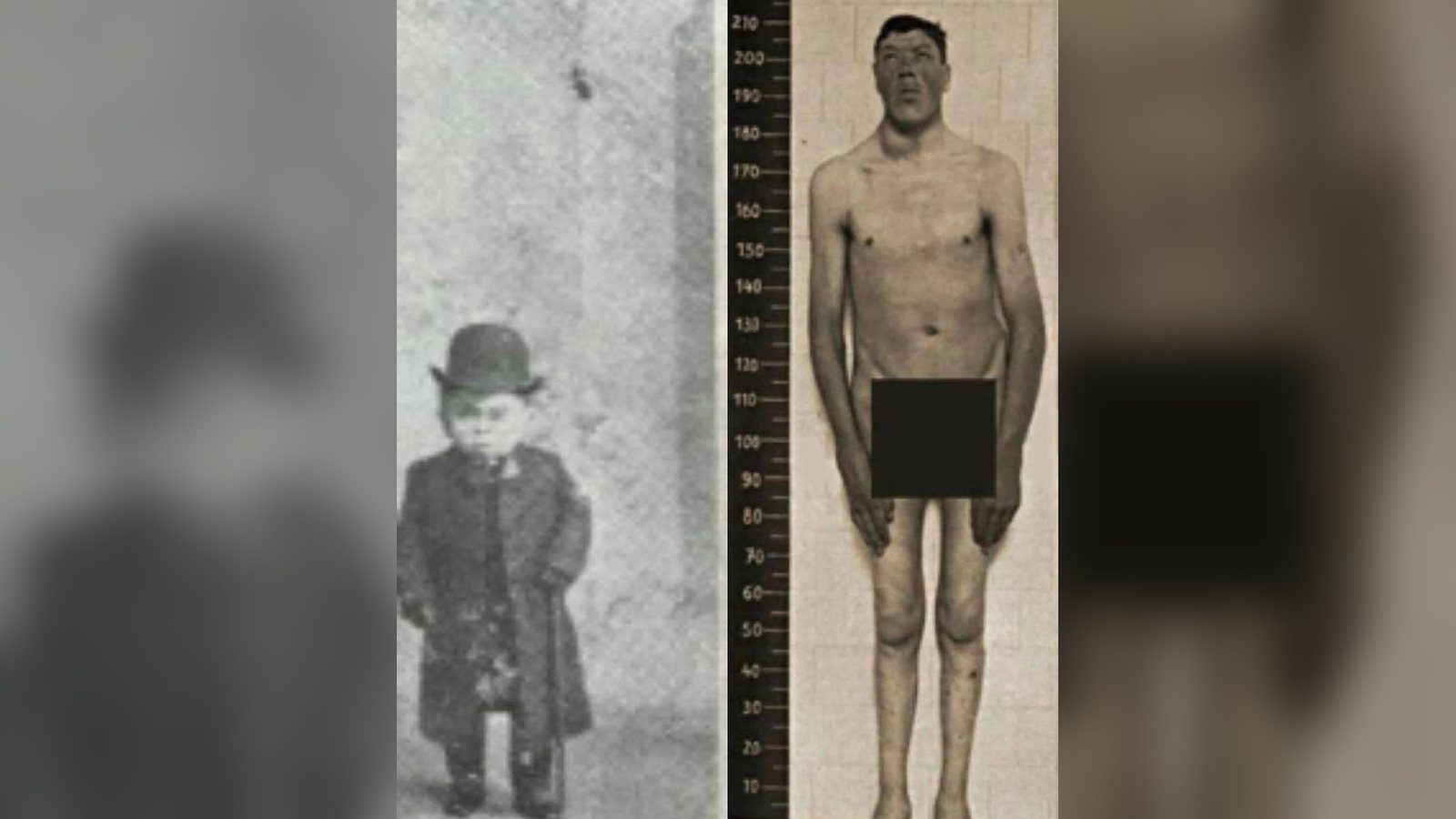
This rare medical photograph captures a profound biological anomaly: a human frame caught between the extremes of human stature. Preserved within clinical archives and medical journals from the mid-20th century, such imagery represents the only verified visual record of Adam Rainer, an Austrian man whose life defied standard medical understanding. While internet folklore often mislabels unrelated historical photographs of circus performers, authentic documentation from endocrinologists tells a startling true story. This article explores the provenance of these rare images, the mechanics of Rainer’s condition, and how a quiet life in southern Austria became a cornerstone of medical history.
What the photograph shows
The verified photographs of Adam Rainer, published notably by Dr. Oscar Hirsch in 1961, display a man bearing the stark physical hallmarks of advanced acromegaly. In these clinical frames, Rainer’s towering height is accompanied by visibly enlarged hands, feet, and facial features, including a prominent mandible, enlarged nose, and thickened lips. Unlike sensationalized postcards of contemporary sideshow giants, these photographs were captured in a clinical setting to document an unprecedented medical phenomenon. The visual evidence reveals not just height, but the asymmetrical toll that unchecked growth hormone production took on his skeletal and muscular structure over decades.
The moment behind the image
Born in Graz, Austria, in 1899 to parents of average height, Rainer spent his youth with an extraordinarily small stature. Historical military records indicate that during World War I, in 1917 and subsequent enlistment attempts, he stood roughly 122.5 to 138 centimeters tall—well under the height threshold required for service—despite possessing unusually large size 10 shoes. For the first twenty years of his life, society and medicine classified him as a person with dwarfism. Then, around his 21st or 26th year, a dormant benign tumor on his pituitary gland began excessively hyper-secreting growth hormone. What followed was a violent, unrelenting growth spurt. Rainer began expanding upward and outward at an alarming rate, adding inches every year until he towered over seven feet tall.
Photographer and provenance
Unlike casual street snapshots, the authentic images of Adam Rainer originated from rigorous medical examination. Doctors A. Mandl and F. Windholz began studying Rainer in 1930, identifying the underlying acromegaly driven by a pituitary tumor. In December 1930, surgeon Dr. Oscar Hirsch performed a daring and high-risk exploratory operation to remove the tumor, hoping to halt the devastating physical changes. While follow-up examinations confirmed that the aggressive vertical growth slowed, it never fully ceased, and his spine continued to curve severely. Hirsch later published these clinical photographs in 1961, cementing Rainer’s case in medical literature and establishing the verified visual archive that separates factual history from online misidentifications.
Historical context
Rainer’s life unfolded during an era when endocrinology was in its infancy, and surgical interventions on the brain carried staggering mortality rates. Contemporaries like Robert Wadlow, the tallest recorded man in history, faced similar pituitary disorders in the United States, yet modern endocrinology recognizes Rainer’s trajectory as entirely unique. To transition from severe dwarfism to clinical gigantism is a physiological paradox. Alongside his massive height gains—reaching approximately 234 centimeters (7 feet 8 inches) by his death—Rainer suffered progressive health complications, including spinal curvature, loss of vision in his right eye, and hearing deterioration, though local physicians noted he remained ambulatory and cared for himself late into life before passing away on March 4, 1950.
Why it still matters
Decades after his passing, Adam Rainer remains a singular figure in medical textbooks and Guinness World Records. The authenticated photographs serve as vital historical artifacts of human resilience and the mysteries of the endocrine system. By distinguishing true clinical records from miscaptioned circus postcards, historians and medical professionals continue to study Rainer’s case to understand the complexities of skeletal development, pituitary function, and the profound limits of the human body.