


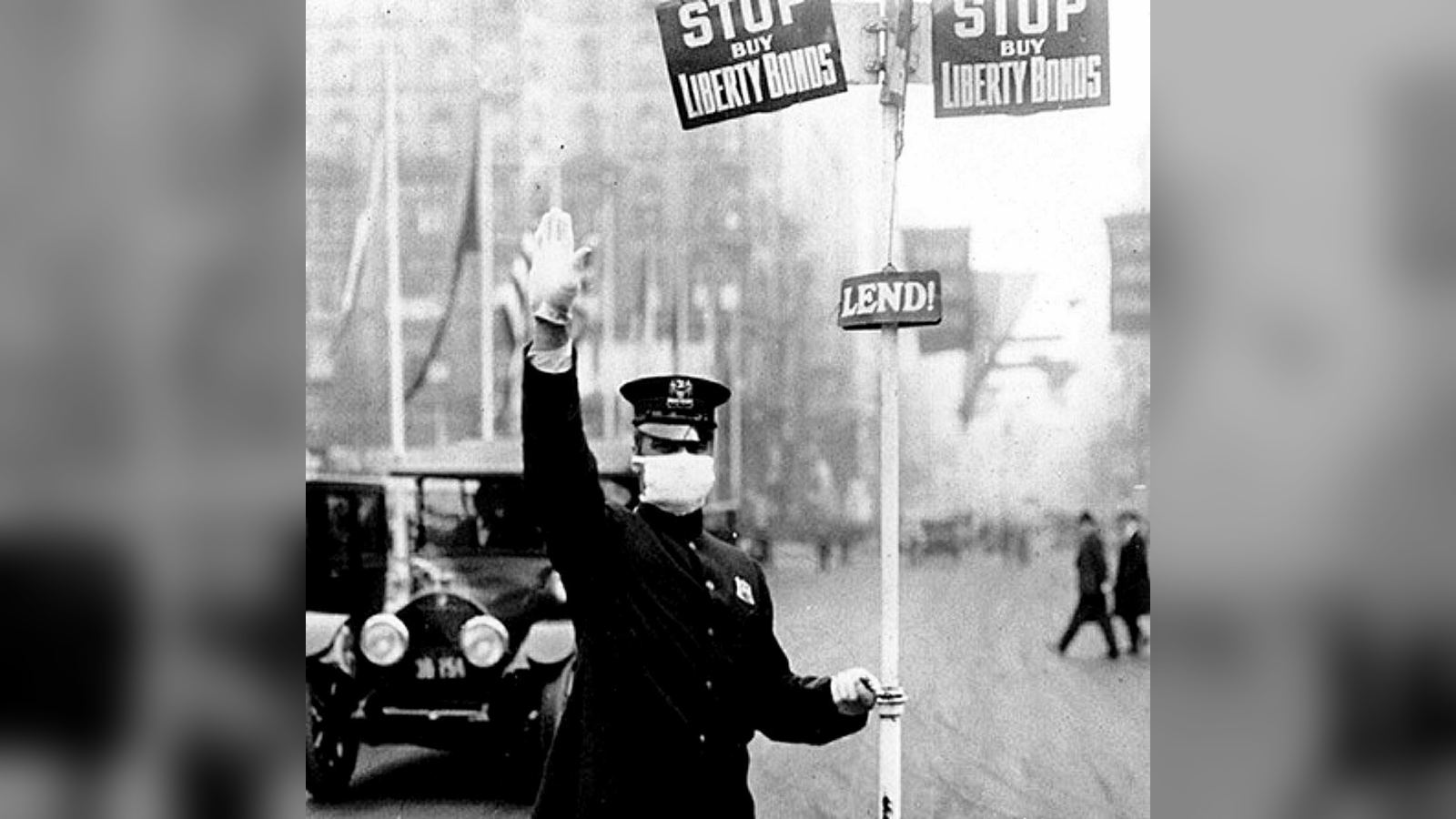
Standing firm amidst the bustling noise and early autumn haze of 1918 Manhattan, a New York traffic policeman gazes directly past the camera lens, his lower face entirely concealed by a simple white gauze mask. This arresting historical photograph, preserved within the extensive collections of the U.S. National Archives and officially dated October 16, 1918, freezes a fleeting instant of profound public health tension. As the lethal second wave of the Spanish influenza tore ruthlessly through global populations while World War I raged concurrently across Europe, urban streets transformed overnight into unwitting frontlines of a silent war. Looking closely at the frame, the viewer is immediately confronted by a striking juxtaposition: the familiar symbols of authoritative civic order—a heavy woolen uniform coat, gleaming brass buttons, and a regulation service cap—now paired with an unfamiliar, clinical facial covering that signals invisible, airborne peril. This photograph captures far more than a routine traffic stop; it preserves the exact moment when the ordinary machinery of urban life collided with a global biological catastrophe, raising eternal questions about how society functions when every shared breath carries risk.
What the photograph shows
The visual composition centers tightly on the traffic officer, capturing him upright and alert during the height of the crisis. His heavy winter-weight uniform marks him as a classic New York City “cop” of the late 1910s, charged with managing the chaotic confluence of horse-drawn delivery wagons, electric streetcars, and the rapidly multiplying internal combustion automobiles of the era. Tied securely over his nose and mouth is a multi-layered gauze mask, fashioned hastily from surgical fabric—an extraordinary and jarring accessory for law enforcement personnel at that time. His posture is resolute and unyielding, projecting professional composure and authority despite the underlying anxieties of the contagion sweeping the metropolis. While the background remains softly muted with the damp atmospheric haze of a crisp October day, the razor-sharp focus on his masked visage highlights the sudden, radical intrusion of biological hazard into the ordinary routine of street-level traffic direction. Every visible fold in the gauze and every glint of metal on his badge tells a story of immediate, improvised protection against an enemy too small to be seen.
The moment behind the image
By October 1918, the Spanish flu was sweeping mercilessly through American cities, ultimately claiming tens of thousands of lives in New York alone. The city’s Department of Health scrambled frantically to contain the airborne pathogen by encouraging widespread preventive measures, including the municipal distribution of specialized gauze masks to essential workers who interacted with thousands of citizens daily. Approximately 1,700 such protective masks were allocated specifically to the city’s police force to safeguard officers on duty. Traffic officers stood at congested, high-volume intersections exposed to endless streams of pedestrians and commuters, making them exceptionally vulnerable to infection yet completely vital for maintaining public order in a nervous metropolis. In the moments immediately before the photographer raised the camera, this officer likely spent hours signaling horse carts and early trucks to halt and proceed, his voice muffled by the thick fabric across his face. After the shutter clicked, he would have continued his grueling shift under the unrelenting autumn gray, embodying the quiet, unheralded endurance required of urban servants during an unprecedented health emergency.
Photographer and provenance
The photograph is housed in the archival holdings of the U.S. National Archives at College Park, Maryland, specifically within the records of the War Department, Record Group 165. While the individual photographer remains officially uncredited in archival metadata—a common occurrence for military and government documentation produced during this era—the image was created under the direct auspices of the U.S. Army’s Medical Department as part of an official visual survey concerning the 1918 influenza epidemic. The federal government and military agencies frequently commissioned or gathered such photographs to document medical responses, logistical challenges, and home-front mobilization during wartime. Over subsequent decades, this particular frame migrated from dusty departmental filing cabinets into historical publications, academic texts, and digital preservation platforms, transforming a routine bureaucratic record into an iconic visual touchstone of 20th-century epidemiological history.
Historical context
Although the influenza pandemic ultimately claimed more than 20,000 lives in New York City, the metropolis suffered a lower per-capita mortality rate than severely impacted cities like Boston, Philadelphia, or San Francisco. Modern historians and epidemiologists attribute this relative success to New York’s robust public health infrastructure, aggressive quarantine protocols, and proactive intervention strategies enforced by health authorities. Public education campaigns utilized persuasive slogans, famously urging citizens that it was “better to look ridiculous than to be dead,” successfully bridging the gap between scientific advice and public compliance. Police officers played a direct role in enforcing sanitary ordinances, managing emergency hospitals, and modeling compliance by wearing gauze masks in public view, thereby reinforcing municipal directives through personal example.
Why it still matters
More than a century after its exposure, this archival frame resonates with startling modern relevance, bridging the gap between past and present to demonstrate how human societies confront invisible biological threats. It stands as a testament to the power of collective discipline, municipal organization, and frontline sacrifice during moments of existential crisis. The masked New York officer remains an enduring symbol of resilience, reminding contemporary viewers of a historical crossroads when the simple act of covering one’s face became an essential act of civic duty and shared survival.