


What the photograph shows
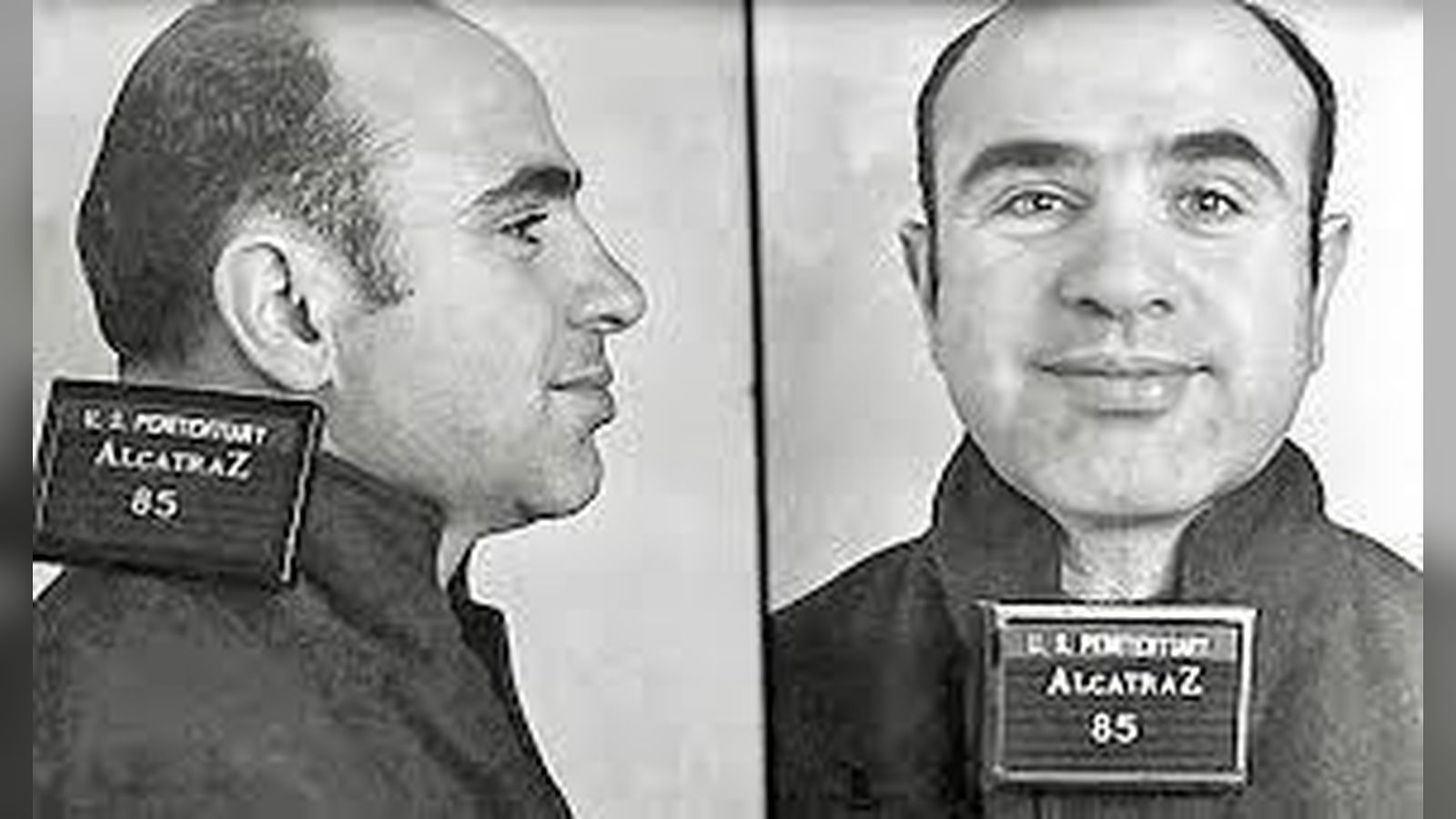
This striking historical photograph captures Al Capone under heavy federal guard in 1934, moments after his arrival at the newly established maximum-security federal penitentiary on Alcatraz Island. The frame focuses intently on the notorious Chicago boss’s guarded demeanor, capturing the grim and oppressive atmosphere of San Francisco Bay’s legendary fortress. Dressed in standard civilian transfer attire under the watchful eyes of federal marshals and armed guards, Capone’s posture reflects a man whose absolute reign over the American underworld had abruptly vanished. Photographed from an authorized press vantage point, the image visually contrasts his once-untouchable status as a wealthy syndicate leader with the stark, uncompromising reality of federal incarceration.
A close visual reading of the composition reveals the severe architecture of the island installation and the methodical choreography of federal law enforcement. The sharp morning light glints off official badges and the cold concrete docks, casting long shadows that accentuate the gravity of the transfer. Capone does not display the defiant swagger or theatrical smiles seen in earlier courthouse photographs from his 1931 tax evasion trial; instead, his expression is tight, hooded, and subdued. The surrounding officers maintain a tight defensive perimeter, their uniforms and physical positioning reinforcing the unprecedented nature of handling America’s most high-profile prisoner. Every detail within the frame—from the heavy wooden doors of the launch to the distant, fog-shrouded silhouette of the San Francisco coastline—underlines the complete finality of his removal from society.
The moment behind the image
By the spring of 1934, the federal government had grown increasingly dissatisfied with Capone’s continued influence, wealth, and socializing inside Atlanta Federal Penitentiary, where he was serving an eleven-year sentence for tax evasion. Corrupt guards and compliant inmates allowed the imprisoned mob boss to maintain operational lines of communication with his outside syndicates, subverting the punitive intent of his sentence. To sever his criminal network entirely and make an unmistakable example of him, Attorney General Homer Cummings and Bureau of Prisons director James V. Bennett orchestrated a secretive, highly secure transfer to the newly opened federal prison on Alcatraz Island, famously nicknamed ‘The Rock.’
The arrival captured by this photograph marked the absolute closing chapter of Capone’s active criminal mythos. Stripped of his tailored silk suits, custom diamond jewelry, pocket cash, and armed entourage, he stepped onto the cold concrete docks of the San Francisco Bay installation as inmate AZ-85. The journey itself had been executed under a veil of extreme military secrecy, utilizing armored railway cars, heavily guarded convoy vehicles, and armed coast guard cutters to prevent any potential ambush or rescue attempt by remaining loyal gang members. When the camera shutter clicked to record his boots hitting the dock, it signaled more than just a change of address; it documented the federal government’s decisive reclamation of law and order during the darkest years of the Great Depression.
Photographer and provenance
Distributed widely by major news agencies, wire services, and photographic syndicates of the era—including Acme Newspictures and International News Photos—this image quickly became a foundational artifact of American photojournalism. Press photographers assigned to cover the federal crackdown on organized crime had positioned themselves on authorized launch boats and observation points around San Francisco Bay, anticipating the arrival of the nation’s most infamous prisoner. Because Alcatraz was heavily restricted by military and federal authorities, access to the actual docking area was strictly limited to official personnel, leaving wire service photographers to capture the dramatic sequence from permitted perimeter angles and arriving transport vessels.
The survival and widespread archival preservation of these glass-plate and film negatives ensured their enduring place in history. Preserved across institutional repositories such as the National Archives and Records Administration, regional library collections, and commercial photo libraries like Getty Images, the photograph has been reproduced in hundreds of documentary films, true-crime publications, and historical exhibitions. While specific individual attribution for the exact camera operator often varied across syndicates that purchased and syndicated the wire photo, the image remains a masterclass in Depression-era spot news documentation, capturing a fleeting historical juncture with crystalline precision.
Historical context
The 1934 transfer to Alcatraz occurred at the absolute height of the federal government’s aggressive legislative and law enforcement campaign to dismantle America’s most ruthless criminal syndicates. Following the repeal of Prohibition in 1933, federal agencies sought new avenues to prosecute and isolate gangsters who had amassed colossal fortunes through bootlegging, racketeering, and public corruption. Yet, while the newly fortified prison walls of Alcatraz were deliberately designed to break his spirit and sever his underworld ties, an unseen and far more destructive biological force was already dismantling Capone from within.
Contracted decades earlier during his early days working in Chicago bordellos, an unchecked case of syphilis was quietly invading his central nervous system. During his years confined to Cell No. 181 on Alcatraz, neurosyphilis steadily eroded his mental faculties, causing erratic behavior, severe cognitive decline, memory lapses, and hallucinations. He frequently failed to follow guards’ orders—not out of calculated defiance, but due to an inability to cognitively process instructions—and was eventually certified legally insane. This profound medical deterioration rendered him entirely harmless long before his eventual compassionate release in November 1939, transforming the once-feared mastermind into a tragic figure broken by disease.
Why it still matters
Decades after the shutter clicked on that chilly San Francisco morning, this photograph endures as an iconic cultural artifact of the twentieth-century American underworld. It freezes the precise historical junction where the larger-than-life myth of the invincible mob boss collided with the unyielding machinery of the federal state and biological mortality. Long after the Tommy guns fell silent and the iron cellblocks of Alcatraz closed their heavy doors for the final time, this image remains a haunting reminder of the ultimate unraveling of Al Capone, serving as a timeless visual testament to the limits of power, crime, and human endurance.