


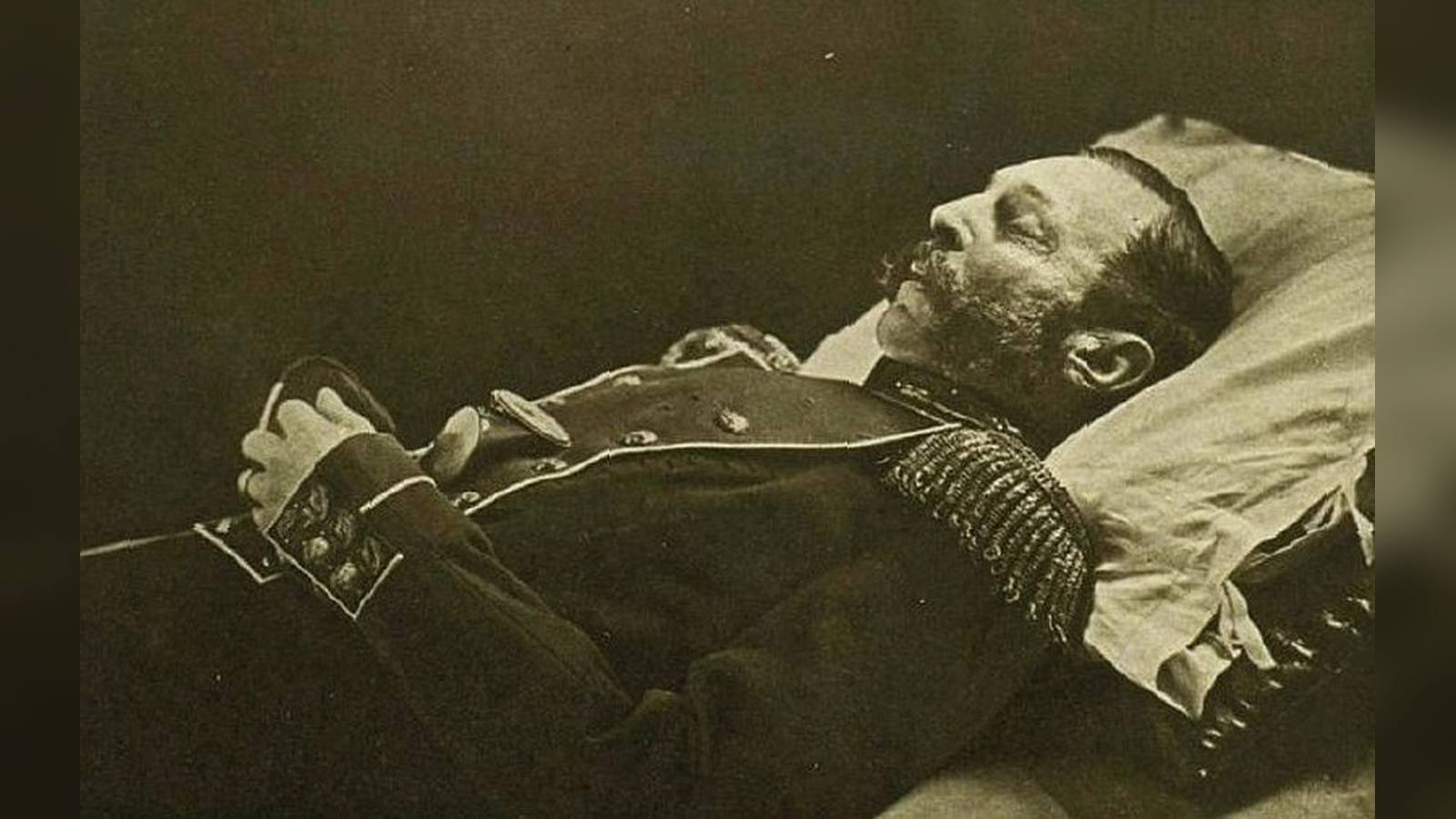
This poignant visual record captures the harrowing aftermath of a defining moment in Russian history: the mortal remains of Emperor Alexander II resting quietly on his deathbed in Saint Petersburg, just two days after the catastrophic bomb attack on March 1, 1881. Rather than a direct photographic snapshot taken inside the heavily guarded death chamber of the Winter Palace, this historical artifact survives primarily through Konstantin Makovsky’s dramatic commemorative canvas, which immortalized the fallen autocrat for posterity. By examining the visual composition of the frame, its intricate carved border, and the complex provenance connecting it to imperial-era collectors, this feature unpacks how a single tragic image came to encapsulate the sudden, violent collapse of an entire political era.
What the photograph and visual record show
Within the central focus of the frame, the deceased monarch lies in repose, draped in solemn linens, his facial features etched with the finality of the fatal wounds inflicted by Ignaty Grinevitsky’s explosive device. The lighting is low, somber, and reverent, casting deep shadows across the deathbed and drawing the viewer’s eye directly to the sovereign’s quiet profile and the stillness of his posture. Yet the visual narrative extends far beyond the central portrait: the painting is encased in an extraordinary, highly unusual commemorative frame commissioned or curated to honor his reign. Inscribed directly onto the wood in carved relief are the defining milestones of his governance—such as the emancipation of the serfs, the freedom of the press, and the establishment of public trial by jury—culminating in the stark, chilling epitaph at the base: "Killed on March 1, 1881." This physical melding of portraiture and legislative ledger turns the artwork into a visual shrine, forcing the viewer to confront the paradox of a reformer monarch cut down by the very society he sought to modernize.
The moment behind the image
The historical backdrop to this imagery is charged with terminal tension. On a snowy Sunday afternoon in March 1881, members of the radical terrorist organization Narodnaya Volya (The People’s Will) hurled explosives at the Emperor’s carriage along the Catherine Canal in Saint Petersburg. Alexander, known to history as the Tsar Liberator for abolishing serfdom in 1861 and introducing sweeping judicial and local government reforms, survived the initial blast of Nikolai Rysakov’s bomb, only to be mortally wounded when Ignaty Grinevitsky detonated a second device directly at his feet. Rushed to the Winter Palace in a state of catastrophic blood loss, the Emperor succumbed to his injuries hours later amid frantic medical efforts and unimaginable grief among his family. The immediate aftermath plunged the imperial capital into profound shock, triggering massive security crackdowns, widespread public mourning, and a swift, decisive political shift away from the tentative constitutional liberalizations of his late reign toward the rigid autocracy of his son and successor, Alexander III.
Artist, provenance, and collection
The painting itself was executed by Konstantin Makovsky, a prominent Russian realist and historical painter celebrated for his grand canvases and keen eye for dramatic portraiture. It eventually entered the notable private collection of Kozma Soldatenkov, a prominent Moscow merchant, publisher, and patron of the arts whose extensive holdings later enriched the cultural heritage of institutions like the State Tretyakov Gallery. Soldatenkov’s discerning eye brought together works that reflected both domestic realities and national historical drama. While contemporaries like the formidable critic Vladimir Stasov grouped Soldatenkov alongside fellow collectors Pavel Tretyakov and Fyodor Pryanishnikov as the foundational pillars of Russian cultural patronage, pieces like Makovsky’s memorial to Alexander II served a deeply somber, almost devotional function within private collections, acting as visual shrines to a fractured national identity that struggled to reconcile autocracy with reform.
Historical context and legacy
The assassination of Alexander II marked a devastating psychological turning point for the Russian Empire. For two tumultuous decades, the nation had wrestled with the seismic social restructuring set in motion by the Great Reforms of the 1860s. Makovsky’s depiction, heavily augmented by its programmatic and didactic frame, reads almost as a visual ledger of a reign torn between modernization and the desperate survival of autocracy. By preserving the image of the fallen tsar side-by-side with the catalog of his historic reforms, the artwork transformed a gruesome political assassination into a tragic historical monument, ensuring that the profound contradictions of late-nineteenth-century Russia would remain permanently etched in the national consciousness.
Why it still matters
As rare exhibitions continue to bring hidden masterpieces out of museum archives and private vaults, works like Makovsky’s portrayal of Alexander II remind modern audiences of the heavy human and political costs embedded in historical transition. The image endures not merely as a historical portrait of a dead monarch, but as a powerful visual archive of trauma, capturing the precise, fragile moment an empire lost its footing and plunged headlong into an uncertain, turbulent future.