


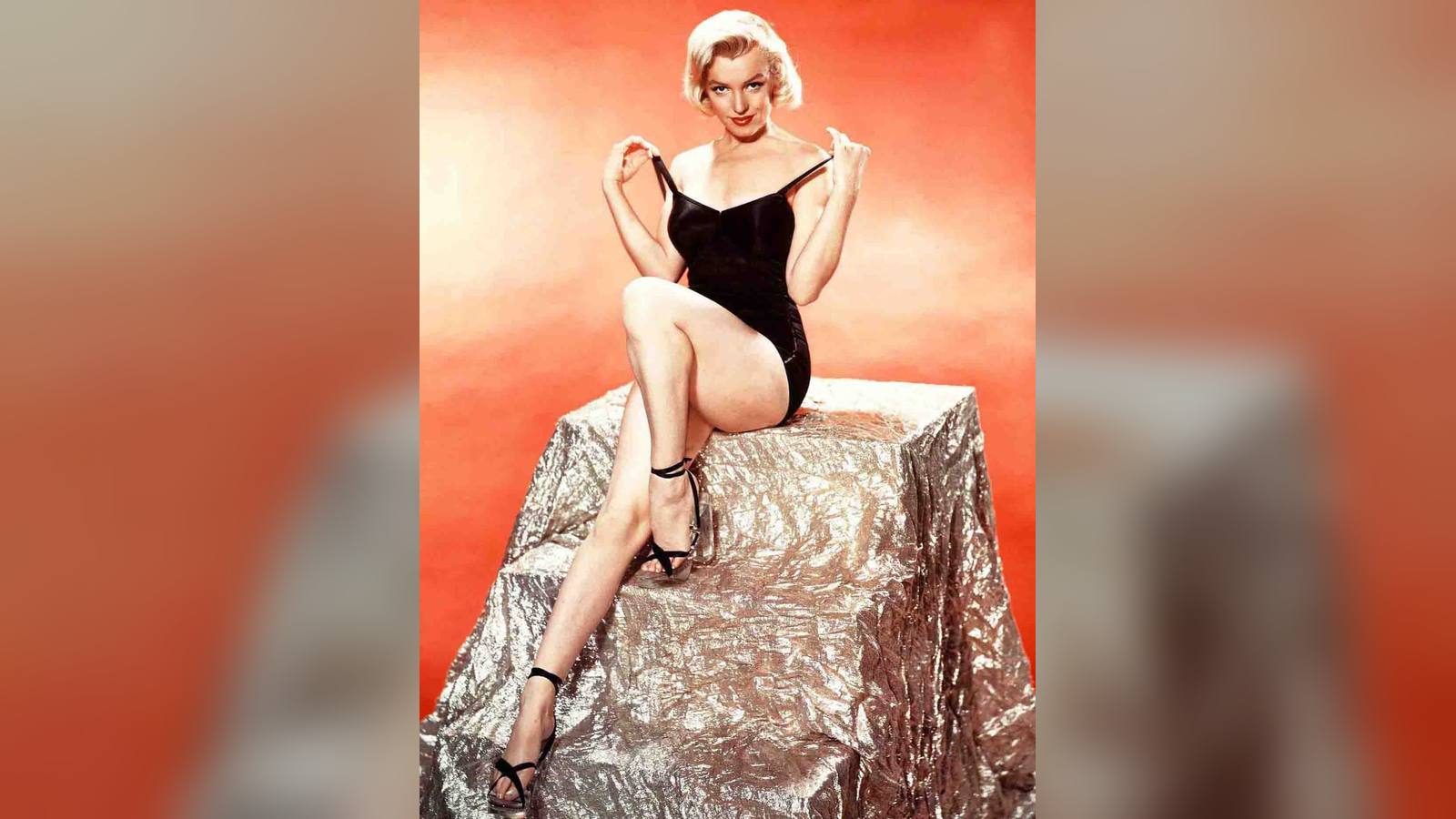
In this striking 1951 portrait, Marilyn Monroe looks into the lens not yet as the untouchable myth of mid-century cinema, but as an ambitious twenty-four-year-old actress on the cusp of an unprecedented ascent. Draped in voluminous layers of dark tulle with an off-the-shoulder neckline, she sits framed by studio lighting that catches the soft curl of her platinum hair, the deliberate poise of her hands, and an expression poised delicately between vulnerability and absolute composure. Photographed on March 29, 1951—the day of the 23rd Annual Academy Awards—the image preserves a watershed moment in photographic and cinematic history: the exact threshold where Norma Jeane Mortenson firmly commanded the apparatus of American celebrity culture.
What the photograph shows
The visual power of the photograph lies in its calculated elegance and dramatic restraint. Monroe wears an evening gown of dense black netting and sheer fabric, a striking departure from the shimmering metallics, satins, and pastels typically associated with Hollywood red carpet pageantry of the early 1950s. Her bare shoulders and décolletage contrast sharply against the dark silhouette of the dress, creating a graphic tonal balance under the controlled tungsten lamps of the studio setup. Her posture is upright yet supple, her gaze level and searching, free from the exaggerated pout or comedic breathlessness that studios often demanded of her in promotional stills. Every element—from the manicured nails resting against the sheer fabric to the precise fall of her short blonde waves—points to a performer acutely aware of how light sculpts identity.
The moment behind the image: The 1951 Oscars
The photograph was made in conjunction with Monroe’s first and only appearance on the Academy Awards stage as a presenter. On the evening of March 29, 1951, at the RKO Pantages Theatre on Hollywood Boulevard, Monroe took the podium to present the Oscar for Best Sound Recording to sound director Thomas T. Moulton for Joseph L. Mankiewicz’s critically acclaimed drama All About Eve. Monroe herself had appeared in the film as Miss Claudia Casswell, an aspiring graduate of the “Copacabana school of dramatic art,” delivering brief but scene-stealing dialogue alongside George Sanders and Bette Davis. The dress she wore for both the ceremony and Florea’s portrait was an elaborate costume borrowed directly from the wardrobe archives of 20th Century Fox. Backstage lore recounts that just moments before walking out in front of the Pantages audience, Monroe discovered a tear in the gown’s delicate tulle and burst into panicked tears, terrified she would ruin her biggest public industry appearance to date. After quick emergency mending by studio seamstresses, she stepped onto the stage flawless and composed, a triumph of poise over panic that Florea’s camera had already anticipated hours earlier.
Photographer and provenance: John Florea and Collier’s
The man behind the camera was John Florea, one of the premier American photojournalists of the twentieth century. Florea had earned international renown as a courageous war correspondent for Life magazine, documenting the brutal frontlines of the European theater, the liberation of concentration camps like Nordhausen, and the bitter winter battles of the Pacific. Returning to postwar California, Florea brought the sharp eye, technical precision, and emotional immediacy of combat reportage into the heavily stage-managed world of Hollywood portraits. Rather than relying on rigid, flat studio glamour conventions, Florea preferred dynamic, naturalistic framing that captured his subjects’ psychological presence. His March 1951 session with Monroe yielded a series of intimate and formal studies, several of which were licensed to national periodicals. Most notably, they illustrated a major multi-page feature titled “The 1951 Model Blonde” in the September 1951 issue of Collier’s magazine, cementing Monroe’s status across millions of American living rooms as the definitive screen beauty of a new decade.
Historical context: Crafting an icon
In early 1951, Monroe’s future in Hollywood was far from guaranteed. Though her small supporting parts in John Huston’s The Asphalt Jungle and Mankiewicz’s All About Eve had earned praise from critics, she was still signed to modest studio contracts and frequently relegated to cheesecake pin-up layouts. Florea’s session represents a conscious, collaborative effort to elevate her visual grammar from provincial starlet to sophisticated leading lady. Monroe understood the camera better than almost any of her contemporaries, recognizing that still photography was not secondary to motion pictures, but the primary engine of modern fame. Working with photographers like Florea, she learned how to manipulate exposure, posture, and mood to build an enduring public persona that pushed back against the studio system’s narrow expectations.
Why it still matters
Decades after Marilyn Monroe’s death, Florea’s 1951 portrait endures because it lacks the tired clichés of posthumous Marilyn memorabilia. It captures an artist in total control of her instrument, standing at the precipice of international superstardom before the overwhelming commercialization and tragedy of her later years took hold. The frame remains an indispensable historical artifact of Hollywood’s Golden Age—a testament to how a brilliant photojournalist and an exceptionally gifted subject could transform borrowed studio tulle and stage fright into permanent cultural memory.