


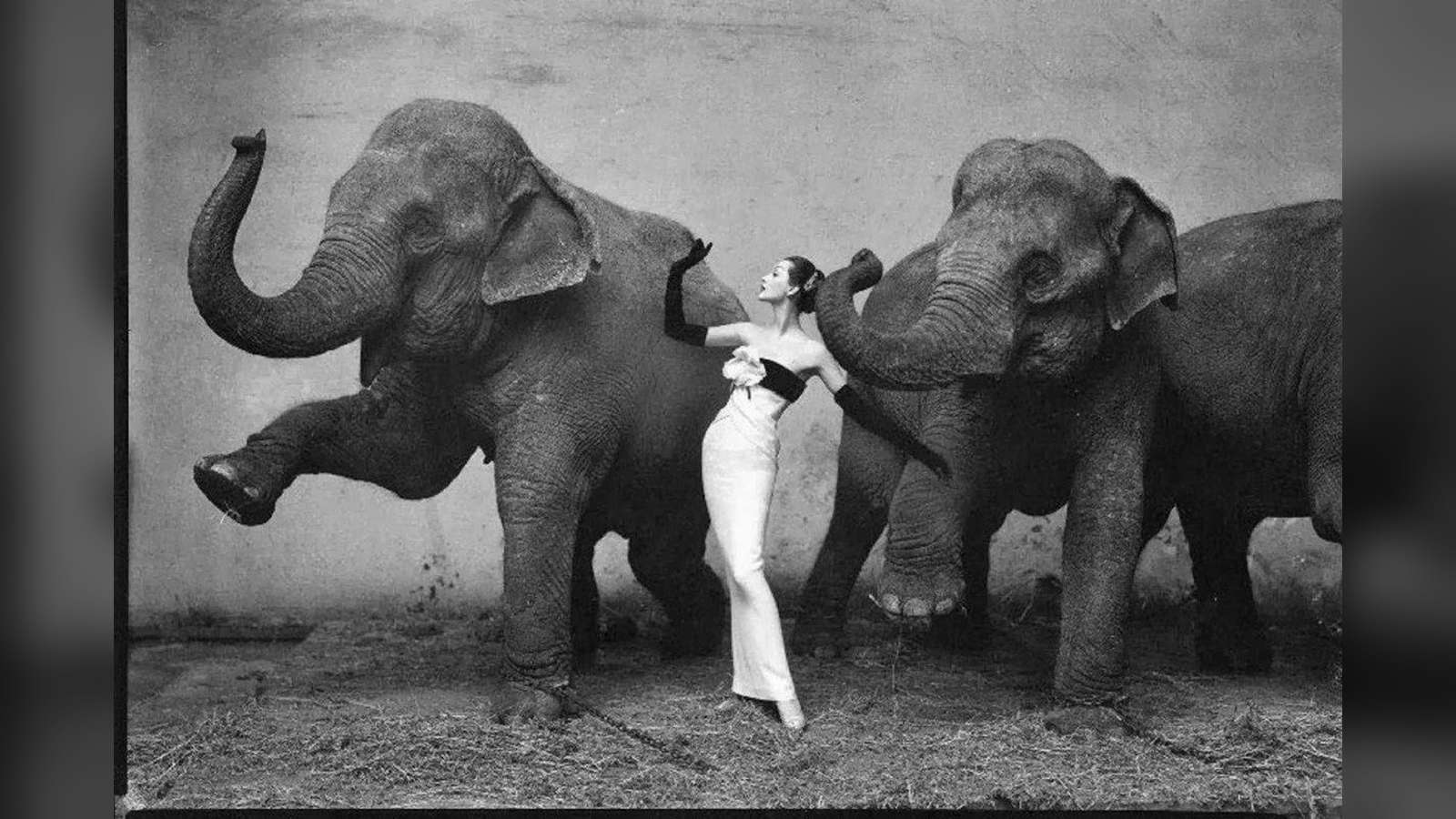
A woman of porcelain stillness extends her arm toward the textured trunk of a towering circus elephant, her body arched in an S-curve of immaculate elegance inside the dim interior of a Parisian ring. Richard Avedon’s 1955 masterpiece, titled Dovima with elephants, evening dress by Dior, Cirque d’Hiver, Paris, August 1955, remains one of the defining triumphs of twentieth-century photography. Rather than treating fashion as a static catalog of garments, this frame turned high fashion into high theater. What makes this single instant endure across decades, and how did a spontaneous assignment in a circus arena become a watershed moment in the history of visual culture?
What the photograph shows
In the center of the frame stands Dorothy Virginia Margaret Juba, known professionally as Dovima, the era’s highest-paid and most celebrated model. She wears an austere black evening gown accented with a wide sash of white satin, an ensemble that hugs her silhouette before sweeping downward. Flanking her on either side are two Asian circus elephants, their leathery, crinkled hides and chained legs providing an intense physical contrast to the smoothness of Dior’s fabric and Dovima’s pale skin. In the shadowy background, a third elephant shifts into partial obscurity beneath the vaulted architecture of the arena.
Avedon’s composition relies on dramatic contrast and rhythmic tension. Dovima’s outstretched right hand mimics the curvature of the raised elephant’s trunk beside her, creating an extraordinary dialogue between human grace and brute animal strength. The sawdust on the floor, the heavy iron chains around the elephants’ ankles, and the dark, textured perimeter of the arena evoke captivity and grit, while Dovima appears completely serene, almost otherworldly. Her expression is calm, imperious, and detached, untouched by the immense creatures towering over her.
The moment behind the image
The photograph was created in August 1955 during Avedon’s annual pilgrimage to Paris to cover the autumn-winter haute couture collections for Harper’s Bazaar. Legendary editor-in-chief Carmel Snow had sent Avedon to France to capture the Parisian spirit, granting him immense creative latitude. Rather than booking a conventional salon or naturalistic Parisian street, Avedon chose the historic Cirque d’Hiver on the rue Amelot, a permanent winter circus inaugurated in 1852 by Napoleon III.
Inside the arena, working under available skylight complemented by carefully positioned strobe lights, Avedon directed Dovima alongside the circus trainers. The working conditions were demanding: the arena smelled of damp straw and animal musk, and the elephants had to be commanded into their dynamic poses while the model held rigorous poses in delicate couture. Avedon took numerous frames on large-format film, testing subtle variations in Dovima’s posture and the position of the elephants’ trunks. In the chosen exposure, the balance snapped into absolute perfection—the moment when gesture, lighting, and composition coalesced into a single, seamless narrative.
Photographer and provenance
By 1955, Richard Avedon had already transformed fashion photography, stripping away the rigid, stiff mannequins favored in pre-war magazines in favor of models who laughed, leaped, and walked briskly through city streets. Yet, as he later admitted, his artistic roots always carried a theatrical instinct. Working alongside art director Alexey Brodovitch, Avedon believed that a magazine spread could carry the weight and formal rigour of classical art.
The gown itself holds remarkable historical pedigree. Although bearing the label of Christian Dior, the dress was among the very first major designs conceived by the house’s newly hired nineteen-year-old assistant, Yves Saint Laurent. Published in the September 1955 issue of Harper’s Bazaar, the photograph immediately captivated the fashion industry. Decades later, Avedon produced large-format exhibition prints. In November 2010, an oversized vintage print created for a 1978 retrospective was auctioned at Christie’s in Paris, achieving 1,151,976 dollars (841,000 euros), setting a world auction record for Avedon’s oeuvre and confirming the photograph’s status as a bona fide art-historical treasure.
Historical context and changing visual culture
In post-Second World War Europe, haute couture was not merely a commercial luxury; it was a symbol of national recovery, cultural pride, and artistic revitalization. Christian Dior’s 1947 “New Look” had restored Paris as the undisputed capital of style, emphasizing lush fabrics and structured feminine silhouettes after years of wartime rationing. By the mid-1950s, however, visual language was evolving rapidly.
Avedon understood that the modern woman was no longer confined to gilded French salons or pristine photography backdrops. By staging Dior’s sophisticated architecture against the raw, dusty majesty of the circus, Avedon captured the post-war collision between classical refinement and an assertive, adventurous modernism. The composition evokes archetypes of beauty and the beast, fairy tale mythologies, and surrealism, bridging the gap between commercial advertising and museum-level fine art photography.
Why it still matters
Dovima with elephants remains unforgettable because it refuses to age. While fashion trends fluctuate and photographic technologies evolve from analog film to digital algorithms, the tension within Avedon’s frame remains electric. It demonstrates that commercial imagery can achieve mythic permanence when governed by rigorous aesthetic discipline and visionary daring.
Avedon once observed that his photographs had a reality for him that the subjects themselves did not possess in everyday life. In this image, Dovima is not merely a model displaying a seasonal garment; she is an ethereal, timeless protagonist frozen between ancient, lumbering giants and modern metropolitan elegance. Through the lens of Avedon’s camera, the Cirque d’Hiver became an eternal stage where fashion, danger, and beauty achieved an enduring equilibrium.