


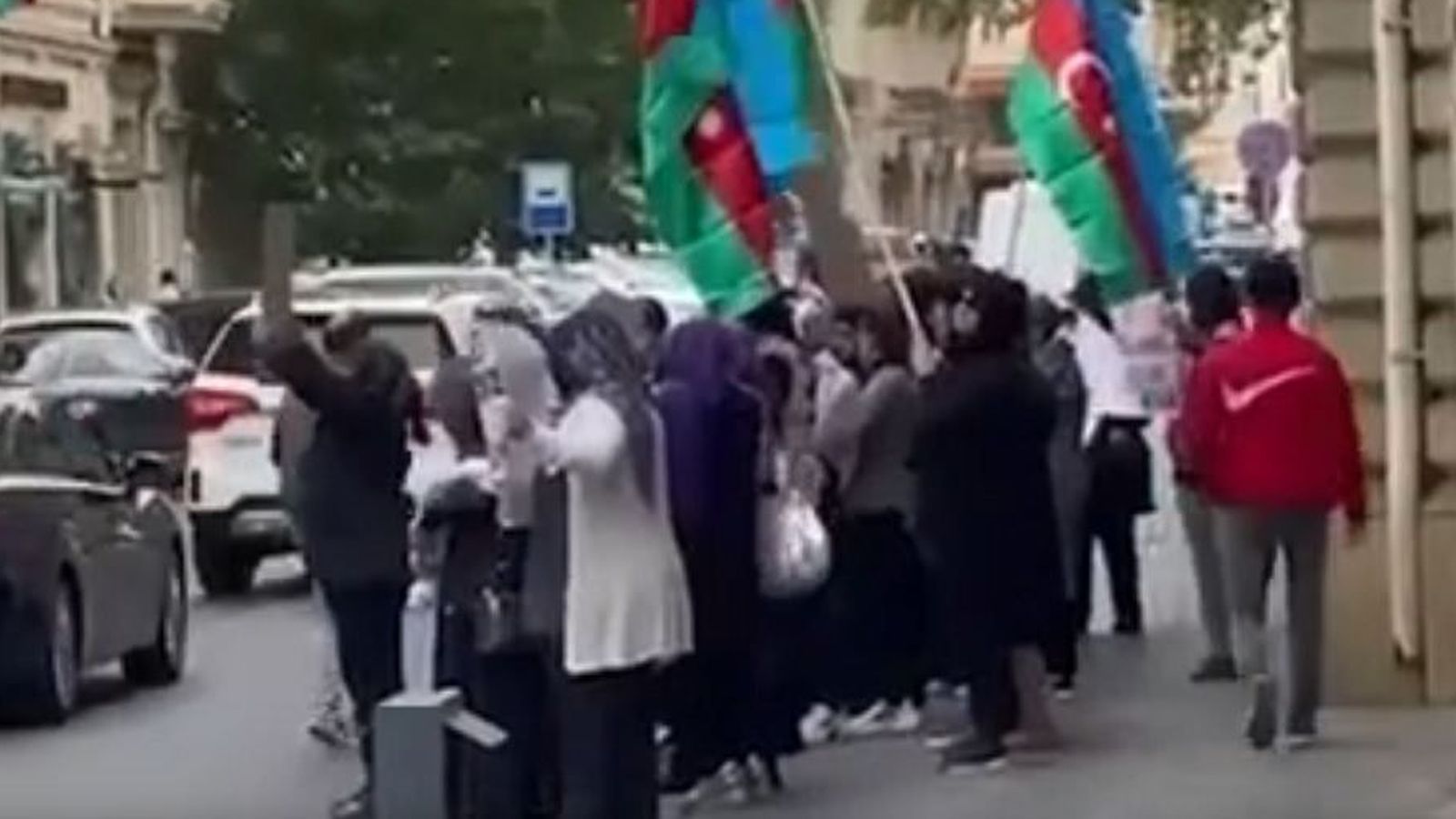
BAKU (Azat TV) – Azerbaijani authorities arrested 37 people in Baku following rare public protests and class boycotts triggered by newly enforced school uniform regulations that effectively bar the hijab, according to regional reports. The Cabinet of Ministers approved amendments enforcing a unified dress code and a secular dress code for pupils, with requirements extending to teachers. While the regulatory texts stop short of explicitly naming the Muslim headscarf, schools began actively enforcing the rules by preventing hijab-wearing students and teachers from attending classes. Videos circulating online showed emotional scenes of students and staff being turned away at school gates, prompting spontaneous demonstrations and a sharp diplomatic dispute with regional ally Turkey.
Protests, Class Boycotts and Digital Restrictions in Baku
The enforcement of the dress code ignited immediate public pushback across several educational institutions. Local outlets and social media reports confirmed that students in at least two institutions boycotted classes in protest against the restrictions, while a hijab-wearing teacher at Richard Sorge Secondary School No 90 in Baku was reportedly dismissed. The Interior Ministry stated that 37 individuals were detained for disturbing public order, damaging school property, and attempting to disrupt classes during confrontations with school staff. Amid the growing unrest, users across Azerbaijan reported widespread difficulties accessing online platforms such as Instagram and TikTok, where videos supporting the right to wear the hijab had gained traction. Many citizens noted they could only bypass the restrictions by utilizing virtual private networks, or VPNs, as authorities sought to control the flow of information regarding the demonstrations.
The Ministry of Internal Affairs maintained that those detained had crossed legal boundaries by directly confronting school personnel and damaging public property during the unrest. Videos shared widely on digital platforms depicted students embracing their dismissed teachers and weeping outside school gates. Additional footage captured female students holding signs protesting the sudden exclusion of headscarf-wearing individuals from educational facilities. These visual records quickly galvanized public sympathy across various domestic channels, leading to wider discussions regarding the limits of state-enforced secularism in public administration and schools.
As online visibility increased, citizens noted sudden disruptions across popular social platforms. Feeds stopped updating and media files failed to load properly on applications like Instagram and TikTok, prompting widespread speculation regarding intentional digital throttling by state telecommunications regulators. Observers noted that similar information controls have historically been deployed during periods of acute social friction to curb the unvetted spread of unauthorized footage and prevent further assembly.
Diplomatic Friction Between Baku and Ankara
The domestic controversy quickly spilled over into international relations, creating a rare diplomatic friction point between Azerbaijan and Turkey. Oktay Saral, an adviser to Turkish President Recep Tayyip Erdogan, alongside lawmakers from the ruling Justice and Development Party, criticized the measures publicly on social media, describing the denial of education to girls wearing headscarves as unacceptable and urging Baku to reverse the policy. In response, Azerbaijan's ruling New Azerbaijan Party condemned the remarks as populist and irresponsible, warning that they threatened bilateral ties. The ruling party emphasized that Azerbaijan operates as a constitutionally secular state and that the principle of one nation, two states does not justify foreign interference in domestic educational policies. Furthermore, the ruling party defended Baku's robust strategic and security partnerships with Israel, pushing back against renewed criticism from segments of the Turkish political establishment over foreign policy choices.
The diplomatic exchange marked a stark departure from the usual warmth characterizing relations between Baku and Ankara. Turkish officials voiced deep concern over the exclusion of young women from classrooms, drawing historical parallels to past domestic restrictions on headscarves within Turkey prior to the rise of the current administration. Conversely, Baku's leadership insisted that its sovereign right to maintain educational neutrality must remain entirely insulated from outside ideological campaigns, regardless of the source.
Furthermore, the ruling New Azerbaijan Party noted that Turkey itself maintains a firmly secular constitution, arguing that criticism originating from Ankara overlooked the foundational legal frameworks governing both nations. The party's formal statements underscored that international partnerships, including those involving defense and security cooperation with Israel, are formulated strictly on mutual interest and international law. This broader geopolitical defense highlights the complex balancing act facing Azerbaijan as it navigates domestic religious identity alongside distinct foreign policy priorities.