


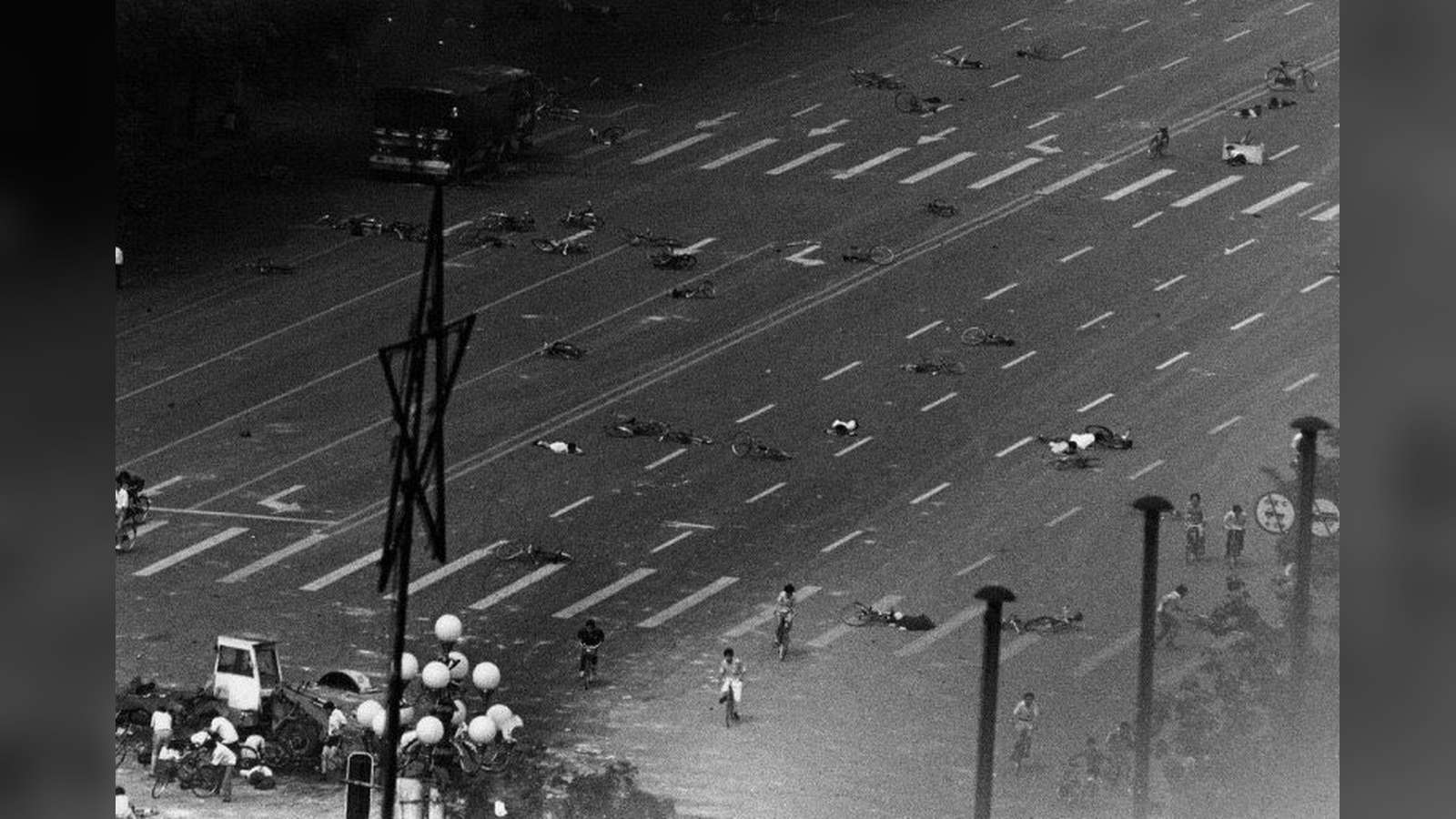
What the photograph shows
This powerful historical photograph captures the desolate, debris-strewn landscape of Beijing on the morning of June 4, 1989, immediately following the military clearance of Tiananmen Square. The wide frame presents a sobering view of urban destruction: shattered asphalt, lingering wisps of smoke from burned military and civilian vehicles, scattered personal belongings, and the heavy, oppressive stillness of a capital city under martial law. Unlike tightly framed portraits of individual defiance, this expansive vantage point emphasizes the collective scale of the urban battlefield. Every visible detail—from scorched barricades to abandoned bicycles and the deserted thoroughfares—serves as silent testimony to the violent confrontation that unfolded just hours prior. The composition is stark and unsparing, drawing the viewer’s eye across a scarred cityscape where ordinary life has been instantly upended by state violence.
The moment behind the image
The shutter moment preserved in this archival frame sits at the harrowing intersection of mass civic mobilization and brutal state suppression. In the early morning hours of June 4, 1989, heavily armed units of the People’s Liberation Army advanced into central Beijing, moving systematically to occupy Tiananmen Square and clear the surrounding major intersections. What had begun in mid-April as peaceful public mourning for the reformist former Communist Party leader Hu Yaobang had steadily escalated into a nationwide movement involving up to a million demonstrators. Students, workers, and ordinary citizens filled the square and surrounding avenues, demanding economic reforms, press freedom, and an end to official corruption. As troops opened fire with live ammunition and tanks crushed makeshift barricades, the festive atmosphere of resistance was replaced by chaotic terror. In the immediate aftermath captured by this photograph, the deafening roar of gunfire had subsided into an eerie quiet, leaving bewildered survivors and onlookers to survey the wreckage and reckon with the unprecedented human cost.
Photographer and provenance
The provenance of photographs documenting the June Fourth crackdown is rooted in immense professional risk, clandestine operations, and severe international reporting restrictions. Foreign correspondents, wire service photojournalists, and local citizen witnesses operated under constant threat of detention, confiscation of equipment, and physical violence by security forces. Many of the most enduring wide-angle views and street-level scenes were captured using telephoto lenses from the balconies of surrounding hotels, such as the Beijing Hotel, or by photographers mingling covertly with civilian crowds. Working in defiance of official martial law curfews and sweeping censorship mandates, these individuals smuggled exposed rolls of film out of China hidden in diplomatic pouches, airline baggage, and tourist luggage. The survival and subsequent global circulation of these negatives transformed transitory news events into enduring historical archives, safely housed in international libraries, human rights repositories, and museum collections across the democratic world.
Historical context
To fully grasp the visual weight of the photograph, one must understand the complex socio-political pressures that converged in Beijing in the spring of 1989. Post-Mao China was experiencing rapid economic development that brought inflation, widening income inequality, and widespread anxiety over the dismantling of state-guaranteed welfare systems, colloquially known as the iron rice bowl. When Hu Yaobang passed away on April 15, students gathered in Tiananmen Square to honor a leader associated with political tolerance, quickly turning the memorial into a broader platform for democratic grievances. The movement gained unprecedented momentum by mid-May, galvanized by a high-profile student hunger strike that inspired solidarity marches in some 400 Chinese cities. Deep divisions within the Chinese Communist Party leadership paralyzed the government’s response until hardline factions, backed by paramount leader Deng Xiaoping, prevailed. On May 20, the State Council declared martial law and mobilized hundreds of thousands of troops, setting the stage for the catastrophic showdown on the night of June 3 and 4.
Why it still matters
Decades after the shutters clicked across the boulevards of Beijing, photographs depicting the aftermath of the Tiananmen Square crackdown remain heavily censored and systematically erased within mainland China. State authorities have enforced a strict narrative blackout, forbidding public remembrance, educational discussion, or digital references to the events of June Fourth. Consequently, the preservation and dissemination of these photographic archives by international historians, journalists, and diaspora communities are vital to safeguarding historical truth. This photograph transcends its function as a mere historical artifact; it stands as an enduring universal testament to the extraordinary courage of ordinary citizens who dared to challenge authoritarian power, and a solemn reminder of the profound human price paid for demanding freedom and accountability.