


What the photograph shows
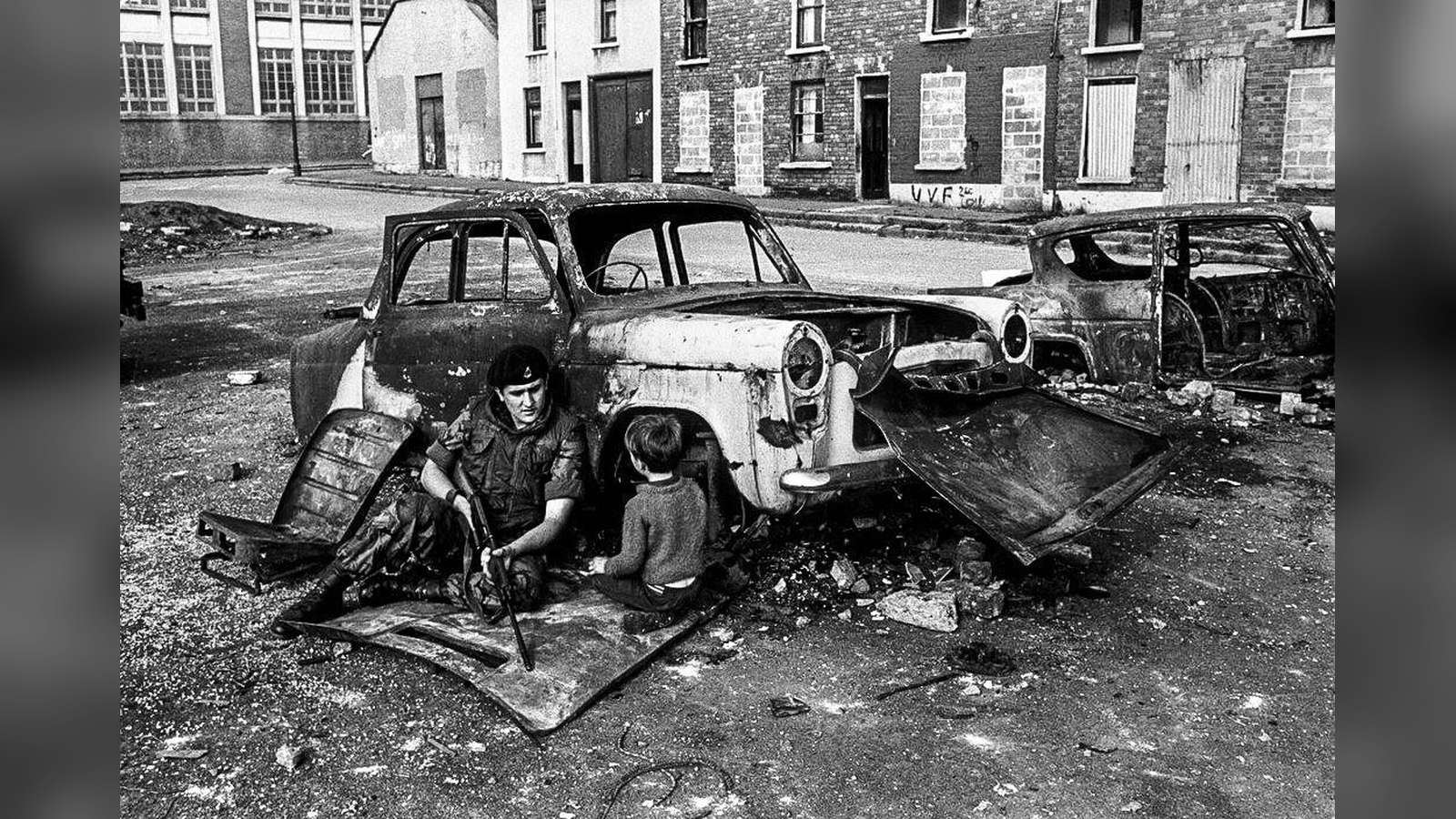
This stark, black-and-white photograph captures a chilling juxtaposition of childhood innocence and the harsh reality of urban warfare. In the foreground, a group of young children stand on a Belfast street, their expressions and postures suggesting a defiant, almost playful interaction with British soldiers. They are not cowering in fear; rather, they seem to be jeering or mocking the armed figures, a behavior that speaks volumes about the desensitization that occurred in neighborhoods under constant military occupation. The composition is deliberately framed to contrast the small, vulnerable, and unarmored figures of the children against the heavy, mechanical, and intimidating presence of the military patrol.
Behind the children, the scene is marred by the smoldering wreckage of a burnt-out car—a common sight in the city during this era. Further into the background, the silhouettes of armored vehicles and security personnel loom, reinforcing the sense of an environment under siege. The light in the image is overcast, typical of a Northern Irish winter, casting long shadows that add to the grim, heavy atmosphere of the scene. Every element of the frame, from the debris on the ground to the watchful, rigid eyes of the soldiers, suggests a city caught in an inescapable cycle of instability. The visual focus is on the children’s faces, which convey a mixture of curiosity, bravado, and an unsettling familiarity with the chaos surrounding them.
The moment behind the image
While the Getty archive dates this photograph to December 7, 1971, historical context suggests it may have been captured earlier in the year. The children’s clothing—relatively light for a December day—and the specific intensity of the unrest point toward the aftermath of the introduction of internment. Internment, the policy of detaining suspected IRA members without trial, was implemented in August 1971. The immediate period following this policy saw a dramatic spike in rioting and military raids. This photograph captures one of those moments where the ‘normal’ life of a city—school, play, and community—collided violently with the realities of an occupation force trying to maintain order in a hostile environment. The children are not just bystanders; they are active, albeit minor, participants in the social friction of the time.
Photographer and provenance
The photograph remains anonymous in its attribution, a common occurrence for news wire images of the period. Journalists and photographers from various international agencies flocked to Belfast as the conflict escalated, often working under extreme pressure and at personal risk. The image was likely commissioned as a piece of photojournalism to illustrate the escalating civil disorder for global audiences. Its survival in the Getty archive ensures it remains a primary visual document of the era. The chilling archival title, ‘Terrorists To Be,’ provides a window into the mindset of the time, revealing how the media and political observers viewed the youth of Belfast not as victims, but as an inevitable future component of the sectarian violence. This label, while historically significant as a record of bias, strips the children of their individual humanity, reducing them to political symbols.
Historical context
1971 was arguably the most volatile year of ‘The Troubles.’ The British government’s reliance on outdated intelligence to conduct raids led to the arrest of innocent civilians, including the elderly and those with no links to militant groups. These actions backfired, creating a surge of sympathy for the IRA and driving many young people toward militant republicanism. The background of the photo, featuring smoldering ruins, is a testament to the daily unrest that transformed working-class Belfast into a front line. The sectarian divide was not just a political concept; it was a physical reality etched into the streets, the burnt-out vehicles, and the constant presence of armored patrols. The social fabric of the city was being torn apart, and the children in this photo were growing up in an environment where the sound of explosions and the sight of soldiers were as normal as the morning bell at school.
Why it still matters
This photograph remains a powerful document because it strips away the political rhetoric of the time to show the human reality of the conflict. By focusing on the children, the image forces the viewer to confront the long-term social cost of the violence. As these streets have since been rebuilt and modernized, the photograph serves as a haunting reminder of a version of Belfast that has largely vanished, yet whose scars remain etched in the collective memory of those who lived through it. It stands as a testament to how an entire generation was forced to grow up in the shadow of conflict, forever changing the trajectory of Northern Irish society. It is an image that asks us to consider what happens to a child’s perception of authority when their neighborhood is treated as a battleground.