


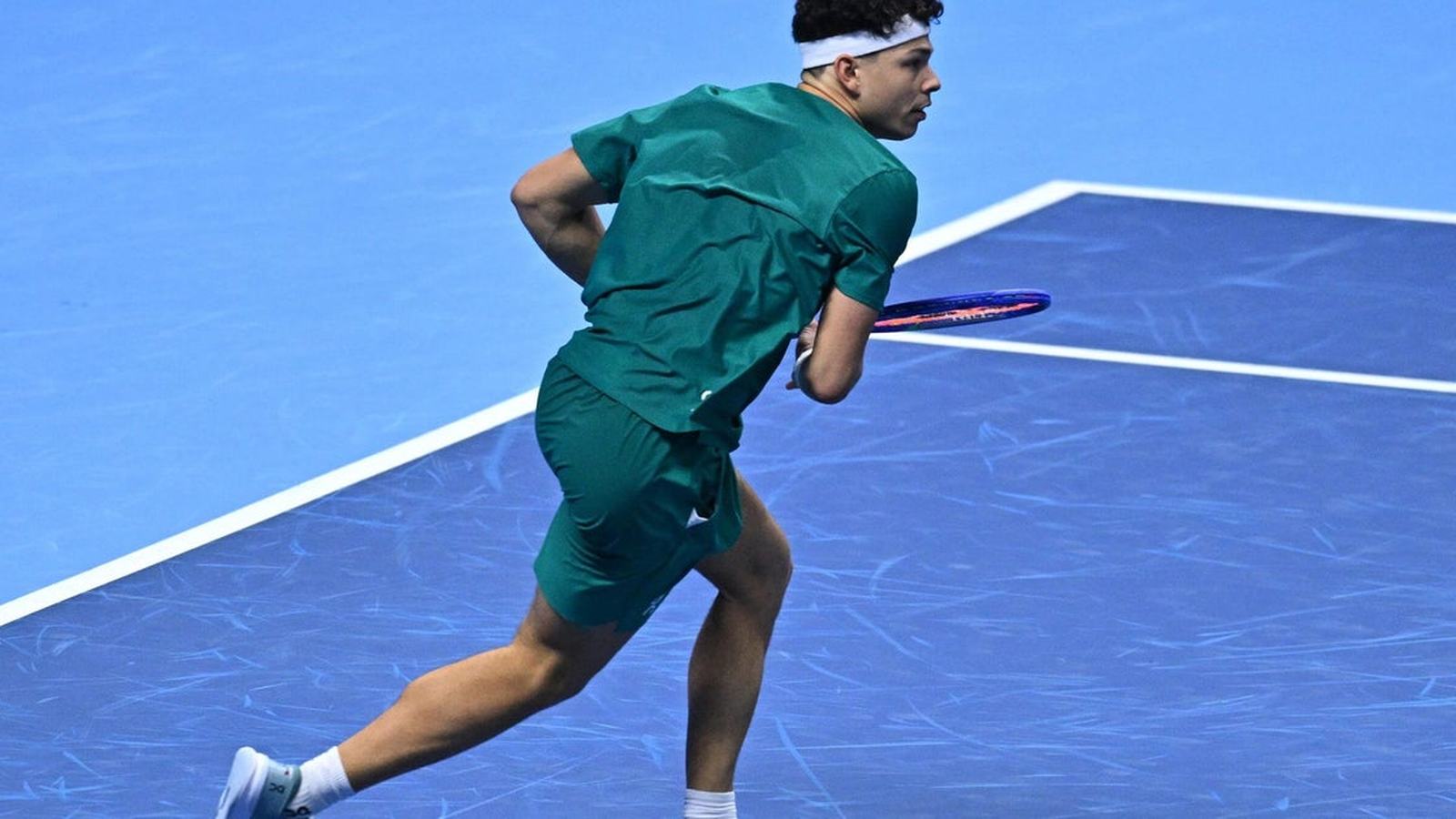
A Breakthrough in Turin
On November 15, 2026, American tennis player Ben Shelton secured his first-ever match victory at the ATP Finals in Turin, Italy. Defeating France’s Arthur Fils 6-2, 3-6, 6-3, the 24-year-old effectively moved past his winless 0-3 debut in the 2025 tournament. This result, as reported by The Athletic, serves as a tangible metric of the incremental progress Shelton has pursued throughout his professional career. While the win itself is a significant milestone, it represents a culmination of a season-long commitment to technical refinement and tactical patience.
Shelton’s transition from a high-energy, raw competitor into a tactically disciplined player has been a primary focus of his 2026 season. Entering the tournament ranked world No. 4, Shelton has demonstrated significant statistical growth, accumulating 5,170 points compared to his 2025 entry total of under 4,000. His win-loss record has also improved to 46-19, reflecting a more consistent approach to match management. For a player who burst onto the scene as an NCAA champion with immense natural power, the shift toward a more nuanced game is the hallmark of his maturation.
Tactical Evolution and Coaching
A key element of this development is the integration of new coach Juan Carlos Ferrero into his team. Shelton noted that the collaboration has already focused on daily refinement of his technical weaknesses. During the victory against Fils, Shelton’s backhand—historically his least stable groundstroke—demonstrated marked reliability. He utilized the shot to push his opponent deep into the court, proving that he is no longer solely reliant on his signature serve to dictate points. His movement coach, Gabriel Echevarria, has emphasized the “paso a paso” (step by step) approach, a philosophy that has permeated Shelton’s training.
This tactical maturity is essential as Shelton faces higher-ranked competition, such as world No. 1 Alexander Zverev. Zverev, who defeated Shelton in the 2026 U.S. Open final, observed in a press conference that Shelton has successfully eliminated the frequent unforced errors that defined his play in previous years. The evolution is not limited to groundstrokes; Shelton has also diversified his game through increased use of the slice, which now accounts for 32 percent of his backhand efforts. Furthermore, his topspin backhand has shown improved net clearance, averaging 97 centimeters this season compared to 92 in 2025, providing him with a higher margin for error during intense rallies.
The Path to Consistency
Despite his raw power, Shelton’s career trajectory has been defined by his commitment to marginal gains. Throughout 2026, he achieved several career milestones that indicate a broader range of surface proficiency. He secured an ATP 500 title on clay in Munich—the largest title for an American man on European red clay since 2002—and his first grass-court title at the Stuttgart Open. Furthermore, his performance at the Paris Masters, where he reached the final, highlighted his ability to adapt his game to indoor hard courts—a surface that has previously presented significant challenges to his playing style. Previously, Shelton’s serve was less effective on indoor surfaces, but his ability to maintain a 91 percent win rate in service games throughout 2026 underscores his improved efficiency.
While Shelton acknowledges that he still has a path toward consistently challenging top-tier players like Jannik Sinner and Carlos Alcaraz, his current focus remains on the “race” of 52-week standings. By prioritizing these long-term metrics over singular tournament results, Shelton continues to build a foundation that balances his natural athleticism with the technical precision required for elite-level success. His victory over Fils provided concrete data that this methodology is working; he saved break points and maintained focus through the three-set battle, a stark contrast to his 2025 season where he struggled to close out matches after injury-plagued stretches.
Refining the Professional Mindset
As Shelton moves forward in the tournament, facing world No. 1 Alexander Zverev and Rafael Jodar, the pressure remains high. However, the psychological shift is evident. Unlike his 2025 campaign, which ended in frustration and a winless record in Turin, Shelton now approaches these high-stakes matches with a clear, evidence-based plan. His serve remains a formidable weapon, with first-serve percentages ticking up to 68 percent this year, yet it is his ability to avoid the “do-or-die” tiebreak scenarios by winning more critical break points that defines his 2026 progress.
The transition from an entertainer-style player to a disciplined tour regular is never linear, but the data points from 2026 suggest a player who has finally found his rhythm. With his father and Ferrero in his corner, Shelton is no longer relying on the hope of a “hot streak.” Instead, he is building a game that can withstand the rigors of the top four rankings. Whether he captures the ATP Finals title remains to be seen, but the victory over Fils confirms that the “incremental” progress he championed at the start of the year has taken root in the most competitive environments in professional tennis.